
Texas, one of the biggest states in the country, in terms of population, size and influence, is often described as a policy hub, where other states copy policies that Texas introduces if they are successful. Texas used to be surprisingly pro-youth, being one of the only states to give juveniles full access to a jury trial, and the only state to completely ban cities from establishing youth curfews. However, recently, under Texas’ current administration, it has been pushing a whole host of anti-youth policies made to restrict the rights of young people, empower parental rights, and limit the freedom of students. Due to a few recent policies, Texas has quickly become the worst state for student rights in the US.
Table of Contents
Violations of Student Rights in Texas
Pledge of Allegiance
One of the main ways that Texas laws have limited student rights, is by restricting freedom of expression in schools. Courts have previously ruled that teachers cannot compel students to participate in the pledge of allegiance or national anthem. However, quite hypocritically, the courts have also ruled that states can require parental permission in order for students to “opt out” of being required to participate in the pledge. Texas is one of only 3 states that has a law like this, forcing all students to participate in the pledge unless their parent gives explicit consent to the school that their child does not have to participate. This is a violation of students’ right to freedom of speech and freedom of expression. The pledge of allegiance is a symbol of indoctrination in public schools—and requiring students to have parental consent to opt out only furthers this. America is a country that was supposed to be built on freedom and individual rights, and states like Texas being allowed to lock opting out of pledging allegiance to the country behind a parents’ consent is a direct antithesis to this freedom of expression.
Having a policy like this empowers teachers to punish students for dissent, especially surrounding patriotism and the pledge of allegiance. In recent years, students have been suspended or had their grades lowered for not saying the pledge. In most states, any attempt of a teacher to compel students into the pledge, or punish them for refusing it is illegal and unconstitutional. However in Texas, without parental consent, students can still face consequences from teachers, and can face empowered abusive teachers that use the pledge as a method of control. Teachers have been known to intimidate students and even physically force them into standing for the pledge. I recently interviewed a young girl in Texas, as well as her mother, who experienced harassment by her teachers for refusing to stand for the pledge of allegiance in her schools. Even after her mother explicitly consented for her to be able to opt out of the pledge, her teachers still punished her for not participating, tried to compel her to participate, and even verbally harassed her for her decision, saying things like “people died for you”, causing her to cry. Students should never be subject to this mistreatment by teachers surrounding the pledge of allegiance, and Texas requiring parental consent for a student to opt out only further empowers this abuse of power, political indoctrination in schools, and violation of free expression for students.
Student Club Restrictions
Another way that freedom of expression has been directly restricted in schools, is Texas’ restriction on student clubs. Similarly to the pledge of allegiance restriction, Texas is one of only 3 states that requires parental consent in order for a student to join a school-based club. This is another violation of student free expression and freedom of association. Student clubs are widely known as one of the best ways that students can engage in school-based communities with students of similar interests. A lot of student clubs are related to political topics or things that are very personal to a student—that doesn’t necessarily need to be the business of the parent. This disproportionately harms vulnerable youth living in abusive, oppressive and controlling home environments, where their parents actively want to restrict their ability to connect with others. This restriction creates a major issue for students who have differing political ideals from their parents. Hypothetically if a student with left leaning ideals wants to join a club relating to a left leaning ideology, but have right leaning parents (or vice versa), and those parents are controlling and don’t want the child to be exposed to alternate viewpoints, then the student will be completely barred from joining the club. This is a violation of student rights, free speech and freedom of expression.
The Equal Access Act was ruled to apply to student clubs in the Board of Education of Westside Community Schools v. Mergens (U.S. Supreme Court, 1990), meaning a school cannot prohibit a student club based on religious, political, philosophical, or other content of the speech at such meetings. However, Texas has instituted another even more dangerous restriction on student clubs, banning all student clubs in public schools relating to LGBTQ, gender identity or sexual orientation. This is genuinely dangerous for queer youth, especially due to the location. In Texas, which is a majority conservative state, it is safe to conclude that a large number of parents in the state would disapprove of their child identifying within the LGBTQ community, and being able to express that identity openly (I have expanded on this issue in this article). Many queer youth are already unable to safely express themselves within their own home due to fears of their discriminatory parents not accepting them or punishing them for their identity. They couldn’t join another queer related club or group outside of school—since they’d have to explain that to their parents. This leaves the only real way for them to connect with others in similar situations, in person, being through school. But with this bill, joining these safe places becomes virtually impossible. This leaves LGBTQ youth, who are already more vulnerable to mistreatment from discriminatory parents and peers, completely cut off from a possible support system in school.
Discrimination against LGBTQ Students
Along with banning LGBTQ clubs for students, Texas laws also discriminate against LGBTQ students in many other ways. Texas’ “Parents’ Bill of Rights” broadly prohibits Texas public school districts, school employees, and third-party providers from offering “instruction, guidance, activities, or programming” regarding sexual orientation or gender identity to students in prekindergarten through 12th grade. Unlike laws limited to classroom lessons for younger children, this restriction applies across every grade level and extends beyond formal academic instruction. Its broad language could encompass presentations, assemblies, school-sponsored awareness campaigns, staff-led discussions, instructional materials, diversity programs, organized activities, and guidance provided outside an ordinary classroom setting.
The same bill also prohibits district employees from assisting a student with what the statute calls “social transitioning.” This means that teachers are legally not allowed to refer to transgender (or any gender non-conforming) students by chosen name or pronouns. They also cannot “provide information” about social transition or give student guidelines intended to assist with it. This language could restrict teachers, counselors, administrators, and other employees from explaining how a student might use a different name at school, discussing gender presentation, referring a student to transition-related resources, or otherwise helping the student navigate a social transition. The law also restricts schools from teaching about any information related to LGBTQ to gender identity, meaning that students can’t even learn about these things in an educational context.
All of these rules place unfair restrictions on teachers, and are only aimed at removing school as a safe place for LGBTQ students. Because the statute does not precisely define some of the terms, schools may respond cautiously and remove material or avoid discussions that could arguably fall within the prohibition. For example, a teacher responding to a student’s question, a counselor discussing a student’s family or identity, a librarian organizing a display, or a school addressing anti-LGBTQ bullying could raise questions about whether the employee is merely responding to a situation or is providing prohibited guidance or programming. Because schools don’t want to risk being sued for violating the law, they will most likely cease any amount of discussion on the topics of gender identity and sexuality, which further isolates queer youth, and will make them feel unwelcome in school. This is direct discrimination against a vulnerable minority of students, who may already be facing unfair treatment at home from homophobic or transphobic parents. LGBTQ youth deserve for school to be a safe place where they are accepted and can express themselves—not an extension of a system that is trying to erase them.
Forced Religion in Schools
After a recent education policy passed, Texas became the only state to make bible passages required reading for all students in public schools. However, In 1963, the Supreme Court ruled in Abington School District v. Schempp that it was unconstitutional for public schools to include mandatory Bible readings in the curriculum. This was true even if students could request to opt out, the Court reasoned, because a state endorsement of religion violated the Establishment Clause of the First Amendment. Therefore, this Texas policy is blatantly unconstitutional and should be abolished, yet somehow still was passed without challenges. This is yet again an example of Texas using indoctrination in schools, and can be seen as using public school to coerce students towards a particular religion. This is unfair to students who belong to a different religion, or who do not wish to practice any religion. Some people may argue that this isn’t that severe of a student rights violation, because requiring reading bible passages isn’t that major of an issue. However, this is far from the case. Many religious extremist parents use religion (including christianity) as a tool of abuse.
Religion can be used as a tool of abuse if parents prohibit dissent, tell the child they will go to hell for disobedience, or cite the Bible as a justification for extreme punishments. These abusive religious parents have also been known to physically assault children in the name of the bible, enforce harmful purity culture standards on youth, and even do exorcisms on their children. Living with parents like this can cause a child to develop religious trauma—where even the mention of hearing their parents’ abusive religion can induce a trauma response. Because of this, Texas’ policy on requiring bible readings—mandating a student to engage with religion for graded schoolwork—harms these vulnerable youth who dealt with or are currently dealing with abusive religious parents. Having a public school system is supposed to limit the power of abusive and oppressive parents, including those who engage in religious indoctrination, because it is supposed to act as a safe place away from school where students can learn without having religion forced upon them. Texas doesn’t respect this, and prefers to violate student rights with forced religion in schools.
Denial of Basic Healthcare and Mental Health Support
Another major violation of student rights that the Parents’ bill of rights did was make healthcare and mental health support in schools conditional on parental approval. Under the law, parents are allowed to opt their children out from being able to receive health related services like basic first aid, wellness checks, vision or hearing screenings, and other functions that don’t qualify as medical treatment. Along with this, parents are required to give explicit consent for students to have access to health care services including any action that could be considered medical treatment like administering medications, evaluating injuries beyond first aid, making clinical judgments, or performing procedures that go beyond simple care. This also applies to mental health support, and parents are allowed to opt their children out of being able to speak with a school consular, or get any support for mental health related issues in school.
Students should not be reliant on their parents in order to receive the most basic healthcare. Some parents are medically neglectful, either due to faith based reasons, conspiracy reasons, or simply for using medical control as a tool of their abuse. This leads them to distrust medical professionals (even school nurses) and prefer for their child to not have access to any healthcare, rather than be treated by a school nurse. This is extremely dangerous for young people, as a young person could get injured at school, and not be allowed to receive any treatment due to their parents opting them out of health related services.
Where this can become especially devastating though, is when parents prohibit young people from receiving mental healthcare in schools, such as being able to see a school consular. Due to the fact that being able to get therapy in most states also requires parental consent, many young people rely on school consulars as their only way to have support for their mental health struggles. But if they are also cut off from school counselors without parental consent, then they are virtually cut off from any way to receive mental health support. Not all parents will be supportive of young people with mental health struggles, as some parents will punish young people for opening up about the struggles they’re facing.
A particular 2024 study in the Journal of Clinical Psychology surveyed 1,495 adolescents with histories of suicidal thoughts, suicide attempts, or nonsuicidal self-injury who had disclosed these issues in therapy. Researchers specifically asked what happened when therapists informed their parents. A substantial number described reactions that they perceived as harmful or punitive. One participant said their mother subsequently made fun of them for their self-harm. Another reported being told they were “dramatic and trying to get attention.” Another said their parents became angry because the teenager had leaned on friends for emotional support. The study’s authors specifically noted that restrictions imposed after disclosure were often described negatively and experienced by adolescents as punitive or unhelpful.
These stories show how parents can be directly harmful to children with mental health issues, and that having to inform their parents of these struggles can directly result in more mental harm. So therefore, Texas allowing parents to restrict their children from receiving these services is very dangerous, as many parents do not have their child’s best interests at heart, and want to cut their children off from mental health support in order to punish them for struggling. Furthermore, abusive parents can take advantage of this to purposely cut their children off from support. If a parent is abusing a child, they obviously aren’t going to want the child to be able to speak with anybody about this abuse. Where is the easiest place for a child to get support if they’re facing an unsafe environment? The consular or other mental health professionals in the very school they go to every day. So that makes school consulars one of the biggest threats to abusive parents—and giving them the ability to prevent their children from accessing these support systems directly empowers their abusive behavior. This law in Texas is a violation of students’ basic medical autonomy and bodily autonomy.
Why is Texas Doing This?
After looking at these policies and laws that Texas has recently passed, there is a clear pattern emerging. Texas is directly restricting freedoms and rights of students, whether that be freedom of expression, freedom of speech, freedom of association, or basic bodily autonomy. Most of these restrictions on student rights are completely unprecedented, and open students up to glaring harms. However, these laws are paraded as wins for “parents rights”, giving them a lot of backing by the supporters of Texas’ current administration. The problem with “parents rights” is that every time a parent gains a “right” from one of these laws, it is actually just a right being directly taken from their child, where it should belong in the first place. Parents should not have the right to deny their child access to clubs, control whether a child has to stand for the pledge or deny their child access to basic health care or mental health support in schools.
Parental rights isn’t the only angle that Texas is trying to push with these new restrictions. A lot of these student rights violations have a common theme: they’re enforcing christian, conservative, evangelical ideals onto students. First of all, this is clearly shown by how they specifically target LGBTQ youth, restrict their safe places, and create policies that discriminate unfairly against them in schools. It’s no secret that conservatives are often hostile towards LGBTQ, especially regarding young people, with many conservative politicians believing that LGBTQ identities are inherently wrong and are something young people should never be exposed to. The policies pushed by the Texas government onto students showcases exactly how they are trying to harm LGBTQ youth by silencing their freedom to express themselves, and forcing them to rely on their parents for basic rights in school. The christian ideology that Texas is enforcing on students is further reinforced by the fact that passages from the bible have been added as required reading for students. This obviously demonstrates a bias for christianity that public schools are now mandated to take part in. There’s no required reading from any other religious groups’ holy book—only the christian bible. If this isn’t clear religious bias and indoctrination of youth, then I’m not sure what is.
The next question is why are students being specifically targeted by these policies? Why are student rights being violated so severely? Well, there’s a pretty straightforward answer for this—student rights are the easiest for states to violate. First of all, putting restrictions on youth rights is notoriously easy for politicians, because they can always fall back on “parental rights” or “protecting the kids” excuses as safety, and garner a lot of support. Because a parent’s right to make decisions regarding their child is seen as an extension of their own autonomy, the threat to the child’s rights is usually ignored. So if Texas passes a law requiring parental consent for all student clubs, they can use the excuse of saying that parents have the “right” to be “informed” about what their child is doing in school. Then, after using that as an excuse, the policy is celebrated for increasing parental rights, while the actual children facing the negative repercussions are ignored by this. Politicians can enforce restrictions on LGBTQ content for minors under the guise of “protecting” them, and conservatives will flock to support it.
Secondly, regulating school policies is incredibly easy, since public schools are government-run and therefore passing legislation to enforce restrictions on them is easy for the government to do. It’s a lot harder to enforce regulations on young people in other ways. If they enforce these regulations on how families can privately parent their youth, then that would interfere with their “parental rights” scapegoat, while also being much harder to enforce. I think it reasonable to believe that if these conservative politicians had the ability to enforce anti-LGBTQ restrictions on all youth, even outside of school, they would.
Lastly, students are also usually targets for discrimination by government institutions because schools are gathering points for political activity. I recently interviewed Greg Stoker, a green party candidate running for Texas congress, who discussed this issue in detail. Stoker recanted how many of the great protests and anti-government movements were pushed by students using college campuses and schools as gathering points—such as the anti war movement, ICE walkouts, and other climate change related movements. Stoker explained how because of this, government institutions are often threatened by student activism, which is why student activism is often subject to many restrictions.
Schools are one of the main places that youth can gather together and get empowered to create change against things they feel aren’t right. This change is a direct threat to the current administration—so therefore it’s reasonable to assume that they’re directly trying to silence that dissent. This is why there have been so many restrictions on student freedom of expression and freedom of assembly in schools. Because Texas cannot legally ban student clubs relating to political ideology (even though they technically did that already with LGBTQ clubs), if Texas passes a law requiring parental consent for students to join clubs, then this decreases the amount of students that will be able to join clubs in general—due to conflicts with their parents. The less students that can join politically active clubs in schools, the less students can organize and protest the wrongdoings of the current administration. All of these restrictions of student rights are connected and part of a broader effort to silence students and shut down dissent.
Other Anti-Youth Policies in Texas
Age Verification
Outside of student rights violations, Texas has also pushed many other anti-youth policies that harm the rights of minors. Texas has increasingly pushed age verification across the internet, beginning with HB 1181, which requires websites containing substantial amounts of sexual material harmful to minors to verify that users are 18 or older; the U.S. Supreme Court upheld that requirement in 2025. Texas has since broadened its approach through laws such as the SCOPE Act (HB 18) and the App Store Accountability Act (SB 2420), the latter requiring app stores such as Apple and Google to verify the ages of all Texas users and obtain parental approval before minors download apps or make purchases. The effects have extended to individual social platforms: in July 2026, Bluesky announced that Texas law was requiring it to implement age assurance and began restricting the app for users who do not verify their age, while removing certain content and features for Texas users under 18, while Texas also secured an order requiring Discord to implement stronger age-assurance measures. Together, these actions show Texas moving from age checks for pornography toward much broader age-verification requirements affecting ordinary apps, social media platforms, and potentially adult users as well.
First of all, age verification is a violation of everyone’s privacy regardless of age, and puts citizens’ personal information at risk. For example, in June 2026, the Texas Parks and Wildlife Department disclosed a data breach affecting more than 3 million people after hackers gained access to an outside vendor that operated the state’s hunting and fishing license system. The compromised data reportedly included driver’s license and passport numbers, email addresses, phone numbers, and home addresses. The breach drew particular criticism because Texas has simultaneously expanded laws requiring age verification and identification checks online, encouraging more companies and third-party vendors to collect sensitive identity information. Privacy advocates have pointed to the incident as an example of the risks created when government IDs and other personal data are stored across multiple verification systems and contractors. So even after the harm of requiring ID verification was put on full display—with millions of Texas citizens’ personal information being leaked in a data breach, Texas still maintains its position of wanting to enforce these regulations across the entire internet.
Age Verification being required to download apps or access social media platforms is inherently harmful to minors in many ways. First of all, social media is more beneficial to teenagers than it is harmful. Social media is often used as a place for minors to advocate for what they believe in, and organize protests and other political activity. So it becomes no surprise that Texas is attempting to restrict minors’ access to social media. They already went to great lengths to hinder student activism in schools by violating student rights, now they’re going after the only other main place that youth can organize together and seek change. Secondly, social media often acts as a safe place for youth who are in toxic or vulnerable situations in real life. Many LGBTQ youth, disabled youth, bullied youth, socially awkward youth and youth from abusive homes connect with online communities and support systems in order to get the support that is not offered to them by individuals in real life. Just like Texas targeted LGBTQ youth safe places and minors’ access to support systems with their restrictions on student rights, their restrictions on social media access for minors will have the same effect. All of Texas’ regulations only lead to more vulnerable minors being cut off from the support systems they rely on, which will have the unintended (or maybe intended) effect of worsening their mental health or pushing them closer to suicide.
Again, Texas will hide behind the excuse of these age verification requirements being for the purpose of “protecting” children, and will often cite concerns of the youth mental health crisis. However, social media is not the cause of the youth mental health crisis; more often than not, poor mental health in youth is caused by exposure to toxic living environments. Even though the family is often causing the most direct harm for young people—this idea threatens the “parental rights” angle that Texas is using to bolster its policies—so it elects to ignore these facts. With all of Texas’ recent policies, laws and regulations surrounding youth cutting off young people from support systems outside of their parents, this forces them to rely on their parents for this support, which is incredibly disastrous for young people living with unsupportive, abusive or toxic parents.
Parental Rights Amendment
In November 2025, Texas passed a Parents Rights Amendment into their constitution. Under this amendment, parents were given constitutionally enshrined stronger control over their children, and stronger legal rights if they challenge schools, medical providers, or government programs for any decision made regarding their children. Once again, this is incredibly dangerous for youth living in situations where their parents are abusive, overly controlling, or do not have their child’s best interests at heart. Giving parents increased legal power against institutions that make decisions involving their children is a gateway to compounding the harms of the other youth rights violations in the state. For example, with the law regarding health related services, if a parent opts a child out from being able to receive them, a school nurse can still legally give health related services in an emergency. However, what exactly is considered an emergency? The definition is very vague. Some individuals may consider an emergency to only be when someone’s life is threatened, while others believe an emergency constitutes any situation in which someone is facing great pain or discomfort.
So hypothetically, if a child injures themself badly at school, is in great pain, but is opted out of being able to receive health related services, a school nurse could deem the situation an emergency and apply them anyway. However, under Texas’ Parents’ bill of rights, and further compounded by the parental rights amendment, a parent could fight back and argue the situation was not an emergency, and attempt to sue the school or have the nurse removed just for doing their job. The possibility of this occurring will undoubtedly make it so that many professionals in situations regarding children will be a lot more hesitant to make important—maybe even life-saving—decisions regarding children without parental consent, out of fear of facing legal repercussions.
Along with this, increasing parental rights with an amendment in the constitution will increase legal challenges when parental rights are actively harming a child. A comment on my article about Texas’ Parental rights amendment illustrated a situation like this perfectly: “One thing it seems everyone overlooks on this issue is children that have been taken away from their parents. I am legal guardian to our grandson. Our daughter was his mom. Her husband says she died by suicide, I don’t now or ever believe that, but Austin police didn’t investigate because the drunk husband said she took her own life, end of investigation. After her death CPS took our grandson, investigating abuse. I took the father to court after CPS returned the child to the father. It was on me to pay AND prove in court he neglected AND abused his son…and I DID. The court still gave him unsupervised visits, can’t believe that, but better than him being with him all the time. Now they want to give assholes like this back more parental rights? Looks like I will have to sue to have his rights terminated now to prevent and protect my grandson if this passes, and I WILL. Maybe everyone that has guardianship of another’s child will as well. Someone needs to voice this point.”
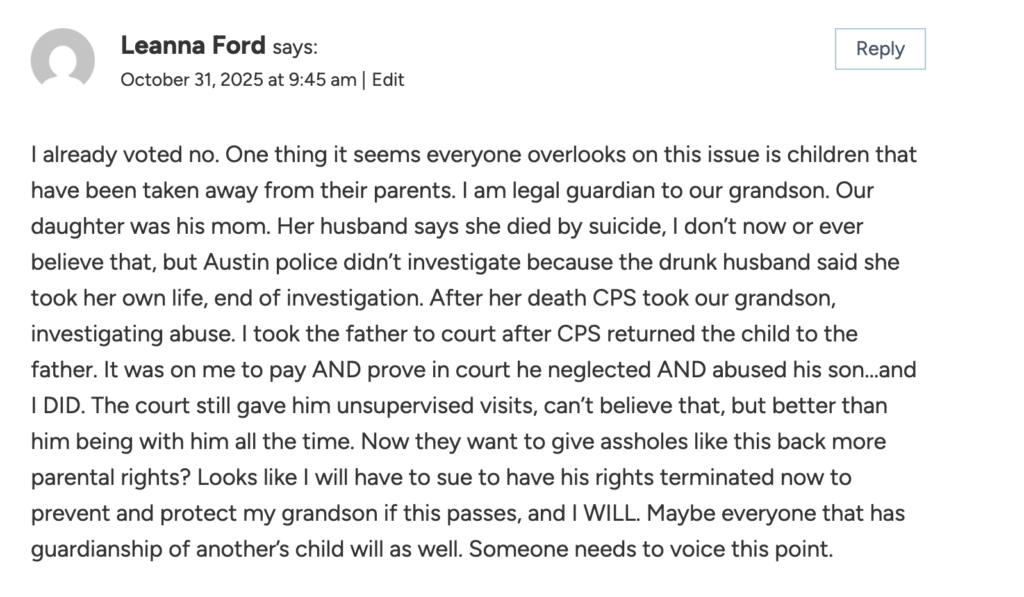
This story shows an exact situation in which Texas prioritizing parental rights in custody situations is harmful for young people. An abusive, neglectful, drunken father was allowed to have unsupervised visitation with his son, because it’s his “parental rights” to be able to do so. We do not need to be empowering poor excuses for parents like this—because the only people who are going to end up suffering are the children who bear the brunt of it. With every single regulation that Texas passes, they’re cutting off young people from support, and pushing them to be forced to only rely on their parents, which is the worst possible thing for young people in toxic home situations with abusive parents. Texas has clearly shown that they value the “rights” of abusive parents, over the basic human rights of students and youth. Texas has become the worst state in the country for student rights, and one of the biggest anti-youth states under their current administration.
The National Youth Rights Association
If you’re interested in Youth Rights, consider volunteering with us. We are always looking for new members and would love to have you on board. If you have a personal story to share, of how these student rights and youth rights violations have impacted your life, or about a general youth rights violation, consider sending us an email at nyra@youthrights.org. We’d love to help get your story out to the world.
The text of Texas has Become the Worst State in the U.S for Student Rights © 2026 by Zane Miller is licensed under CC BY-SA 4.0.