
Recently, the UK has announced that it plans to ban all minors under 16 from all social media platforms, including YouTube, Instagram, TikTok, X, and other platforms. Along with this, they are going to enforce excessive restrictions on 16 and 17 year olds to prevent them from communicating with strangers online, and livestreaming. They have also tested out the idea of mandatory online curfews for all minors using social media, and potential scrolling breaks. These social media bans and restrictions are ridiculous and discriminatory against youth. In my previous article, I discussed how the UK’s social media ban is all about control rather than protection, and actually harms every citizen by enforcing digital ID verification and giving the government overwhelming control of people’s privacy. But in this article, I want to focus on attacking the claim that social media is inherently bad for teenagers, by showing all of its benefits.
Table of Contents
- Social Media is Taken for Granted
- Freedom of Speech and Advocacy
- Education and Learning Skills from Social Media
- Connectivity to Peers and Benefits for Marginalized Youth
- Banning Social Media for Youth Solves Nothing and Creates More Harm
- Protesting the UK Social Media Ban
Social Media is Taken for Granted
Social media bans and restrictions for minors can be put in place by governments because of the fact that there has been a growing negative stigma around teenagers’ ability to use social media. Another country that recently put a similar policy into place was Australia, which banned minors under 16 from accessing social media. When I spoke with Electronic Frontiers Australia, a digital freedom organization opposing the ban, they said that the main reason bans like this can go into place is because they’re “populist” policies, largely supported by parents, due to the growing opinion that social media is overwhelmingly harmful for minors. Parents, teachers, and government officials have been continuously pushing the agenda that internet access and social media for teenagers should be heavily monitored/restricted, or outright banned, using exaggerated negative connotations, particularly when it comes to online bullying, grooming, and excessive screentime.
Because of the fact that these negative stories have been artificially amplified into the public eye, people have begun to forget the overwhelming benefits of social media and online connectivity. In fact, I would go as far as to say that due to habituation, people have begun taking social media and the internet itself for granted, only discussing its negative effects and completely ignoring its benefits, because they have been surrounded by its benefits for so long that they forget how game changing it is.
When explaining this phenomenon, there is a certain metaphor that puts it into perspective. Imagine fire—what’s the first thing that comes to your mind when you think of it? Usually, people’s first instinct when thinking of fire, is to imagine all of its negative associations—destruction, burning, pain, etc. It’s viewed as a threat, something to avoid. People’s minds instinctively focus on all of the damage it causes, rather than the benefits that it has for humanity. People often forget that fire was the game changer for humanity’s evolution. It allowed us to cook our food, provided us with warmth, light and completely transformed early human behavior. And yes, it comes with negative side effects, but the benefits far outweighed the consequences. Imagine that the first caveman to discover fire accidentally burned their house down, and humans decided to never use it again. We would still be in the stone age at that rate. And yet, in our modern-day lives, the main connotations that come with imagining fire are all of its negatives, rather than how it transformed humanity. And this is due to the fact that when someone is completely immersed in the benefits of something, they ignore those benefits, because they’re not novel, they’re just an everyday part of life.
The internet has gradually begun to follow this same route, only with magnified intensity. When the original internet boom occurred, it was widely loved and supported. The increased connectivity to others it brought, along with the free flow of information was a complete game changer for education, and access to the broader world. But as the internet and social media became part of everyday life, those benefits began to bleed into the mesh of everyday life—to the point that people take them for granted. And since these benefits are not the focus of the general public, the negative aspects of social media are pushed straight to the top. Why? Because they’re big stories; they’re emotionally charged. People seek out things that upset them, without even realizing it. And due to this phenomenon, governments like the UK and Australia can push these fascist social media bans, under the guise of “protecting children” from the internet’s artificially amplified harms. Once this is complete, they can slowly enforce digital ID, and strip privacy from all of their citizens, while the uneducated individuals who support it are cheering.
So how do we fight social media bans? We first have to change the public perception of social media and internet access for youth. Social media absolutely has more benefits for teenagers than it has harms, and its harms can easily be reduced and mitigated without the need to arbitrarily discriminate against an entire demographic. Social media is a vital resource for teenagers for many reasons, but particularly for three reasons: the free flow of information for educational purposes, the connectivity with others, and freedom of speech.
Freedom of Speech and Advocacy
Focusing first on freedom of speech and advocacy, it is important to note that minors under 16 in the UK (the minors who would be affected by the social media ban) do NOT have the right to vote or run for office in the country. This means that an entire demographic has no way to have their interests represented in politics. The only way for young people’s voices to be heard by the country, is for them to use social media to inspire change. Youth can use social media platforms to garner a following, and speak out about issues that directly affect them.
One of the most important examples of this, is actually the very social media ban we’re discussing. The only people being affected by this social media ban, are ironically the only demographic that cannot vote, and therefore have no representation among the politicians that are instituting these discriminatory bans. If a teenager who is directly affected wants change, they can’t vote for it—they just have to use their voice and speak out—and social media is by far the most effective way to do that. There have been many examples of youth using social media to speak out on issues, and coordinate advocacy.
At 15 years of age, Greta Thunberg started posting about her school strikes for climate change. Her posts eventually spread worldwide and helped begin the “Fridays for Future” movement. This inspired numerous students everywhere to protest and raise awareness about issues they care about. After a shooting that occurred in Parkland, Florida, students used social media to organize #MarchForOurLives rallies and promote gun control. During the start of 2026, thousands of students located across the United States coordinated ICE Out protests using social media to spread the message and encourage participation. These youth-led protests, organized with social media, helped show how many youth truly care about speaking out for human rights. Without access to social media, these young people would never have been able to form these protests and have their voices heard.
And this isn’t just a small number of students and youth using social media to engage in activism, most students also recognize social media’s pivotal role in youth advocacy. According to research by San Francisco Foghorn, 79% of students stated that social media is extremely important for activism in this day and age, and 100% reported participating in some form of digital activism, while only 5% have taken part in in-person activism. This shows that online platforms serve as a great and more effective way for youth to speak out about certain situations that affect their everyday lives.
The fact that social media is the main way for youth to exercise their freedom of speech and speak out on issues that affect them, makes it the very definition of authoritarian, for governments like the UK to ban it for minors. These governments want to suppress the voices of an entire demographic of people that already have a limited ability to be represented.
Education and Learning Skills from Social Media
Next, one of the biggest benefits of social media for minors is the free-flow of information, and the educational value that social media has. Again, because of the amplification of the internet’s harms, people rarely view social media as educational. When the average adult imagines a minor on social media, their first thought is a lazy kid doomscrolling TikTok videos in bed when they could be outside. However, this couldn’t be farther from the truth. Social media is an integral part of education, and a major way that young people keep up to date with current events. A survey by Common Sense Media found that 54% of teenagers learn about news and current events through social media, and 65% stated that it helps them better understand what is going on. This proves that the platforms can provide access to information that may not always be available through other sources.
An important aspect of this that many people fail to bring up in these conversations, is the free flow of information. When people learn from social media, they’re not learning from the government pushing an agenda, or from educational materials backed by a multi-billion dollar company also pushing their own ideals. Social media content is created by individual people, and made to be consumed by individual people. So social media exposes young people to all different types of viewpoints, all in one place.
Outside of just using social media to stay informed, it could also be used for learning about various topics and skills. For example, Youtube specifically has thousands of educational videos on different niche topics, and thousands more tutorials for skills. I can’t even count how many times I’ve used Youtube to wander down a rabbit hole of a topic I find fascinating. For example, as a kid, I was really interested in space, and always felt like I didn’t get to learn enough about it in school. So as a teenager, I used Youtube to watch as many space videos as I wanted, in order to learn more about this niche topic that interested me. Thousands of young people use social media in a similar way—not to pointlessly doomscroll, but to actually learn about something.
Of course, critics always fire back with the counterpoint that teenagers can “pick up a book” to learn about these topics instead of relying on screens. But to put it simply: not everybody wants to do that. Yes, reading is great for youth! However, if a thousand young people have a choice between watching a video about an educational topic, or reading a textbook, what do you think they’re going to choose? Obviously, they’re going to go with the video. Youtube videos have a way of making information easily digestible and engaging to an audience. So removing the ability for young people to use social media to learn, will only decrease the amount of curious teenagers learning.
Another major way that social media, specifically Youtube can be educational, is by teaching skills through tutorial videos. One of the best parts of Youtube, is that practically any skill or hobby that can be taught by watching and learning, is on the social media platform—all you have to do is find it. You just got a guitar, but your family doesn’t have enough money for professional lessons—it’s okay, there’s hundreds of Youtube videos teaching you any song for the guitar you could possibly want to learn. You just got into coding and want to understand how to make something—perfect, there’s thousands of Youtube videos explaining practically any part about any coding language you could ever want to learn. And the best part about all of this—is it’s all free. This is why it’s absolutely ridiculous for Youtube to be roped into this social media ban, because of its immense potential for education, and teaching young people valuable skills.
So imagine if social media was banned for young people. Hundreds of thousands of FREE educational videos and tutorials that were previously available to curious and creative youth are now gone. This means that if a young person wants to learn a skill, they either have to find another way through the internet, or their family has to spend money to put them through lessons. This means that lower income youth are especially negatively affected by social media bans, which is grounds to classify these social media bans as not just discriminatory against people based on age, but also on economic status.
While writing this article, I interviewed Lucy, a NYRA member and 17 year old student living in the UK, who was positively impacted by social media growing up. She described the educational benefit of certain YouTube channels, saying: “YouTube, which is being banned for under 16s with the UK social media ban inspired me to learn and discover from before I was a teen. Vsause and Kurzgesagt inspired me to pursue physics in my last 2 years of school in the UK while channels like 3blue1brown helped me be inspired to explore maths. Without access to this I would likely not be the person I am today, nor be nearly as academically capable.”
Hundreds of teens use social media for the same beneficial reasons, and yet their stories are buried to the ground by propaganda, and the stories of social media’s negativities are blasted to the top.
Another part of social media that’s beneficial to youth, is actually creating the social media content itself. Teenagers can make well-edited, interesting content for social media platforms such as Youtube, TikTok, Instagram, and other platforms. Or, teenagers can stream content using platforms like Twitch, to share their interesting personality to the world. Because platforms like Youtube and Twitch are monetized, this means that teenagers who gain a social media following can actually make money off of their content.
For example, two content creators from the UK, Tommyinnit and Tubbo both started streaming and Youtube Channels when they were teenagers, and both amassed millions of followers before they ever turned 18. While they were still teenagers, they were making huge amounts of money from ad revenue, and donations from their fans. Two teenagers had their lives completely changed for the better by the careers they were able to gain from social media. However, if the UK social media ban for under 16s, or a social media curfew for all minors were in place, doing this as a teenager would become practically impossible. So social media bans don’t just take away educational opportunities from minors, they also take away their financial opportunities. And even if a young person doesn’t become social media famous from their content, the mere action of creating the content also builds skills. Teenagers learn video editing, production, and other types of skills just from creating content for an audience, motivated by the prospect of being able to make money off social media.
Connectivity to Peers and Benefits for Marginalized Youth
One of the most controversial, but also the most important benefits of social media for youth, is the connectivity that it gives them to others. Unfortunately, this is one of the issues that are blasted by negative connotations. When you speak of young people using social media to connect with and meet others, some of the first things brought up are “What if they meet a bad person?”, “What if they’re bullied? Or sexually harassed? Or Groomed by someone they meet on the internet”. And while these are valid concerns that do occur in some instances, equating all social media connectivity for youth with the possible harms completely ignores the major benefits that it can have for teenagers, specifically teenagers of marginalized groups or with unfortunate life circumstances.
As stated by the National Library of Medicine, social media offers marginalized adolescents an easier way to connect with others who share similar identities and interests. This helps lower rates of mental health issues among youth who may feel out of place offline. Social media messaging platforms like Discord allow youth to be able to meet millions of people, giving them the ability to form lifelong friendships. There are many reasons why youth would want to connect with others using social media. For example, many young people live with oppressive parents that hinder their ability to make friends, and may punish them by removing their freedom to see their friends. Teenagers without strong support systems in the real world may turn to online friends for comfort and safety. Research by the National Center for Health Research found that social media helps teens to be accepted (58%), supported (67%), creative (71%), and connected with friends (80%). In addition, 70% of adolescent girls of color find race-affirming content on social media platforms.
In my previous article about the harms of social media bans and restrictions for minors, I spoke to a young person who grew up in the foster care system, and found support in a “safe space” Discord server. She informed me that because of her life circumstances, she has no support system in the real world. She also told me that without the people she met online, she would likely have been a victim of suicide. These stories are especially important to understand the drastic consequences of banning social media for minors that are ignored by politicians.
One of the marginalized groups that benefits directly from social media is LGBTQ youth. If a queer teenager’s parents are homophobic, they may not be able to safely express themselves in the real world without consequences. Social media allows them to do so, and connect to support systems and other youth of similar backgrounds. For example, according to a study by The Trevor Project, a majority of LGBTQ+ youth use online platforms as a way to connect with others because it is difficult to do so in their daily lives.
Along with this, youth may connect with each other on social media for a variety of other reasons. Socially awkward youth may find it easier to connect with others online, due to not having the fear of being stuck in an awkward real-life situation if they put themselves out there. Disabled youth may not be able to leave the home often to “hang out” with friends, so they go to social media as a way to connect with others online. Youth who live in rural locations may not have a lot of people their age near them, so they find it easier to make friends on social media. Youth that are routinely bullied at school may be able to make more genuine friendships with those they meet online. And some people may just enjoy meeting people over the internet. The point is simple: not everybody that teenagers meet online is an evil strangers that is looking to groom them or harass them. Sometimes, they’re the realest friends, and strongest support system that a young person can have.
In my own personal experience, social media allowed me to make some of the most unforgettable friendships of my life. As someone who was always socially awkward, and found the concept of striking up a conversation without someone in real life difficult, but had no problem doing so over social media, that’s where I turned to in order to make friends. The friends I made over social media supported me through my toughest times, and were just as real as any friend I met in person. And I know countless teenagers who agree and who have had similar positive experiences with meeting others on social media. So whatever someone’s reason for using social media to connect with others, it’s valid. Social media is an extremely important place for youth to connect and support each other, and escape the conflicts of their lives in the real world.
Banning Social Media for Youth Solves Nothing and Creates More Harm
When the UK government announced the ban, one of the phrases that kept being repeated was to “give kids their childhood back.” Boomers and older adults who grew up without social media seem to believe that the second you remove something from an entire generation that has never been without it, they’re just going to drop everything, go outside and start frolicking in the playground together instead of spending time on the internet. This couldn’t be farther from the truth. Realistically, banning social media for youth solves nothing, and only causes more problems.
First, it is important to debunk the boomer fantasy that in the absence of social media, our youth will return to the ’90s lifestyle of everyone hanging out in public all day. The truth is, youth simply do not have that ability anymore, for a wide variety of reasons. The main culprit is business discrimination against youth, where businesses will completely ban unaccompanied minors from entering the premises. These types of bans have been on the rise lately, all throughout the world, not just in the UK. One of the main examples is malls, which were once iconic teenage hangout places, but have increasingly begun to ban unaccompanied youth from entering.
The broader trend has become so widespread that major media outlets have begun covering it as a cultural shift. A recent article in The Wall Street Journal, which I was interviewed for, described how malls that once depended heavily on teenage customers are now increasingly restricting them through escort policies and curfews. Critics of the policies, such as myself, argued that they amount to broad age based discrimination against young people, especially because entire groups of minors are restricted regardless of individual behavior.
And malls aren’t the only place exercising this type of business discrimination. Bookstores, restaurants, stores, fast food locations, conventions and concerts, have all been instituting similar youth restrictions or bans recently. These bans simply did not exist to the same effect, during the time that the older generation was growing up. This is what empowered the older generation to live out this teenage fantasy that they believe the youth of today can as well. But this is just simply impossible. Youth can not go to several locations unaccompanied anymore. Many malls and other venues have begun to check ID at the door to enforce their discriminatory policies as well. So if minors don’t have the ability to hang out in public locations, but also don’t have the ability to connect with each other on social media, what are they supposed to do?
Some may argue that they don’t need to be at a specific business or location to hang out, and instead could just meet and play on the streets. However, there has been another growing trend of teenagers being punished and prosecuted by police simply for congregating in public, despite not committing any crimes. One of the strongest examples comes from academic research on the UK’s dispersal powers. A study titled Criminalizing Sociability through Anti-social Behaviour Legislation: Dispersal Powers, Young People and the Police examined how police used anti-social behavior laws to break up groups of young people who were simply congregating in public. The researchers found that youths were often brought to police attention because of who they were with rather than because they had committed crimes. The paper argues that dispersal powers frequently treated ordinary youth socializing as a public order issue and effectively criminalized young people’s use of public space.
In Woking, Surrey, police issued a dispersal order covering much of the town center in 2025. Under the order, officers used special powers to force four teenagers to leave the area. News reports indicated that the youths were dispersed because police had received reports of “anti-social behavior” in the area, but the teenagers themselves were not reported as having committed any violent offense. The order allowed police to remove people from public spaces based on concerns about potential behavior rather than actual criminal conduct. This means that basically any adult can see a gathering of teenagers outside, call the police saying that they “could” cause a disturbance (even if they’re not currently causing one) and the police can order them to disperse even when no crime has been committed.
Situations like this show that teenage gatherings in locations like town centers, that aren’t even property of a business, will also be shut down by authorities. So teenagers in the UK cannot use social media to connect with their peers, they can’t gather in large businesses or malls due to business discrimination, and they can’t gather in other places in public due to being seen as a disturbance by police. With how much teenagers have been prosecuted in public recently, it’s no wonder why they have been turning to social media. One of the main criticisms of Gen Z is that they spend too much time on their phones, the internet and social media, but if you’re punished simply for being outside, then what else are you supposed to do?
Some people may still argue that the teenagers could go to each other’s houses to hang out, instead of being in public. This may be a viable solution in some circumstances, but it isn’t always. First of all, it’s important to note that many teenagers actively prefer to avoid hanging out with their friends around their family, so they can have better privacy, and are free to be louder and more vocal without criticism from their parents. Along with this, many teenagers’ homes may be chaotic or unstable, not giving them a safe place to have friends over. On top of this, many parents may simply not allow youth to have friends over to the home, since they don’t want to deal with loud guests.
So if a teenager in the UK can’t use social media, can’t go to businesses without their parents, can’t hang out with others outside, and aren’t allowed to have friends over to their house, they are essentially cut off from connecting with their peers outside of school. When teenagers are barred from connecting with others, they simply become isolated. And considering how isolation is a major risk factor for depression and suicidal ideation within youth, it’s especially disturbing how the UK government is pushing these regulations so hard under the guise of improving youth connection. This is why the idea of banning social media to “give children their childhood back” is a pointless fantasy that is covering up the real reasons why the UK government is enforcing this social media ban—control.
All in all, social media is an insanely valuable resource for youth and adults that has been taken for granted in the last few years. Despite social media’s negative impacts being artificially blasted into the public eye, its benefits far outweigh them. Social media is vital for teenagers for freedom of speech, advocacy, education, learning skills, financial opportunities, connectivity with peers, building strong support systems, and helping marginalized youth. Banning social media for minors wouldn’t solve any problem, and would instead only contribute to isolating youth from each other. Because of this, social media bans, like the ones that have been announced in the UK and already implemented in countries like Australia, should not stand, and you should fight back against them.
Protesting the UK Social Media Ban
If you’re interested in Youth Rights and fighting back against social media bans for teenagers, consider volunteering with us. We are always looking for new members and would love to have you on board. If you have a personal story to share, of how social media benefited your life as a teenager, how a social media ban would negatively impact you, or about a general youth rights violation, consider sending us an email at nyra@youthrights.org. We’d love to help get your story out to the world.
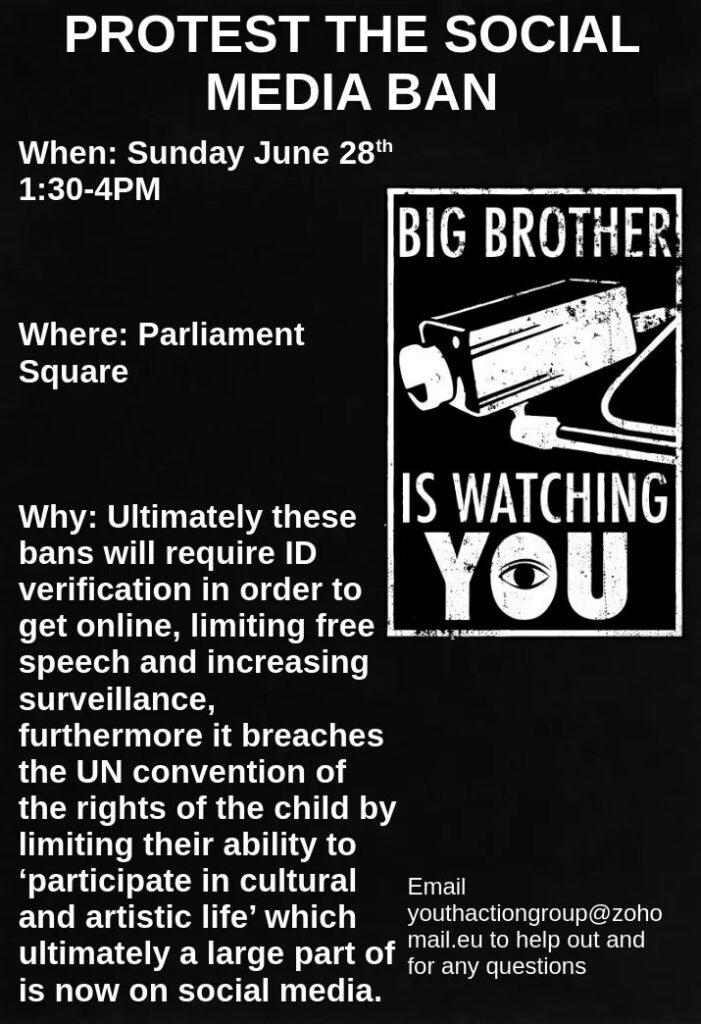
If you are in the London area, and looking to resist the social media ban, join us in our protest on June 28th, at Parliament Square!
The text of Social Media For Teenagers Has More Benefits than Harms © 2026 by Zane Miller is licensed under CC BY-SA 4.0.