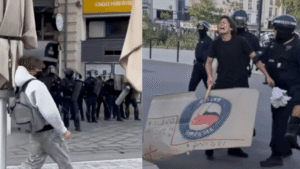

Student political expression refers to when students exercise their First Amendment right to free speech and peaceful assembly by openly expressing political stances and beliefs. This can include marches, wearing symbolic clothing, protesting, and forming student groups focused on political issues. In recent years, student political expression has become increasingly visible amid highly polarizing conflicts and heightened social tensions. In response to this rise there has been an increase in the targeting and restriction of students’ political expression by schools, political figures and even other students. The responses to student political expression in recent years illustrate the ongoing tension between student free speech rights and school discipline: while public school students retain constitutional protections under the First Amendment, schools also have a duty to maintain a safe, orderly, and educational environment.
Students deserve the fight to organize, protest, and engage in political activity in schools, without facing punishments and backlash from schools because of it. In the following webpage, the National Youth Rights Association students’ rights to protest in schools, and ways that schools can restrict and punish student activism
Table of contents
- The Legal Foundation of Student Political expression
- Public School vs. Private School Speech Protections
- Current Research and Data on School Punishment for Political Activity
- Harms of School Punishment for Political Activity
- Modern K-12 and University Stories and Cases of School Punishment for Political Activity
The National Youth Rights Association
If you’re interested in Youth Rights, consider volunteering with us. We are always looking for new members and would love to have you on board. If you have a personal story to share, of your school punishing you for political activity, or about a general youth rights violation, consider sending us an email at nyra@youthrights.org. We’d love to help get your story out to the world.
The Legal Foundation of Student Political expression
The Tinker v. Des Moines Decision
The Tinker v. Des Moines court case involved a group of students who were suspended for wearing black armbands to school to protest the Vietnam War. The students knew that school authorities had adopted a policy threatening suspension for anyone who refused to remove an armband, making their protest also a direct challenge to the school’s attempt to restrict their political expression. The Supreme Court ultimately ruled in 1969 that students do not “shed their constitutional rights to freedom of speech or expression at the schoolhouse gate,” establishing an important precedent for student free speech in public schools. The students, including John Tinker, Mary Beth Tinker, and Christopher Eckhardt, were at the center of the case. The Court’s decision emphasized that schools could only restrict student expression when it would materially and substantially disrupt the work and discipline of the school. As a result, Tinker became foundational to defining the scope of First Amendment protections for students. Its impact continues to be seen in the 21st century, as the decision continues to be cited in cases involving students’ freedom of expression.
SPEAKS Act
The SPEAKS Act is a model policy developed by the American Legislative Exchange Council (ALEC) that was finalized in January 2026. Since it is a “model policy,” it is not a federal law, but rather a template for public K-12 schools that state or local governments can adopt. The Safeguarding Personal Expression at K–12 Schools Act, protects students’ right to free expression by prohibiting discrimination based on religious, political, and ideological viewpoints expressed through classwork, speech, clothing, or student-organized activities. These protections extend to student expression in homework assignments, artwork, and presentations. The Act also allows students to organize religious, political, and ideological school clubs.
However, the Act has limitations. It does not prevent schools from prohibiting, restricting, or limiting student expression that is severe, objectively offensive, or that materially and substantially disrupts school operations.
The SPEAKS Act builds upon principles established by Tinker v. Des Moines by providing additional protections for student expression in K–12 public schools. While Tinker established a constitutional standard allowing schools to restrict student expression when it materially and substantially disrupts school operations, the SPEAKS Act would provide additional statutory protections for certain forms of student expression. If adopted by a state or local government it would also provide students with a potential legal remedy if their rights under the policy were violated.
Public School vs. Private School Speech Protections
State action doctrine
The state action doctrine refers to the principle that the First Amendment’s protections for freedom of speech apply to actions taken by the government or state actors, rather than private organizations. Because public schools are government institutions, they are considered state actors and are therefore legally bound to uphold the First Amendment and its protections for student expression. Private schools, however, generally are not considered state actors and therefore are not bound by the First Amendment in the same way. As a result, the constitutional standard established by Tinker v. Des Moines generally applies to public schools but not to private schools.
This distinction reflects the different obligations of public and private schools. Public schools, as government institutions, must generally respect students’ constitutional rights and cannot favor one political viewpoint over another when regulating protected expression. Private schools, by contrast, have greater freedom to prioritize particular ideals, values, and traditions without being subject to the same constitutional requirements regarding student expression. This can result in private schools having greater control over the political and ideological environment they create for their students, which in turn can impact the types of political expression welcomed in the school.
Exceptions: Leonard Law and Contract Law
In order to provide greater protection for students’ freedom of speech, certain states have passed laws extending free-expression protections to students at private schools. The most notable example is California’s Leonard Law, which extends certain First Amendment protections to students at private schools and colleges. Additionally, some private schools receive federal funding, primarily through equitable services or state-facilitated programs. However, receiving federal funds does not generally make a private school a government actor or require it to comply with the First Amendment.
Private colleges and universities are similarly not generally required by the Constitution to uphold the First Amendment. However, their policies and procedures must comply with applicable state law, and many private institutions voluntarily make commitments to freedom of expression through their student handbooks and other institutional policies. When these commitments are incorporated into a school’s policies, some state courts have treated them as contractual obligations, meaning that institutions may be legally required to follow the standards they have established for themselves. Additionally, many private colleges and universities publicly present themselves as institutions that value freedom of expression, including political expression, creating an expectation that they will uphold the speech protections promised in their policies.
Current Research and Data on School Punishment for Political Activity
Student political expression has become increasingly visible in the years following 2020. Major political and social events have contributed to increased student activism, including protests surrounding racial justice and the Israel-Palestine conflict.
One report examining student expression and retaliation found that between 2020 and 2024, 1,014 students were documented as being targeted or punished for exercising their freedom of speech. The political response to student expression also varied depending on the political viewpoint being expressed. During this period, 476 cases involving left-leaning expression resulted in punishment, compared with 337 cases involving right-leaning expression.
The data also shows that racial justice became a particularly prominent subject of student political expression in 2020. According to FIRE’s Students Under Fire data, 55% of calls for punishment came from individuals or groups who were politically to the left of the targeted student or student group. This occurred during a period when many students were protesting racial injustice following the killing of George Floyd, while other students reported classmates for speech they considered racist or offensive. At the same time, schools responded differently depending on the nature of the expression. School administrators punished 69% of students who used their freedom of speech to express racist messages and publicly condemned 58% of those students.
Beginning in 2023, student political expression increasingly centered around the Israel-Palestine conflict. According to the Students Under Fire database, 41% of all student speech controversies in 2023 involved student expression related to the Israeli-Palestinian conflict. The source also shows a shift in who was responsible for calls to punish or restrict student expression. Unlike in earlier years, when other students were frequently responsible for reporting or seeking punishment for controversial speech, government officials and politicians became increasingly involved in efforts to restrict student expression.
For example, President Donald Trump threatened to revoke the visa of a student who participated in protests concerning Israel and Gaza after accusing the student of antisemitism. Representative Elise Stefanik also questioned university presidents about their responses to antisemitic activity on their campuses. These examples demonstrate how student expression surrounding the Israel-Palestine conflict became the subject of intervention not only by schools and students, but also by highly influential political figures.
Harms of School Punishment for Political Activity
Schools have legitimate authority to maintain order, but punishment should not be used simply because administrators dislike or disagree with a student’s political message, as has occurred in some cases. Harsh and excessive punishment for student political expression can discourage students from participating in political and civic activities. If students believe that expressing their political opinions could result in serious punishment, they may choose not to express themselves even when their speech is legally protected. This is a well-established free-speech concern, as punishment for protected political expression can raise additional free-speech and due-process concerns.
This is particularly concerning because schools play an important role in preparing students to participate in civic life. Additionally, disproportionate consequences, including suspensions, expulsions, and the revocation of diplomas, can interfere with students’ education and future opportunities.
Modern K-12 and University Stories and Cases of School Punishment for Political Activity
Political expression inside the classroom
Kenton Vizdos, a senior at Deep Run High School in Henrico County, Virginia, was attending school virtually when he was repeatedly suspended for protesting racism and police violence through his classroom presentations. On November 4, 2020, Vizdos displayed a slideshow containing images of Michael Brown, Breonna Taylor, and other Black victims of police violence during class. His teachers repeatedly asked him to turn off the slideshow, and when he refused, he was removed from the class. The following day, Vizdos was warned by his assistant principal, Laura McKinney, that he would be suspended if a teacher reported him for protesting in class again. In response, Vizdos changed the classroom’s scrolling slideshow to a static image containing a similar message. He subsequently received a two-day suspension. After returning to school, Vizdos continued displaying the static image and was suspended again, this time for 10 days.
The school justified Vizdos’s suspensions by arguing that his presentations were unrelated to the content of his classes and caused disruption. The American Civil Liberties Union (ACLU) challenged the school’s decision, arguing that the suspensions violated Vizdos’s First Amendment rights. Eden Heilman, the legal director of the ACLU of Virginia, stated that “Instead of encouraging Kenton’s civic engagement and addressing the issues of systemic racism he’s trying to raise, the administration is punishing him and jeopardizing his future. Schools don’t get to determine how its students express themselves or what issues they care about.” The ACLU subsequently sent a formal letter to the principal of Deep Run High School arguing that Vizdos’s suspensions violated his First Amendment rights and citing the Supreme Court’s decision in Tinker v. Des Moines.
The ACLU also argued that the school’s decision was inconsistent with its own approach to virtual education. Deep Run High School’s instructional plan treated virtual learning as a normal school day, yet the school had suspended Vizdos for expressing his views in the virtual classroom. The ACLU argued that, because the virtual classroom was the primary forum available to Vizdos for exercising his right to free expression, punishing him for using that forum raised the same constitutional concerns that would arise if he had expressed himself through a peaceful demonstration during an in-person school day.
Political demonstrations and school attendance rules
Student protests following the Parkland school shooting provide another example of the complicated relationship between political expression and school discipline. In 2018, students across the country organized walkouts to protest gun violence and demand stronger gun-control measures. These demonstrations raised an important legal distinction: schools could generally discipline students for violating attendance policies, but they could not impose a harsher punishment simply because the absence was motivated by a particular political viewpoint. As a result, the disciplinary response to a student participating in a political walkout could depend on whether the school was enforcing an ordinary attendance rule or attempting to punish the political message behind the absence.
Threats of punishment for political demonstrations
The 2018 incident involving the Needville Independent School District in Texas further demonstrated the tension surrounding student political expression following the Parkland shooting. At a time when students across the country were organizing protests, walkouts, and other demonstrations against gun violence, the district’s superintendent posted on Facebook that students who participated in political demonstrations at school would receive an automatic three-day suspension. The threat drew criticism from organizations including the ACLU, which argued that the school district’s proposed punishment raised concerns about students’ First Amendment rights and the legal standards governing political expression in public schools.
Nonviolent protest and campus rules
Florida International University (FIU) moved forward with disciplinary action against students who participated in a nonviolent silent protest against ICE on campus in March 2026. The university issued written reprimands to students who participated in the demonstration, which took place during a speech given by the university’s president. The students stood up, shouted “ICE OFF FIU,” and then stood silently for several minutes before calmly leaving.
Based on reports the protest was nonviolent and did not substantially disrupt the event. FIU justified the reprimands by citing its campus policy restricting expressive activities indoors, which includes activities such as marches, protests, and parades. However, the policy raises First Amendment concerns because FIU is a public university funded by the state government and is therefore subject to constitutional protections for student expression.
University protesters face disciplinary action over campus demonstrations
Five students at the University of California, Irvine, filed a lawsuit in 2024 challenging the university’s suspensions, arguing that the disciplinary actions did not comply with the university’s own internal policies. The students had participated in pro-Palestinian protests on campus, calling on the university to divest from corporations and companies they believed profited from the war in Gaza. The students argued that the university failed to provide them with proper due process before imposing the suspensions.
The case reflects a broader conflict occurring on college campuses. Many college student protesters have faced criminal charges or disciplinary proceedings related to campus demonstrations. In many cases, students’ actions have conflicted with university policies governing when, where, and how political demonstrations can take place, resulting in disciplinary measures such as suspensions and expulsions. Students and civil-liberties advocates have pushed back against these punishments, arguing that severe disciplinary actions can have lasting consequences for students’ educational and professional opportunities.