

Device and Internet Monitoring, Managing, Restricting and Searching is one of the most common ways that Oppressive Parents violate the privacy of their children on a daily basis. This comes in many forms, usually from some type of “family safety” software that allows parents complete and total control over a teenager’s device and internet access. These apps allow parents to read private messages between a teenager and their peers, restrict certain aspects of internet access, set limits on a teenager’s ability to use their own device, and even constantly scan the screen of the device for “keyword alerts”. In the modern world, where the internet, social media, and texting/calling are the main ways that teenagers keep in touch with each other, and interact, placing unreasonable restrictions on this, or having intrusive supervision over these things is an egregious violation of privacy. This can harm young people in many ways, including causing anxiety/depression symptoms, hindering education, restricting creativity, isolating a young person from support systems and resources, and damaging a young person’s ability to communicate with their peers openly and honestly.
Parents often use internet restrictions as a way to prevent their children from accessing social media, online communities and ways to communicate with others over the internet. This is also inherently harmful, because social media can be beneficial to minors in many ways, including allowing them to access support that they don’t have in their home, allowing them free access to information and alternate viewpoints, allowing them to freely advocate for their beliefs by exercising their right to free speech, and allowing them to access educational resources for learning skills. Parents who restrict internet and social media access from their children often cut them off from vital support systems online, especially if they are living in an abusive household, and prevent them from accessing alternative information in order for the parents to have control and indoctrinate them into political and religious beliefs without opposition. In general, parents using internet restriction to prevent children from accessing social media violates their right to free speech, since social media is the main place that young people organize for advocacy, and voice their opinions on issues.
Unfortunately, these internet/device managing apps are very commonplace within families, as they have been marketed as a way to “keep young people safe”, by supervising all aspects of their digital lives. However, this intrusive monitoring has the opposite effect, by making teenagers more secretive, less likely to trust parents in the event of a crisis and making teenagers continuously resent their parents. Along with this, many first-hand stories describe oppressive parents using device monitoring and restricting as an element of a broader pattern of emotional abuse, psychological control, and unfair treatment. Not all parents have the best interest of their children at heart, and some parents take extreme joy in intrusively controlling every aspect of a young person’s life. Teenagers growing up with these sorts of restrictions have their education, personal development, and relationships with others hindered by these narcissistic parents’ behavior. Device restrictions can also make it so teenagers living in abusive environments have a much harder time reaching out for support, accessing important resources, and recording instances of the abuse.
Young people deserve basic freedom and privacy, including freedom from intrusive device/internet monitoring and control. In the following webpage, the National Youth Rights Association explains Device and Internet Monitoring, Management and Restrictions, the harms it has on youth, research on its negative effects, and first-hand cases and stories of these restrictions hindering young peoples’ lives.
Table of Contents
- Elements of Internet and Device Monitoring and Restricting
- Harms of Parental Controls on Teenagers
- Common Device Managing Apps and Software
- Research on the Effects of Device Monitoring and Restricting
- Cases and Stories of the Harms Created by Device Managing Software
The National Youth Rights Association
If you’re interested in Youth Rights, consider volunteering with us. We are always looking for new members and would love to have you on board. If you have a personal story to share, of how device/internet managing software by parents negatively impacted your life, or about a general youth rights violation, consider sending us an email at nyra@youthrights.org. We’d love to help get your story out to the world.
Elements of Internet and Device Monitoring and Restricting
Device Searches – One of the most direct forms of device control is when parents go through the child’s phone, tablet, laptop, or other device to inspect its contents. This can include opening texts, photos, notes apps, browser history, downloads, saved passwords, contacts, call logs, screenshots, or deleted folders. While some parents frame this as basic supervision, it becomes far more invasive when the searches are frequent, unpredictable, broad, or done without any specific safety concern. In that situation, the device stops being a tool the child uses and becomes something the parent treats as permanently open for inspection. This can make the child feel that even their digital life is not their own.
Photo and Media Inspection – Device monitoring can also involve checking photo galleries, videos, screenshots, voice memos, downloads, and saved images. This becomes especially invasive when the parent uses private media as a source of interrogation, shame, or punishment. A device often stores personal memories, jokes, creative experiments, and emotionally meaningful content. When all media is treated as open to parental review, the child may feel that there is no digital space where personal meaning can exist without interference. This is even more harmful in cases where the child may need to record instances of their parents’ abusive behavior, but is unable to because of risk of it being discovered due to device searches.
Message Monitoring – One especially invasive form of device control is message monitoring. This can include reading texts, direct messages, group chats, emails, or app-based conversations, either manually or through device monitoring software that captures them. Some parents may review conversations only after a specific concern arises, but others treat all communication as something they are entitled to inspect at any time. This can severely affect the child’s willingness to confide in friends, ask for help, vent, or build normal private relationships, because digital communication is no longer private enough to feel emotionally safe.
Restrictions on Internet Access – A parent may heavily restrict internet access by blocking websites, limiting the ability to search freely, cutting off Wi-Fi, disabling mobile data, or requiring permission before the child can access certain types of information. The issue becomes more serious when these restrictions are used to prevent independent learning, exposure to different viewpoints, or private access to information about identity, relationships, health, or support. In these cases, the internet is treated not just as something risky to supervise, but as a source of independence that must be tightly controlled.
Restricting or Preventing Access to Social Media – One of the most common things blocked by device restrictions is social media. Parents may block social media entirely, remove access to specific platforms, or make it practically impossible for the child to participate in them. This can include banning all social media apps, deleting accounts, disabling account creation, changing passwords, or using parental controls to prevent access to platforms where peers commonly interact. While some parents may justify this as a way to reduce risk, the restriction can become much broader in effect because social media is often one of the main ways teenagers communicate, maintain friendships, follow communities, explore identity, and stay socially connected. When access is heavily restricted or fully prevented, the child may not just lose entertainment. They may lose an important part of modern peer interaction, support, self-expression, and belonging.
Browser History Checks and Search Term Scrutiny – Parents may routinely inspect browsing history, saved tabs, autocomplete suggestions, or search terms to learn what the child is thinking about. This can be especially intrusive because internet searches often reflect curiosity, confusion, identity questions, health concerns, or emotional struggles that a child is not ready to discuss openly. When every search becomes discoverable and subject to parental interpretation, the child may stop looking up important information or begin fearing their own curiosity.
Restrictions on Information About Identity, Health, or Support – A particularly significant form of device restriction happens when parents block access to information about sexuality, gender identity, neurodivergence, religion, abuse, mental health, or other topics that might help the child understand themselves or seek support. This can prevent the child from privately learning about their own experiences or finding language for what they are going through. In that sense, device restriction is not just about screen habits. It can become control over knowledge itself.
Contact List Control – Some parents control who the child may contact by deleting numbers, blocking certain people, requiring approval for new contacts, or forbidding communication with specific friends, relatives, or mentors. This goes beyond simple device supervision and becomes a way of controlling relationships through the device itself. The child’s phone then becomes not a tool for connection, but a tool through which the parent regulates who is allowed access to them.
Download Restrictions – Many Device monitoring apps put specific restrictions on the apps which a device can download. Under these restrictions, the minor may only be able to download certain apps on their own and need permission for others. In other cases, the minor may need permission from their parents to download any app to the device, even if it is harmless.
Controlled App Blocks – Parents may also control devices by blocking specific apps, removing them remotely, preventing installation of new apps, or requiring approval before any app can be downloaded or used. This can apply to social media, messaging, games, browsers, note-taking tools, music platforms, or even educational resources. App control becomes especially overbearing when it is used to heavily manage the child’s social life, interests, communication, and access to outside communities. The child may then feel that the parent is not merely guiding device use, but deciding which parts of modern life they are allowed to participate in.
Screen Time Limits – Another major element is the use of strict overall screen time caps, such as allowing only one or two hours of total device use per day regardless of what the device is being used for. On its own, a time limit may sound simple, but its impact can be much broader. A single daily cap may affect friendships, schoolwork, entertainment, emotional support, creative hobbies, and access to information all at once. It becomes especially controlling when the child has little say in how the time is allocated or when the limit is applied rigidly without regard to context.
Specific Time Cutoffs – Some parents set hard shutoff times so that the device becomes unusable after a certain hour, such as 9 pm or 10 pm at night. This may be presented as a sleep-related rule, but it can also be part of a larger system of digital control. A child may lose access not only to entertainment, but to late-night conversations with friends, online support spaces, or the ability to privately decompress at the end of the day. When time cutoffs are rigid and enforced automatically, the device no longer responds to the child’s needs or circumstances, but to the parent’s imposed schedule.
Remote Locking or Shutdown Controls – A parent may have the power to remotely lock the device, disable certain features, pause internet access, or shut the entire device down from their own phone. This gives the parent immediate control over when and how the child can use the device, regardless of what the child is doing at the time. The device may stop functioning during a conversation, while working on school tasks, or during private reflection, simply because the parent decides access should end. This kind of control can make the child feel that their digital access exists only at the parent’s moment-to-moment pleasure.
Constant Internet Usage and Device Monitoring – Parents may use software or settings that continuously track what the child does on the device and online. This can include reporting websites visited, apps opened, search terms entered, time spent on each service, videos watched, and other activity patterns. The monitoring becomes especially intense when it is ongoing rather than occasional, and when the parent checks it obsessively or responds to harmless behavior as though it were suspicious. In that kind of environment, the child may feel that every click is being watched and interpreted for punishment.
Keyword or Content Alerts – Some monitoring systems alert parents when certain words, phrases, images, or topics appear on the child’s device. This can include flags for sex, drugs, self-harm, or other sensitive topics. While marketed as safety tools, these systems can also become overbroad and invasive, especially when they pull deeply personal or contextual communication into parental oversight automatically. The child may stop talking honestly about serious problems because even reaching out for help could trigger parental intervention or punishment.
Location Tracking – Many parents now use location-sharing features, GPS tools, or family safety apps to track where a child is in real time. In some cases this is limited and situational, but it can become overbearing when the tracking is constant, indefinite, and tied to interrogation or punishment. The child may feel that they are never allowed to exist unobserved, even when doing nothing wrong. Location tracking becomes especially controlling when it is combined with demands to justify every stop, route, or change in movement, turning physical space into something the parent monitors minute by minute.
Google Account Management – Another element of control happens through centralized account management, especially through Google accounts or similar systems. Parents may manage the child’s email, YouTube access, app downloads, Chrome browsing, account passwords, school device settings, cloud storage, or sign-in permissions from a linked parent account. This type of control can be especially far reaching because it affects multiple services at once and may give the parent administrative power over the child’s broader digital identity. The child may not only use a device under supervision, but exist online inside an account structure they do not meaningfully control.
Social Media Account Management – Parents may require access to usernames and passwords, run the child’s profile settings, approve posts, review followers, delete content, or even post as the child. This kind of control is especially significant because social media is often part of how young people build identity, friendships, and social presence. When parents dominate that space, the child may feel that even their public-facing self is not fully theirs to shape.
Monitoring Through “Family Safety” Apps – Family safety platforms often bundle multiple features together: screen time caps, location tracking, browsing reports, app approvals, content filters, and activity summaries. The overall effect can be much greater than any one restriction alone. When used aggressively, these apps can create a fully managed digital environment in which the child’s communication, movement, time use, and information access are all routed through parental oversight. The device becomes part of a broader control system rather than simply a personal object.
Constant Screen Reading – Another element of device monitoring happens when parental control software or device management apps are able to continuously scan what appears on the child’s screen in real time, or frequently enough that the device is effectively being “read” as it is used. Instead of only tracking websites visited or total time spent, these systems may analyze messages, social media content, search results, images, typed language, or on-screen activity in order to flag certain words, themes, or topics for parents. In some setups, the parent may receive alerts based on what the child is viewing or writing, even if the parent is not manually checking the device at that moment. This makes the monitoring much more intrusive because it reaches into the live content of the child’s digital experience rather than just the fact that they used the device. The child may feel that anything they read, type, or look at can be interpreted and reported automatically, which can create a strong sense of surveillance even when no parent is physically present.
Communication Shutoffs as Punishment – Parents may punish children by disabling messaging, removing phone privileges, cutting off internet, or suspending access to communication apps. This can do more than take away entertainment. It can isolate the child from peers, support systems, school contacts, and any outside relationships they rely on. When communication tools are turned off as discipline, the device becomes a lever of social control.
Punishment for Attempts at Digital Privacy – The control becomes even more severe when parents punish children for trying to create privacy on their devices. This can include anger over password changes, punishment for deleting browsing history, accusations over locked screens, or conflict over wanting a private account or conversation. In these cases, privacy itself is treated as suspicious. The child learns that not only is the device monitored, but wanting any private control over it is considered wrongdoing.
Using Device and Internet Management as Part of Broader Emotional Abuse – In some homes, device monitoring is not just a standalone rule system about screen habits or online safety. It becomes part of a wider pattern of emotional abuse and coercive control. A parent may use device searches, message monitoring, location tracking, shutoff controls, and internet restrictions to intimidate the teenager, isolate them from support, catch them expressing negative feelings, enforce obedience, or create the constant sense that they are never beyond the parent’s reach. In that kind of environment, the device is turned into a tool of domination. The teenager may begin to feel that there is no safe place to think, speak, reach out, or even privately react to what is happening at home. This can intensify fear, helplessness, and emotional entrapment, because the same technology that could help the teenager connect, document abuse, or seek support is instead being used to extend the parent’s control into every part of their daily life.
Harms of Parental Controls on Teenagers
Violations of Privacy – Device managing is one of the most common types of privacy violations that minors experience. When parents can see everything a teenager reads, writes, searches, or looks at, the teenager may begin to feel that they have no private space left. A private inner life is an important part of growing up. Teenagers need room to reflect, question, imagine, process feelings, and figure out who they are. If even those processes are constantly exposed to parental oversight, the teenager may stop feeling like their thoughts truly belong to them. That can create a deep sense of emotional crowding, where the child feels psychologically surrounded and unable to mentally belong to themselves.
Violation of Others’ Privacy – Device monitoring apps don’t just violate the privacy of the teenager who is the subject of them—they violate the privacy of anyone the teenager communicates with. If a device monitoring software gives parents the ability to read all of the messages between a teenager and their peers, anything private or sensitive that the peer says to the teenager—believing their conversation to be private—can be seen by the parent. This is a major violation of trust, and can create problems for the teenager’s bonds with their friends if they find out about it.
Enforcing Self Censorship – If a parent is using device monitoring to read every message that a teenager sends with their friends, the teenager would obviously interact with their friends differently. They may be less comfortable discussing serious topics, opening up, having fun, or acting in a way that they normally would if they were not being monitored. This can hinder the relationship between a teenager and their peers, by enforcing a deliberate or subconscious self censorship with how the teenager communicates with others over text or online.
Lack of Ability to Vent and Communicate Problems – If a parent can read every message that a teenager sends to their friends, then that creates difficulty when a teenager needs to vent or communicate with their friends about issues that they wouldn’t want their parents to know about. Parents that enforce strict device management usually are also oppressive, controlling and/or abusive in many other ways, which could lead the teenager to have many issues with their living situation. However, if they attempted to communicate those issues with their peers over the phone, and their parents used the device managing software to see it, the parent would likely punish them further. This may lead teenagers to refrain from venting and communicating with their peers about problems that involve their parents, or any other problem in their life that they wouldn’t want their parents to know about. This can lead to built up stress and internal conflict.
Hindrances to Bonding and Connection with Peers – Device restrictions can present hindrances on a teenager’s ability to bond with their friends. For example, if their friends are all playing a game, using an app, or using a website that is blocked by the device’s restrictions, then they would miss out on that experience with their friends. Along with this, if their device has a screen time limit, that limits their ability to communicate with their friends, peers, or anyone they are in a relationship with. Furthermore, if their device shuts off after a certain time of night, this prevents them from communicating with anyone later at night, which causes them to miss out on bonding experiences with friends from late-night calls and activities.
Difficulty Recording Abuse – If a teenager constantly has their device searched, then that usually includes searching through the camera roll, and finding images/videos that were taken from the device. If a teenager is currently living in a home that exhibits other kinds of abuse, such as physical, emotional, verbal, etc, then they may attempt to take records of this abuse by their parents, in order to compile evidence for a CPS report. However, if their camera roll is searched by their abusive parents, then the parents would most likely delete the recorded evidence of the abuse, and punish them for compiling it in the first place. This leads to difficulty in recording abuse, and in most cases, will dissuade a teenager from even attempting to compile records of the abuse in the first place, out of fear of their parents discovering it. This can lead to the teenager being further trapped in their abusive home, and having a less likely chance of being taken seriously by child protective services in order to be removed from it.
Empowering Discriminatory Control – If a parent has complete access to a teenager’s internet history, then that can empower them to enforce a discriminatory control against a child’s identity. For example, if a parent is homophobic, their teenager would likely be closeted if they are queer identifying. This is because they fear being unsupported or even punished if their identity was found out by their parents. And if the parent is also monitoring their internet access, the child would feel uncomfortable, and would most likely refrain from connecting with queer communicates or reaching out to queer resources online, for fear that their parents would notice, and punish them or discover their queer identity. This can contribute to the isolation of the child, which is a major risk factor for depression and other negative impacts.
Empowering Financial Exploitation – It is a real and documented problem that parents can use their child’s social media success to financially exploit them. This usually occurs when a parent takes the earnings that a minor is making from social media, and uses it for themselves, while pressuring the minor into continuing to work without receiving any of the benefit. If a parent has access to a child’s social media account, because of either demanding the password, or through a device managing app, this makes it so a parent has the capability of finding out if the child’s social media account is successful, and the power to commandeer the account and take control of the earnings. This then forces the child into a position where they are being financially exploited from their earnings, due to their parents’ control of their social media account.
Hindrances to Education – Device restrictions can provide serious hindrances on a young person’s education in many ways. First of all, screen time limits can hinder a young person’s ability to complete homework and school projects on time. Oftentimes, certain school assignments are due at midnight, allowing a student to submit it up until that point. But if the student’s device shuts off before then, due to a screen time restriction or time limit, then they have less time to work on the same school projects as their peers. Along with this, devices shutting off after a certain period of time also limits a young person’s ability to study late at night, and complete homework assignments that are due the next morning. All of these can have negative effects on their education and grades. Furthermore, internet restrictions on a young person’s devices limits their ability to access certain websites in order to research for school assignments.
Preventing Ability to Advocate and Voice Opinions – Another harm of parents using internet/device managing apps to restrict social media is that it can reduce a teenager’s ability to speak publicly, participate in discussions, and develop a voice on issues that matter to them. Social media is not only used for entertainment or casual communication. For many young people, it is one of the main places where they share opinions, engage with social causes, learn how public discussion works, and practice expressing themselves to a wider audience. If a parent blocks those platforms entirely or makes participation too difficult or risky, the teenager may lose an important outlet for self-advocacy. This can be especially harmful for teens who care about political issues, school policies, identity-related topics, or other matters affecting their lives, because they may be prevented from joining conversations that shape how they understand themselves and the world. Over time, this can teach the teenager that their voice is not meant to be heard, that public self-expression is dangerous, or that they are not allowed to participate in broader social and civic life.
Preventing Ability to Access Alternate Sources of Information – Heavy internet and device restrictions can also prevent teenagers from accessing information outside of what their parents approve of. In many homes, especially controlling or ideologically rigid ones, this means the teenager may be limited to a narrow set of viewpoints, beliefs, and explanations chosen by the parent. If websites, apps, search tools, videos, forums, or social media communities are blocked, the teenager may have much less ability to compare perspectives, fact-check what they are told, or learn about experiences different from their own household. This can be especially serious when the teenager is trying to understand identity, religion, politics, relationships, abuse, mental health, or other sensitive issues that their parents may misrepresent or refuse to discuss honestly. In that kind of environment, device restrictions do more than manage screen use. They restrict intellectual freedom and make it harder for the teenager to think independently, question harmful ideas, or realize that healthier perspectives and support systems exist outside the home.
Damage to the Teenager’s Sense of Autonomy – A major harm of heavy device monitoring is that it can interfere with the teenager’s ability to develop independence. Modern devices are not just entertainment tools. They are part of how young people communicate, learn, explore interests, manage daily life, and gradually become more self-directed. When every part of that digital life is subject to strict parental control, the teenager may struggle to build confidence in their own judgment. They may feel that they are not allowed to think, choose, explore, or communicate unless a parent approves each step. This can make autonomy feel unfamiliar, dangerous, or unattainable.
Increased Secrecy and Deception – Overly restrictive device control often does not eliminate secrecy. It teaches it. A teenager who feels over-monitored may start hiding harmless things, using alternate accounts, deleting messages, borrowing other devices, or finding workarounds just to regain some privacy and autonomy. In many cases, the increased secrecy is not evidence that the teenager is becoming more dangerous or dishonest by nature. It is a reaction to a system where honest and ordinary behavior no longer feels safe from intrusion. The more extreme the monitoring becomes, the more likely the teenager may feel forced into covert behavior simply to preserve some normal personal space.
Difficulty Developing Identity – Teenagers often use their devices to explore identity in ways they may not yet be ready to discuss openly. This can include interests, beliefs, values, relationships, sexual orientation, gender expression, politics, religion, career goals, personal style, and many other aspects of selfhood. When device monitoring is heavy, that exploration may be cut off or made frightening. The teenager may begin to suppress parts of themselves, not because those parts are harmful, but because it feels unsafe to let parents see them. This can delay identity development and make the young person feel confused, divided, or ashamed of their own curiosity.
Feelings of Powerlessness and Helplessness – A teenager living under heavy device restrictions may feel that they have no meaningful control over their daily life. If they cannot decide when to use their device, who to talk to, what to read, what to download, or what to keep private, they may begin to feel that resistance is pointless. This can create helplessness, especially when any attempt to establish digital privacy is met with punishment or suspicion. Over time, the teenager may stop trying to assert themselves at all, because they have learned that their boundaries will simply be overridden.
Depressive Symptoms and Emotional Decline – When a teenager feels constantly monitored, mistrusted, overcontrolled, and unable to express themselves freely, that can take a serious emotional toll. The sense of being trapped, scrutinized, and denied normal privacy can contribute to sadness, discouragement, numbness, and hopelessness. A device should not feel like an instrument of domination, but in heavily controlled homes it often does. If the teenager starts to feel that there is nowhere they can breathe, think, or communicate freely, that emotional pressure can build into broader depressive symptoms over time.
Difficulty Asking for Help in Moments of Crisis – Strict device restrictions can make it much harder for a teenager to seek help quickly when something serious happens. A child who is in emotional crisis, experiencing abuse, feeling suicidal, being harassed, or facing another urgent situation may hesitate to call, text, search for help, or contact a trusted adult if they know their activity will be seen. In some cases, device cutoffs or locked-down communication tools may also physically interfere with their ability to reach someone at the moment they most need support. This can leave them isolated at exactly the wrong time.
Fear of Normal Curiosity – If search terms, browsing history, app use, and screen content are constantly monitored, a teenager may start to fear curiosity itself. They may hesitate to look up questions about mental health, sexuality, religion, politics, abuse, relationships, conflict, or even harmless personal interests because they know their parents may later see it. This can teach the teenager that seeking knowledge is risky and that wanting to understand themselves or the world is something to be hidden. This is especially the case when parents punish children for what they search online, or use it to make fun of them. Over time, they may become less intellectually open, less willing to explore important questions, and more ashamed of what they want to learn.
Reduced Creativity and Experimentation – Teenagers often use devices as spaces to write, make art, edit videos, explore music, join fandoms, create jokes with friends, and experiment with different forms of self-expression. When digital life is heavily monitored, that experimentation can become much harder. The teenager may censor not only serious personal disclosures, but also playfulness, humor, weirdness, and creative risk taking. They may become afraid to save drafts, make private notes, try new communities, or follow unusual interests. This can narrow their sense of freedom and interfere with creativity in ways that are easy for adults to underestimate.
Normalization of Controlling Relationships – A teenager raised under intense digital surveillance may start to accept the idea that close relationships naturally include access to all messages, passwords, locations, and private conversations. That can shape how they understand friendship, authority, and love later in life. They may be more vulnerable to controlling romantic partners or possessive friends because surveillance feels familiar rather than alarming. They may also struggle to recognize when someone is crossing a line, because their baseline for privacy and respect was already distorted at home.
Difficulty Forming Healthy Boundaries Later in Life – If a teenager grows up with no real control over their digital boundaries, they may have trouble building boundaries in adulthood. They may not know how to protect privacy without feeling guilty, may over-explain themselves to authority figures, or may feel anxious any time they try to keep something personal. On the other side, they may become extremely guarded because they have learned that openness leads to intrusion. Either way, the lack of healthy digital boundaries in adolescence can create long-term confusion about what normal privacy is supposed to look like.
Resentment and Breakdown of the Parent-Child Relationship – Heavy device monitoring often creates deep resentment, especially when the teenager feels that rules are unfair, humiliating, or disproportionate. Even if the teenager cannot openly express that resentment at the time, it may build quietly over years. The parent may believe they are preserving control, while the teenager increasingly feels alienated, mistrustful, and emotionally detached. In the long run, this can contribute to a fractured parent-child relationship in which the teenager shares less, withdraws more, and may eventually distance themselves as soon as they are able. For parents putting their children through these extreme invasive measures, it is important to know that your child is growing to resent you, and as soon as they have the ability to cut you off, they most likely will.
Loss of Decompression Time – Although some parents impose device restrictions in the name of healthy sleep, harsh time cutoffs can also remove one of the main ways teenagers decompress at night. Many young people use late evening device time to talk privately with friends, calm down after stressful family interactions, listen to music, journal, or feel connected after the pressures of the day. When the device shuts off abruptly and rigidly, especially in a high-conflict home, the teenager may lose one of their few remaining coping tools. That can make nights feel more emotionally intense rather than calmer.
Constant Anticipation of Punishment – When monitoring systems are tied to discipline, the teenager may begin to use their device with a constant awareness that any small thing could lead to confrontation later. A flagged word, an unfamiliar app, a misunderstood joke, a harmless photo, a wrong click, or a search taken out of context can become the basis for interrogation or punishment. This creates a tense environment where the teenager is not only using technology, but bracing for the consequences of being seen using it. That state of anticipation can be mentally exhausting and emotionally destabilizing.
Isolation From Broader Support Networks – Even outside direct peer bonding, device restrictions can isolate teenagers from broader networks that matter to them. This can include online communities built around hobbies, emotional support groups, communities for marginalized identities, educational forums, mentors, family members, and people who help them feel less alone. If device management prevents access to those spaces, the teenager may feel cut off from people who could otherwise provide belonging, understanding, or practical help. This kind of isolation can be especially harmful for teens who already feel misunderstood or constrained at home.
In the following video, NYRA President Zane Miller interviews Otis, a young person who grew up using social media for support and connection with others, due to difficulty in making strong friendships in person. Watch the full video to hear about the harms of restricting young people from online communities and support systems:
Common Device Managing Apps and Software
Bark – Bark is one of the best-known parental control platforms and is built around a mix of monitoring and restriction tools. Its site says it scans texts, emails, web activity, and more than 30 social media apps, and it also offers screen-time management, app and website blocking, internet pause controls, contact approval, and location tracking. Bark also sells its own Bark Phone and Bark Watch, which build those controls directly into the device.
Qustodio – Qustodio is a digital wellbeing and parental control app that is commonly used for screen-time rules and content restrictions. Qustodio’s materials compare it with Google Family Link and Apple Screen Time and highlight daily app limits, scheduled offline periods, app and website restrictions, and content filtering, including the ability to block categories such as social media or gaming. It is often used as a more full-featured third-party control layer rather than a built-in operating-system tool.
Google Family Link – Google Family Link is Google’s built-in family management system for children’s Android devices and Google accounts. Google says it lets parents set screen-time limits, approve or block app downloads, locate devices, and manage the child’s Google account and digital activity more broadly. Because it is tied into the Google ecosystem, it is especially common on Android phones, tablets, and Chromebooks.
Apple Screen Time / Family Sharing parental controls – Apple’s built-in option is Screen Time, used together with Family Sharing on iPhone, iPad, and other Apple devices. Apple says parents can use it to set downtime, app limits, communication limits, content and privacy restrictions, and purchase approvals for a child’s device. Because it is built directly into iOS and iPadOS, it is one of the most common forms of device management for children using Apple products.
Microsoft Family Safety – Microsoft Family Safety is Microsoft’s cross-device family management service. Microsoft says it supports screen-time limits, app and game limits, website and search filtering, app blocking, and activity reporting, with coverage across Windows, Xbox, Edge, and some mobile-device functions. It is especially common in households where children use Windows computers or Xbox consoles.
Norton Family – Norton Family is a parental control product from Norton focused on web supervision, time limits, location, and activity oversight. Norton says it offers web supervision, search supervision, video supervision, school-time tools, app supervision, location supervision, and time supervision across supported devices. It is often used by families who want a more monitoring-heavy product from a long-established security brand.
Canopy – Canopy is a parental control app that emphasizes AI-powered filtering and device oversight. Its site says it offers content filtering, sexting prevention, app management, screen-time controls, and location alerts, with a strong focus on filtering images and websites in real time rather than only relying on static blocklists. That makes it a notable example of software that goes beyond simple time restrictions into live content analysis.
MMGuardian – MMGuardian is another parental control app centered on phones and tablets. Its site says it offers text monitoring, social media monitoring, web filtering, app control, screen-time limits, location tracking, and alerts for concerning content. It is commonly discussed as a monitoring-oriented tool, especially for Android devices.
FamilyTime – FamilyTime is a parental control platform built around time limits, app restrictions, location tools, and device rules. Its site says it includes screen-time limits, app blocking, website filtering, location tracking, geofencing, and pickup or SOS-style family safety features. It is a common example of an app that combines behavioral restrictions with location and scheduling controls.
Built in Carrier or Manufacturer Family Control Tools – Beyond the biggest named apps, many families also use built-in controls offered by phone makers, operating systems, carriers, or smart-home platforms rather than a separate third-party app. In practice, this means device management may come from an Android or Apple account system, a Microsoft family group, or another account-based service already tied to the child’s phone, tablet, or computer. These options are common partly because they are easy to enable and often come pre-integrated with the device ecosystem.
Research on the Effects of Device Monitoring and Restricting
Research on adolescent privacy and parental monitoring suggests that heavy device surveillance can damage the very openness parents often hope to create. A well-known longitudinal study found that parental privacy invasion predicted reduced parental knowledge over time, meaning intrusive monitoring was associated with parents ultimately understanding less about their child’s real life rather than more. More recent work has similarly found links between adolescents’ perceptions of parental privacy invasion, greater secrecy, and lower voluntary disclosure. In other words, when teenagers feel watched too closely, they are often more likely to hide things rather than communicate honestly.
Studies also suggest that privacy-invasive monitoring is tied to weaker family functioning. A qualitative study of parent and child perspectives reported that privacy invasions have been associated with increased adolescent secrecy and deficits in family functioning, including problematic communication and relationship strain. That fits a broader pattern in the literature: the issue is not just that monitoring feels unpleasant, but that overly intrusive monitoring can change the emotional climate of the family by replacing trust based communication with suspicion, defensiveness, and concealment.
Another major theme in the research is that restrictive digital control can backfire. A 2023 study on early adolescent social technology use found that restrictive parental monitoring of digital media was positively associated with the child’s problematic internet use. The American Academy of Pediatrics has similarly noted that simply restricting time and content does not by itself prevent problematic internet use, and that discussion and co-engagement can matter more than rules alone. This suggests that harsh screen limits, rigid blocks, and heavy digital control may not teach healthy judgment as effectively as parents assume.
The literature also connects privacy invasion with depressive symptoms and psychological distress. A thesis focused specifically on parental privacy invasions framed them as a form of psychological control and examined them as a theoretical contributor to adolescent depressive symptoms. More broadly, work on parental psychological control has repeatedly linked intrusive, manipulative control of a child’s thoughts and inner life with worse adolescent adjustment, including depressive symptoms. That matters because device monitoring is not always experienced as simple rule setting; in more extreme forms, it can function as a digital extension of psychological control.
Researchers also emphasize that privacy is part of normal adolescent development, not just a preference teenagers invent to avoid rules. Scholarship on parental monitoring and information management explains that adolescence involves a growing need for privacy, autonomy, and independent social relationships, and that family privacy boundaries have to shift as children mature. When device management systems allow parents to constantly track searches, messages, locations, and on-screen activity, they can interfere with that developmental process by limiting opportunities for self-direction, experimentation, and independence.
Cases and Stories of the Harms Created by Device Managing Software
Recently, NYRA President Zane Miller interviewed Joule, a 17 year old teenager in the UK. Joule discussed her personal story of parental privacy violations, specifically with how her mother used Location tracking on her phone to violate her privacy. You can watch the full story here:
In Joule’s story, she discussed how her mother demanded location tracking software on Joule’s phone, and informed her that even when she turns 18, she still must keep the location tracking. However, her mother also used the location tracking to enact parental oppression in other ways, such as to control and hinder Joule’s relationships, and shame her. Joule described that her mother is unsupportive of Joule’s current partner, and will often berate her about spending too much time with said partner, and interrogate her about the time spent with said partner in an aggressive manner. Her mother uses the location tracking software on Joule’s phone to monitor how much time Joule spends out of the house with her partner, and will often verbally attack Joule when she believes that Joule has been out with her too much. This is an example of how device monitoring, specifically location tracking can be used by controlling parents to hinder their relationships with others, and invade their privacy.
Tammi Hamby’s Daughter – Tammi Hamby, a former Crawford County Library Board member and censorship advocate was arrested for abusive behavior relating to abusive enforcement of internet restriction against her disabled adult daughter. According to reports, Tamby attempted to restrict her daughter from communicating with others online, believing that they were predators and scammers. When her daughter resisted the control, Tammi orchestrated a kidnapping of her own daughter, using hired men, to use as a scare tactic to traumatize her daughter against communicating with strangers online. Her husband stated that they wanted to “show her that evil exists”. This story is a good example of illustrating how parents that want to control their children’s internet access in order to “protect” them, are often insane and abusive towards their children, caring more about controlling them than supporting them.
The middle-school girl who was outed after another parent read Snapchat messages — In a Let Grow essay, a mother described a case from her daughter’s school in which one teenager was outed as gay because another girl’s mother had been reading her child’s Snapchat messages and then shared what she learned with others. The author said this was not a one-time emergency search but something the mother did regularly out of curiosity about middle-school life. The harm in that story was not only to the child being monitored, but to the other child whose private identity was exposed without consent. It is a strong example of how message monitoring can spill outward and cause humiliation, loss of safety, and damage to peer trust.
The 18-year-old whose mother kept monitoring her phone after she got her own job — In a self-reported post on Reddit, an 18-year-old girl described finally getting her first job, buying her own phone, and expecting that to bring some independence. Instead, she said her mother told her she would still be monitoring the phone through a child-protection app and would continue watching her messages until she was satisfied with her “behavior.” The writer said she felt “empty and lost” and explained that simply deleting the app was not realistic because it could threaten her housing. Her story is a strong example of how device monitoring can create helplessness and emotional entrapment even after a teenager technically reaches adulthood.
The 16-year-old who lived for years under Qustodio restrictions — In another self-reported Reddit post, a 16-year-old said their parents had put Qustodio on their phone years earlier after a single “slip up” and that the restrictions had followed them for years afterward. They wrote that Reddit was blocked as both an app and a website and framed the post itself as part of figuring out how to get around the controls. The story is useful because it shows one of the recurring harms of intensive device restriction: instead of building trust or judgment, it can push teenagers toward workarounds, concealment, and a constant effort to reclaim even minimal digital freedom.
The commenter who said Wi-Fi restrictions isolated them from friends and homework — In a self-reported Reddit discussion about Wi-Fi restrictions, one user described growing up under rules where the internet would cut out after a fixed amount of use. They wrote that they were isolated and could not talk to their friends, and that at times they could not do homework unless they “groveled” for more Wi-Fi time. In follow-up comments, the same discussion described internet restrictions as a control tactic that could be “really stressful and at times pretty traumatic.” That story highlights how device and internet controls can affect much more than entertainment, interfering with school, coping, and basic social contact.
Recently, we asked members of the r/parentalcontrols subreddit to tell their stories about how parental controls have harmed their life. The thread received over 100 comments, with a mix of personal stories, and opposition from supporters of parental controls.
Here are some of the most impactful stories gathered from the thread.
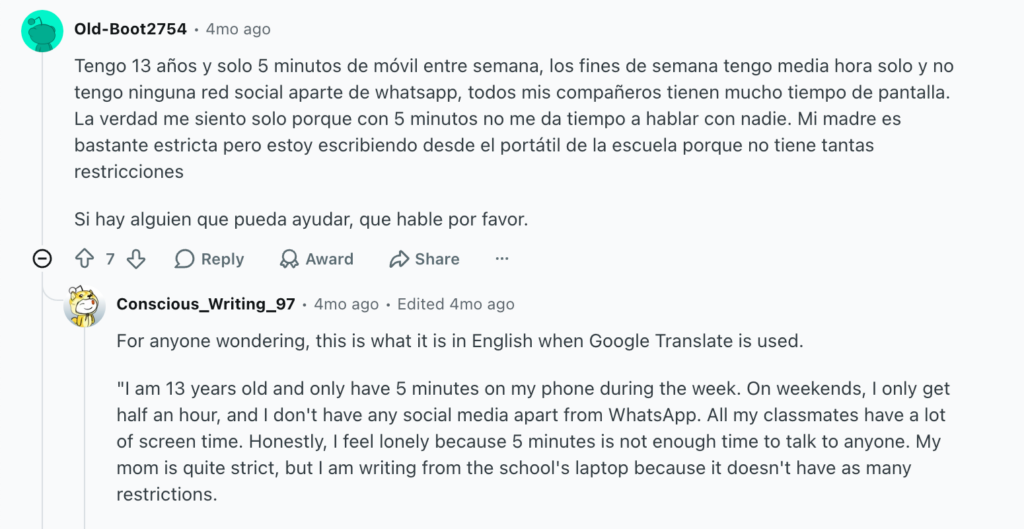
One 13-year-old wrote that they only had five minutes on their phone during the week and half an hour on weekends, with no social media except WhatsApp. They said that all of their classmates had much more screen time and that they felt lonely because five minutes was not enough time to talk to anyone. They were writing from a school laptop because it had fewer restrictions than home. This story is a clear example of how severe time limits can restrict a young person’s ability to maintain ordinary peer connection and leave them socially isolated.
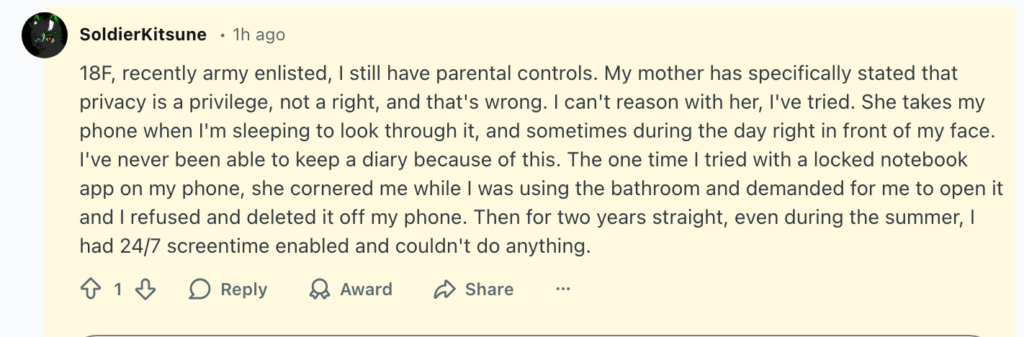
An 18-year-old woman who said she was recently army enlisted but still subject to parental controls. She wrote that her mother had explicitly told her “privacy is a privilege, not a right,” that her mother would take her phone while she was sleeping to look through it, and that when she once tried to use a locked notebook app, her mother cornered her in the bathroom and demanded she open it. After that, she said, she had 24/7 screen time enabled for two years straight, including during the summer. Her story shows how device management can merge with broader privacy invasion and emotional control, leaving the young person unable to keep even a diary or digital private space.
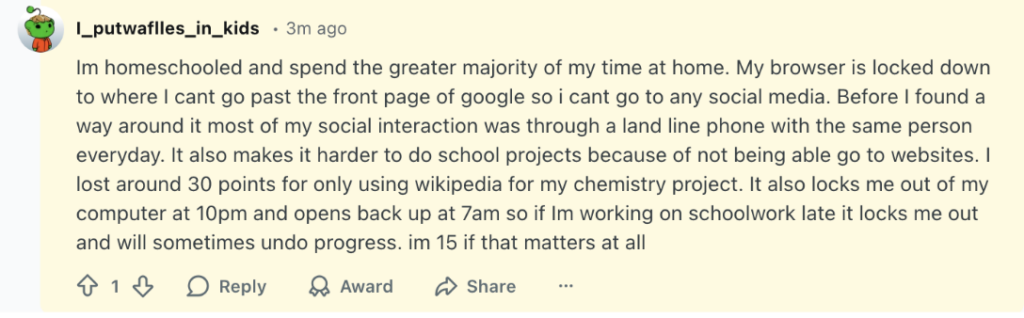
A 15-year-old wrote that they were homeschooled and spent most of their time at home, which made their device restrictions especially isolating. According to the comment, their browser was locked down so heavily that they could not get past the front page of Google or access social media, and before finding a workaround most of their social interaction came from talking to the same person every day on a landline. They also said the restrictions harmed their education: they could not access websites needed for school projects, lost around 30 points on a chemistry assignment because they had to rely only on Wikipedia, and were locked out of their computer at 10 p.m. until 7 a.m., sometimes losing work in progress if they were studying late. The story shows how device restrictions can combine social isolation with direct academic harm, especially for a child already spending most of their life in the home.
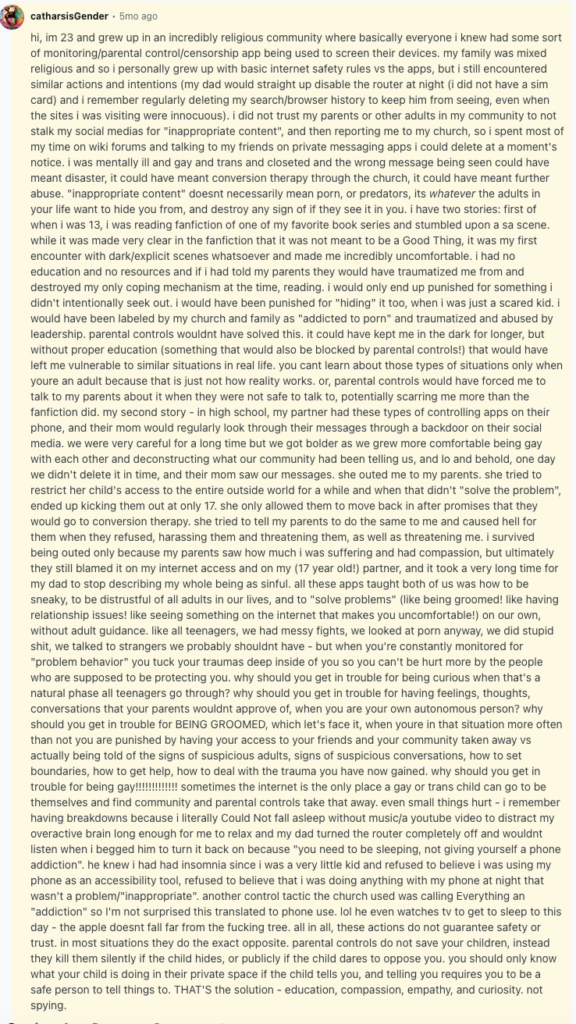
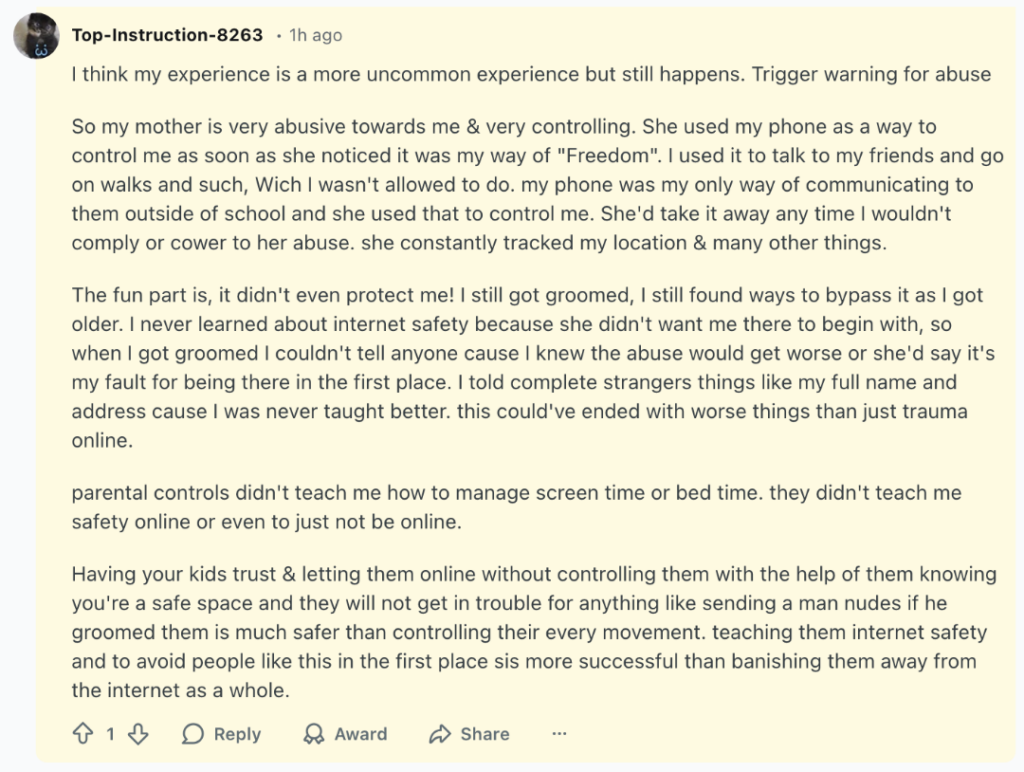
Another commenter described an abusive and highly controlling mother who used the phone as soon as she realized it gave the child a sense of “freedom.” The writer said the phone was their main way to talk to friends and stay connected outside school, since they were not allowed to go on walks or have normal independence, and that their mother would take it away whenever they did not comply or “cower” to the abuse. They also said she constantly tracked their location and used the device to control their movements and communication. The commenter went on to explain that this did not actually keep them safe: they were still groomed online, but because they had never been taught internet safety and knew disclosure would only make the abuse worse, they felt unable to tell anyone. Their story is especially striking because it shows device control not just failing to protect the child, but actively worsening their vulnerability by combining surveillance, isolation, fear, and lack of safe support.
A 23-year-old described growing up in an intensely religious environment where device monitoring, parental-control apps, and censorship were treated as normal. They wrote that even without full-time tracking software in their own home, their father would disable the router at night, and they regularly deleted search and browser history because they did not trust parents or other adults in their community not to inspect their online life and report “inappropriate content” to the church. As a closeted gay and trans teenager who was also struggling mentally, they said the wrong message being seen could have led to disaster, including further abuse or conversion therapy.
The commenter then described a second, more severe story from high school involving a partner whose mother used controlling apps and a backdoor into the child’s social media to read private messages. As the two teens became more comfortable being openly gay with each other, one missed deletion was enough for the partner’s mother to discover the messages and out the commenter to their parents. According to the post, the mother then tried to cut her own child off from the outside world, later kicked them out at 17, and only allowed them back on the condition that they attend conversion therapy. She also allegedly pressured the commenter’s parents to do the same. Looking back, the writer said these apps did not teach safety or responsibility. Instead, they taught both teenagers to be sneaky, to distrust adults, and to handle dangerous situations like grooming, relationship problems, and upsetting online experiences alone, because being honest would only lead to more punishment and isolation.