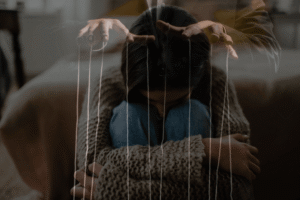


Violating privacy is one of the most common and prevalent forms of Parental Oppression, that so many young people are forced to deal with as a part of their everyday life growing up. This can include several aspects, such as reading private messages, unreasonable searches, device monitoring, overbearing supervision of friendships, sharing private information with others and emotional manipulation around normal boundaries. In extreme instances, parental violations of privacy can involve removing their access to their room, or ripping off bathroom doors/curtains, and denying any right to bodily privacy as well. On top of this, parents often share private information of their children, either directly with others, or by posting it online without the child’s consent. Living in a home where they have no right to privacy can drastically harm a child’s development, mental health, ability to form close friendships and be supported by others.
Parents usually justify their overbearing control with “safety” as the goal, though research has consistently shown when parents engage in overly invasive methods of monitoring and supervision, the child usually becomes more secretive, trusts their parents less, and can develop depressive symptoms from the stress. Although parents denying children privacy has been consistently associated with negative outcomes, this issue of parental oppression is still rarely taken seriously, with most individuals validating their behavior as “discipline”, “healthy supervision”, or “just parenting”. Young people seeking support from these types of parents are consistently labeled as “spoiled”, “ungrateful”, or even given a diagnosis of “Oppositional Defiant Disorder”.
Young people deserve a basic right to privacy, just as adults have, over their property, their living area, their bodies, their interactions with others, and their behavior. Children in oppressive homes in which their privacy is consistently and unreasonably violated deserve an escape from that life, in the same way that someone living in a physically abusive or neglectful home has. Severe privacy violations should be considered a form of child abuse, due to the potential for long-term negative impacts that it can have on a minor’s mental health, and the fact that parents who exert unreasonable control over privacy are likely going to be narcissistic and emotionally abusive in other ways.
In this webpage, the National Youth Rights Association explains types of parental privacy violations, the harms of parents violating privacy on youth, research into the effects of these privacy violations, and various stories (both published, and self-reported via social media), about the worst types of parental privacy violations.
Table of Contents
- Types of Privacy Violations by Parents
- Harms of Parental Violations of Privacy on Youth
- Research on the Effects of Parents Violating Privacy
- Cases and Stories of Parental Privacy Violations
- Social Media Self Reported Stories of Parental Privacy Violations
The National Youth Rights Association
If you’re interested in Youth Rights, consider volunteering with us. We are always looking for new members and would love to have you on board. If you have a personal story to share, of being a victim of parental violations of privacy, or about a general youth rights violation, consider sending us an email at nyra@youthrights.org. We’d love to help get your story out to the world.
Types of Privacy Violations by Parents
Interception of Private Messages – One common form of privacy violation is when a parent reads a child’s texts, direct messages, emails, social media conversations, or other private communications without the child’s consent (or by forcing that consent via coercion or threats of punishment). This can either happen through the parent sneakily accessing the messages via snooping, demanding access to the messages, or most commonly, through the use of device monitoring apps which defaultly give the parents access to the messages. This becomes harmful when the parent treats all communication as something they are automatically entitled to inspect at any time. This can make the child feel constantly watched and unable to speak honestly with friends, trusted adults, or romantic interests. Over time, the child may stop opening up to anyone at all because they assume every conversation will eventually be exposed.
Removing Access to Private Spaces – Another serious privacy violation happens when parents take away a child’s access to private space as a form of punishment or control. This can include removing bedroom doors, refusing to let the child close or lock doors, forcing them to stay in common areas, taking away access to their room, or otherwise making it impossible for them to have a place where they can be alone. Privacy is not just about secrecy; it is also about having a physical environment where a person can decompress, regulate emotions, think, change clothes, sleep, and exist without constant observation. When access to private space is removed, especially on a repeated basis, the child may feel exposed, powerless, and unable to mentally rest. It sends the message that even their most basic need for space and separation can be taken away at any time. This can also negatively impact the child’s relationships and connections with others, due to the fact that without private spaces, they also wouldn’t be able to talk on the phone with others in a private environment, which could lead to self censoring, and restricting their ability to open up to their close friends freely.
Removing Physical/Bodily Privacy – Some parents violate privacy by removing bedroom or bathroom doors, refusing to let children change clothes in private, barging in while they are bathing, or acting as though the child has no right to bodily privacy. In some cases, this behavior could even be considered sexual assault. Violations of bodily privacy can also include forcing physical closeness, commenting intrusively on the child’s body, refusing bodily boundaries, or acting as though the child’s discomfort does not matter. This can be especially harmful as children get older and begin developing a natural need for modesty, personal space, and bodily autonomy. Even when the parent frames this as discipline or transparency, it can create shame, anxiety, and the feeling that the child’s body is never fully their own. Young people living in a household without bodily privacy are shown that they are not entitled to control over who gets access to their personal space, which can create major issues in their relationships later in life.
Device Monitoring Apps – Another type of privacy violation occurs when a parent uses device managing apps to track every website, app, search, call, or keystroke on the child’s devices. These device monitoring apps/software often give parents complete access to the child’s internet history, social media, and most harmfully, private communication with their peers. This type of monitoring is invasive, and often used as a method of total, relentless, control. In these cases, the child may begin to feel that they are under surveillance rather than guidance. That can create fear, secrecy, and an unhealthy home environment where trust is replaced by constant suspicion.
Searching Bedrooms, Bags, or Personal Belongings – Parents can also violate privacy by routinely going through a child’s room, backpack, drawers, purse, or other belongings in a way that goes beyond supervision and becomes invasive control. The issue is especially serious when the searches are done unpredictably, obsessively, or as a show of power or dominance. A child in this situation may never feel settled in their own space, because nothing is truly theirs and any part of their life can be inspected without warning.
Reading Personal Journals, Diaries and Documents – A diary or journal is often one of the only places where a child can process feelings privately. When a parent reads it without permission, especially repeatedly, this shows the child that they have no right to personal boundaries and privacy around their parents. The message is that the child has no right to an inner life that belongs to them alone. This can be especially damaging if the parent then confronts, mocks, punishes, or shares what they found. A child whose journal is invaded may stop reflecting honestly, start hiding emotions more deeply, or feel that even their thoughts are not safe.
Demanding passwords to all accounts – A parent may violate privacy by insisting on unrestricted access to every account the child has, including email, social media, personal online documents/projects, notes apps, cloud storage, and messaging platforms, without any room for any boundaries. The issue becomes more serious when the parent uses that access as a routine way to inspect, control, and intervene in the child’s private life. This can make the child feel that there is no difference between being supervised and being owned. This also poses a security risk if the child has sensitive/confidential information on any of their devices/accounts
Listening in on private conversations – Privacy can also be violated when a parent deliberately eavesdrops on phone calls, listens at doors, reads over the child’s shoulder, or uses device managing software to hear private conversations. This is especially harmful when the child is speaking with a friend, counselor, mentor, or other person they rely on for emotional support. The child may stop seeking help, stop being honest, or become afraid of forming relationships because privacy is never respected long enough for real trust to grow. This is especially damaging when the child is seeking support and help from the controlling environment they are living in due to their parents’ oppression.
Location Tracking – Location sharing or GPS monitoring can become a privacy violation when it is used excessively, obsessively, or indefinitely, especially in ways that deny the child any independent movement appropriate for their age. The issue is not just whether the parent knows where the child is, but whether the child is allowed any normal experience of space, trust, and self-direction. Constant location surveillance can teach the child that they are never allowed to exist unobserved, even when they are doing nothing wrong.
Sharing the child’s private information with others – A parent may violate privacy not just by gaining access to personal information, but by exposing it. This can include telling relatives, family friends, church members, teachers, or social media audiences about the child’s private thoughts, mistakes, crushes, medical issues, mental health struggles, or embarrassing moments. Even if the parent claims they are joking, venting, or asking for advice, the child may feel humiliated and betrayed. Privacy is not only about secrecy from the parent, but also about whether the parent respects the child enough not to turn their private life into public information. One of the most common and widely related to examples of this, is a parent airing out a child’s most embarrassing moments in front of everyone, just to get a laugh out of family members or friends, with complete disregard for the impact it has on the young person. This is especially an issue when a child confides something painful, such as bullying, self-esteem struggles, sexual orientation, relationship problems, or mental health issues, and the parent immediately tells others without permission. The child may feel exposed at the very moment they were trying to seek support, and can make them far less likely to ask for help again, because the cost of disclosure becomes humiliation and loss of control rather than safety.
Publicly posting the child’s personal life online – In the social media era, one major form of privacy violation is when parents post photos, videos, medical details, punishments, emotional breakdowns, school problems, or deeply personal stories about their children online without meaningful consent. This can be especially invasive when the content is embarrassing, emotionally exposing, or permanently searchable. The child may have no control over how they are portrayed, who sees it, or how long it stays online. In these cases, the parent is not just violating privacy in the moment, but potentially shaping the child’s digital identity for years.
Interrogating the child about relationships – Parents can also violate privacy by obsessively questioning a child about friendships, romantic interests, sexuality, or peer interactions in a way that is intrusive and overly controlling. This may include demanding access to every conversation, forcing the child to reveal intimate details, or humiliating them over crushes or relationships. A child subjected to this kind of interrogation may begin to associate closeness and trust with exposure and shame, making healthy social development harder. In severe cases, this can dissuade the child from even wanting to enter relationships in the first place, out of fear of the reaction that their parents would have or constant interrogation that they would face.
Overbearing Supervision of Internet Access – A parent can violate a child’s privacy by supervising internet use in a way that turns into constant control. This can include monitoring every website visited, demanding to watch the child use the internet in real time, blocking broad categories of harmless content, requiring the child to explain every search, or reacting to ordinary online activity as though it is automatically suspicious. The problem becomes especially serious when the supervision is so intense that the child has no practical ability to explore interests, learn independently, communicate privately, become part of online communities that reflect their identity or develop judgment of their own. Instead of teaching safe internet use, this kind of overbearing control teaches the child that curiosity is dangerous and that independent access to information is something they are not allowed to have.
Overbearing Supervision of Interactions with Peers – Parents can also violate privacy by excessively monitoring, controlling, or inserting themselves into a child’s friendships and peer relationships. This may include reading all conversations with friends, demanding constant updates about every interaction, listening in on calls, refusing to let the child spend time with peers unless the parent can fully supervise it, or treating normal friendships as threats to parental control. This is especially invasive when the child is given no room to form relationships that exist outside the parent’s direct management. Over time, this can make friendships feel stressful and unsafe rather than supportive, and it can interfere with the child’s ability to build trust, social confidence, and independent social identity. Along with this, it can damage the child’s ability to form long-term friendships, due to the fact that their friends may be uncomfortable over the parent’s behavior, and will therefore limit their interactions with the child.
Overbearing Supervision of Interactions with Family Members – A parent may violate privacy by controlling or monitoring the child’s contact with siblings, extended family, or other relatives in ways that are excessive and emotionally restrictive. This can include demanding to know everything the child says to grandparents, aunts, uncles, cousins, or the other parent, forbidding private conversations with certain relatives, pressuring the child to report back on what was said, or becoming angry if the child seeks emotional support from family members outside the immediate household. In these situations, the issue is not just supervision but ownership over the child’s relationships. The child may begin to feel that even family connection is not truly theirs to have, because every relationship must be filtered through parental permission and oversight.
Accessing medical or therapeutic disclosures – Parents may also violate privacy by using information from therapy, medical visits, or emotional disclosures as a way to shame, control, or punish the child. Even where parents legally have access to some information, the emotional harm comes from using deeply personal vulnerabilities against the child. If a child believes that anything said in a vulnerable setting will later be weaponized at home, they may stop being honest in treatment or stop seeking help at all.
Making privacy impossible through household control – Sometimes privacy is violated not through one single act, but through the overall structure of the home. The child may not be allowed to close doors, keep possessions to themselves, speak without being overheard, spend time alone, or interact privately with anyone. In these homes, privacy is systematically denied. The child grows up in an environment where personal boundaries are not recognized as legitimate at all.
Punishing Normal Boundaries – The violation becomes even more severe when the parent does not just invade privacy, but punishes the child for trying to have any. This can include anger over locked doors, accusations of secrecy when the child wants time alone, ridicule for journaling privately, or punishment for clearing browser history or using personal passwords. In these situations, privacy itself is treated as wrongdoing. The child learns that wanting boundaries is considered suspicious or disobedient.
Weaponizing discovered private information – Sometimes the privacy violation is compounded when the parent later uses what they found as leverage. They may bring it up in arguments, mock the child for it, tell others, increase restrictions, or use it to manipulate the child into obedience. In these cases, the invasion of privacy becomes part of a broader pattern of emotional control. The child learns that anything private can become ammunition, which can create intense fear around honesty and vulnerability.
Forcing disclosure of private thoughts or feelings – Some parents do not allow children to keep anything to themselves emotionally. They may demand that the child explain every feeling, every crush, every insecurity, every private thought, or every interaction, and become angry if the child wants to keep something personal. This can become abusive when the child is treated as suspicious or disloyal simply for wanting emotional privacy. The result is that the child may feel they have no protected internal space where they are allowed to think or feel independently.
Privacy Violation by Emotional Manipulation – Parents can also violate privacy without searching a room or reading a message at all, by using guilt, shame, fear, or emotional pressure to force the child to disclose private information or submit to intrusive control. This can include guilt tripping the child for wanting privacy, accusing them of being secretive or unloving if they do not share everything, acting hurt until the child gives in, or framing boundaries as betrayal. In these situations, the child may technically “choose” to tell the parent things, but the choice is coerced through emotional manipulation rather than freely made. This is especially harmful because it teaches the child that privacy itself is selfish, and that protecting their inner life will always come at the cost of guilt, conflict, or emotional punishment.
Harms of Parental Violations of Privacy on Youth
Chronic anxiety and hypervigilance – When a child knows that their messages, room, belongings, thoughts, or movements may be inspected at any time, they may begin living in a constant state of alertness. Instead of feeling relaxed in their own home, they learn to anticipate intrusion. This can create chronic anxiety, tension, and hypervigilance, because the child never fully knows when their boundaries will be crossed next. Over time, even ordinary privacy can start to feel impossible, and the child may struggle to calm down because they have learned that they are always being watched.
Increased secrecy and concealment – Parents often justify privacy violations by saying they want honesty, but excessive intrusion often has the opposite effect. A child who feels they cannot keep anything private may become more secretive, not less. They may create hidden accounts, lie about harmless things, conceal emotions, or become highly skilled at covering their tracks. This can make it so it is harder for the child to express concerns about potentially legitimate issues in their private life, for fear of punishment because of their secrecy.
Damage to the child’s sense of autonomy – Privacy is closely tied to autonomy. A child gradually develops into their own person by having space to think, feel, reflect, communicate, and make sense of life internally. When parents repeatedly invade that space, the child may struggle to feel like a separate person with rights and boundaries of their own. They may begin to feel that their thoughts, relationships, body, and environment are all under someone else’s control. This can weaken their ability to trust their own judgment and make independent decisions later in life.
Difficulty forming healthy boundaries – Children learn what boundaries are by experiencing whether their own are respected. If a child grows up in a home where doors are removed, journals are read, private conversations are overheard, and personal information is exposed, they may never develop a clear sense of what healthy boundaries look like. Later in life, they may either tolerate invasive behavior from others because it feels normal, or become extremely guarded because they expect all closeness to lead to intrusion. In either case, parental privacy violations can distort the child’s sense of what respectful relationships should feel like.
Shame around having a private inner life – A child whose privacy is repeatedly violated may start to feel guilty simply for wanting privacy at all. If parents treat privacy like deception, secrecy, disrespect, or rebellion, the child may absorb the message that independent thoughts, feelings, and personal space are shameful. This can create long-term discomfort with journaling, private reflection, setting boundaries, or asking for confidentiality. The child may come to believe that they owe full access to anyone who claims authority or love over them.
Inhibition of emotional expression – When a child knows their private writing may be read, their messages may be checked, or their vulnerable disclosures may be repeated to others, they may stop expressing emotions honestly. They may avoid writing things down, avoid opening up to friends, censor themselves in therapy, or suppress feelings rather than risk exposure. This can make it much harder for the child to process distress in a healthy way. Instead of learning emotional honesty, they learn emotional concealment.
Social isolation and weakened peer relationships – Overbearing parental monitoring of friendships can damage the child’s ability to build and maintain close relationships with peers. If every conversation is read, every call is listened to, and every friendship is heavily monitored, the child may struggle to create the kind of trust and openness that friendships require. This is especially the case when it comes to the child seeking support and venting about issues involving their parents. If they have no ability to express themselves to others without their parents’ overbearing control, then they have no ability to safely seek support from that control. Friends may also pull away if they feel the parent is always present or intrusive. Over time, the child may become isolated, either because relationships feel too risky or because they have not been allowed enough privacy to develop them normally.
Difficulty safely opening up to others about problems at home – Children whose parents constantly monitor their messages, calls, internet use, friendships, and personal disclosures may have a much harder time safely reaching out for support. If the child knows that a parent might read their texts, overhear their conversations, demand access to their accounts, or punish them for talking about the home environment, they may begin to feel that there is no safe way to confide in anyone. This can keep them from venting to friends, asking trusted adults for advice, disclosing abuse, or seeking emotional support when they are overwhelmed. Even when the child desperately wants help, the parent’s surveillance and overbearing control can make honesty feel dangerous. Over time, this can leave the child isolated, emotionally bottled up, and trapped in the belief that they have to manage everything alone because any attempt to reach outward could be discovered and turned against them.
Impaired identity development – Children and adolescents need some private space to experiment with identity, beliefs, interests, values, and relationships. Privacy helps them figure out who they are apart from their parents. When that space is repeatedly invaded, the child may struggle to develop a strong and independent sense of self. They may shape themselves around what is safest to reveal rather than what is true. This can leave them confused about their own identity, especially during adolescence, when self discovery is particularly important.
Emotional exhaustion – Living under constant surveillance or fear of intrusion can be mentally exhausting. The child may spend large amounts of energy thinking about what to hide, what not to say, what might be discovered, and how to avoid punishment or humiliation. That constant mental management can wear them down over time. Even when the parent is not actively invading privacy in a given moment, the child may still feel burdened by the ongoing possibility of it, which creates a draining emotional environment.
Sleep and relaxation problems – A child who does not have a room they can retreat to, cannot close a door, or fears that a parent may come in at any time may struggle to truly relax. Privacy violations can therefore interfere with rest, sleep, and emotional decompression. A child may not feel safe changing clothes, crying, calming down, or simply being alone. The lack of a protected physical and mental space can make the home feel more like a place of exposure than of recovery.
Learned helplessness – If a child repeatedly tries to create normal boundaries and those boundaries are mocked, punished, or overridden, they may begin to feel that resistance is pointless. They may stop trying to protect their privacy because experience has taught them that their limits will not be respected anyway. This can create a deeper sense of helplessness, where the child no longer expects to have control over their own life. That feeling can extend into adulthood and affect how they respond to future invasions of privacy or control by others.
Increased conflict and resentment – Parental privacy violations can poison the emotional climate of the home. Even if the child cannot openly protest, they may feel deep anger, resentment, or emotional distance toward the parent. This can lead to frequent conflict, passive withdrawal, or a breakdown in the relationship over time. This also contributes to the overall home environment for the child being toxic, which can create severe issues while they grow up.
Distorted understanding of love and control – When privacy invasion is consistently framed as love, protection, or good parenting, the child may grow up confused about the difference between care and control. They may begin to believe that people who love them are entitled to full access to their messages, body, emotions, location, and relationships. This can make them more vulnerable to controlling friendships or romantic relationships later in life, because invasive behavior feels familiar and may even be mistaken for concern.
Difficulty asking for help safely – Children whose parents monitor communications or retaliate for disclosure may become afraid to reach out to anyone for help. They may avoid contacting trusted adults, counselors, mentors, or friends because they worry the parent will find out or punish them. This is especially serious when the child is struggling with mental health issues, abuse, bullying, or other crises. Privacy violations can cut off access to support by making help-seeking itself feel unsafe.
Long term trauma responses – In more severe cases, repeated privacy violations can become traumatic, especially when they are tied to humiliation, coercion, emotional abuse, or bodily boundary violations. The child may later experience strong reactions to people entering their space, touching their belongings, reading over their shoulder, asking invasive questions, or demanding access to private information. What looks small from the outside may carry a much larger emotional charge because it echoes years of feeling exposed and powerless.
Loss of a sense of ownership over self – Perhaps one of the deepest harms is that the child may stop feeling that they truly belong to themselves. If their thoughts are inspected, their room is searchable, their body is not given privacy, their relationships are monitored, and their disclosures are forced, they may internalize the idea that nothing about them is fully theirs. This can damage selfhood at a fundamental level. The child may grow up not only feeling watched, but feeling that they do not have a full right to exist as a separate person with private boundaries and inner freedom.
Depressive symptoms and emotional decline – Parental violations of privacy can also contribute to depressive symptoms, especially when the child experiences the intrusion as controlling, mistrustful, or inescapable. Research on parental privacy invasion has framed this behavior as a form of psychological control, and one study specifically examined parental privacy invasion as a theoretical contributor to adolescent depressive symptoms. Related work has also found that adolescents’ negative reactions to monitoring, including feeling over-controlled or as though their privacy is being invaded, are linked to worse emotional outcomes, including depressive symptoms. The harm here is not just that the child feels annoyed or embarrassed. It is that chronic surveillance and invasive control can make the child feel powerless, emotionally trapped, and unable to develop a secure sense of self, all of which can feed sadness, hopelessness, withdrawal, and other depressive symptoms over time.
Research on the Effects of Violating Privacy
Research on adolescence consistently suggests that privacy is not a preference that parents can choose to give as a privilege, but part of normal development. Reviews of parental monitoring and adolescent development note that adolescence involves a growing need for privacy, autonomy, and independent social relationships, and that parent-child relationships need to be realigned as those needs increase. When parents respond to that developmental shift with intrusive surveillance or privacy invasion instead of boundary setting, researchers generally treat that as a potentially harmful mismatch rather than it being justified supervision.
One of the clearest findings is that parental privacy invasion can backfire by reducing openness rather than increasing it. A 2013 longitudinal study in PubMed, is explicitly titled, “I still haven’t found what I’m looking for”: parental privacy invasion predicts reduced parental knowledge. That same line of research has also been linked to increased adolescent secrecy, meaning that when parents use privacy-invasive strategies, children may hide more rather than less. Intrusive monitoring can undermine the very trust and disclosure that parents are often trying to create.
Research also connects parental privacy invasion with worse family functioning. A 2020 qualitative study on parent and child perspectives reported that privacy invasions have been associated with increased adolescent secrecy and deficits in family functioning, including problematic communication, behavior, and relationships. That matters because the harm is not limited to the child feeling embarrassed in one moment. The research points to a broader pattern in which intrusive parental behavior can damage communication inside the family and make the parent-child relationship more conflictual and less secure.
Several studies also suggest that privacy violating or overly restrictive monitoring is associated with problematic digital outcomes rather than healthier ones. A 2023 mixed-method study on early adolescent social technology use found that restrictive parental monitoring of digital media was positively associated with problematic internet use. A 2022 systematic review of digital parenting similarly treated privacy invasion as a meaningful category in the literature and noted ongoing concern that risk-heavy, surveillance-oriented approaches can be problematic for teen development.
The research also supports the idea that privacy invasion can harm a young person’s sense of agency and autonomy. A 2024 Cambridge handbook chapter summarizing this literature states that privacy serves protective functions by allowing adolescents to experience a sense of agency and control over their lives. That is important because it suggests that when parents make privacy impossible, children may turn to secrecy not simply out of rebellion, but as a way to reclaim some control over their lives which was taken from them. More broadly, adolescent development sources emphasize that privacy and personal space are bound up with identity formation and growing independence, so repeated privacy violations can interfere with those normal developmental tasks.
There is also evidence linking privacy invasive parenting to depressive symptoms and psychological distress. A 2018 thesis focused specifically on Parental Privacy Invasions and Adolescent Depressive Symptoms noted that parents’ use of psychological control is associated with several negative outcomes, including adolescent depressive symptoms, and examined privacy invasion as part of that broader pattern of intrusive control. This supports a broader conclusion in the literature: privacy violations do not just create inconvenience or annoyance; they can contribute to emotional strain, depression, and roadblocks in development when they are experienced as domination, mistrust, or the denial of autonomy.
Cases and Stories of Parental Privacy Violations
In the following video, NYRA President Zane Miller interviewed Joule, a 17 year old teenager in the UK about personal privacy violations she had experienced from her mother.
In her story, Joule described that her mother would often ransack her room with no warning, leaving all of her belongings strewn across the floor. Joule discussed that, because of her neurodivergancy, her belongings being gone through had an especially negative impact on her mental state, making her feel uncomfortable in her home. Along with this, her mother used location tracking obsessively to track Joule’s every move. Her mother used the location tracking as a tool of controlling Joule’s relationships with others. Joule would often go and hang out with her female partner, causing her mother to become angry, verbally harass her over this fact, and attempt to punish her by preventing her from seeing this partner. Joule also recounts how her mother would often interrogate her about her relationship with her partner, and make random accusations about them sleeping together, which just shows another instance of her mother having no respect for her boundaries, and verbally attacking her over private things.
Shari Franke — Shari Franke’s story became one of the most visible modern examples of parental privacy violation through family vlogging. As a child, she grew up on her mother Ruby Franke’s YouTube channel, 8 Passengers, where ordinary family life was filmed for millions of viewers. In later interviews around her memoir, Shari said she had “witnessed the damage of what happens when your life is put online” and argued that there is “no ethical way to do it.” People reported that when she was younger, her mother sometimes bribed her to share private moments on camera, and that as she got older she became increasingly uncomfortable with how much of her life was being turned into public content. Her story is important because it shows a form of privacy violation that is not just about a parent reading a diary or checking a phone, but about a parent making a child’s personal life into public property.
Chad Franke — Chad Franke has also described privacy violations inside the same household, but in a more direct and physical way. In 2026, People reported Chad’s public allegations that his mother, Ruby Franke, had removed his bathroom door as punishment, and forced him to sleep on a beanbag for talking back, along with other harsh disciplinary measures. Even on its own, taking away a bathroom door is a striking example of a parent turning privacy deprivation into discipline and control. In his account, privacy was not treated as a basic part of dignity or development, but as something that could be stripped away to enforce obedience. His story illustrates how parental privacy violations can be woven into a broader pattern of domination and humiliation inside the home.
The 13-year-old girl highlighted in Time’s report on public shaming — In 2015, Time reported on a widely discussed case involving a 13-year-old girl who took her own life after being publicly humiliated by her father. According to the article, the father cut her hair as punishment and made a video of the incident, which was later shared online. That case became part of a broader national discussion about parents who use the internet and social media to shame their children. The story stands out because it shows the devastating impact of parental privacy violations.
Anonymous survivors describing “phone raids,” “room raids,” and diary-reading — Not every privacy-violation story becomes a headline, but survivor accounts repeatedly describe the same pattern. In The Mighty’s roundup on abusive parents, one contributor described growing up with “zero to no privacy,” including “phone raids, room raids, having the door taken off the hinges,” and said that as an adult they could see this behavior “wasn’t always ‘for my protection’” but was sometimes “abuse hidden under the guise of safety.” These stories capture the everyday reality of privacy violations that many children experience: not one dramatic event, but a home life built around constant intrusion, search, and surveillance.
Social Media Self Reported Stories of Parental Privacy Violations
Reddit Poster Who was Mocked and Harassed for Private Journal Entries — In this self-reported story, the writer described growing up with adoptive parents and using journaling as a private way to process arguments and frustrations. After getting his first computer, he began writing personal journal entries in Word, including one where he vented that his father always thought he knew what was best for him. He believed those entries were private. A few days later, his mother pulled him aside and aggressively confronted him about what he had written, mocking him and yelling at him for questioning his father’s authority. He wrote that he was mortified and froze while she verbally berated him, realizing in that moment that she had gone through something he had believed belonged only to him. What made the incident so lasting was the damage it did to his ability to feel safe having any private inner life at all. He wrote that after that confrontation, he never journaled the same way again, and even years later found himself paranoid about privacy, frequently deleting browser history and the recycling bin long after he had computers his parents could not access. He also described the event as one of several formative moments that left him with a lasting sense of isolation and distrust, and by the end of the post said he had decided to go low-contact and seek professional help.
Reddit poster whose mother wrote inside her private diary — In one self-reported story on Reddit, a poster described reaching the middle of her diary and realizing the handwriting had changed. According to her post, it was her mother’s writing, inserted directly into a journal where she had been processing bullying, fear, sadness, and thoughts of death. Instead of respecting the diary as a private space, the mother allegedly turned it into a place to defend herself and reassert control. The account stands out because it was not just a case of a parent secretly reading a child’s writing. The parent allegedly entered the diary itself, turning the child’s most private emotional outlet into a confrontation and making even private reflection feel unsafe.
Reddit poster whose mother read her journal at 14 and replied in it — In another Reddit account, a user wrote that when she was 14, her mother went into her bedroom, read her journal entries, and then wrote responses back into the journal. The poster said that years later, now in her thirties, she was still low-contact with her mother and still remembered the violation clearly. What makes this story especially striking is that the invasion did not end with discovery. The mother allegedly used the journal as a way to insert herself into the child’s inner life and take control of what was supposed to be a private place for thought and emotion.
Reddit poster who said they were never allowed real privacy at home — In this self-reported account, the writer described living with a mother who openly treated privacy as something they were not entitled to. According to the post, they could not even be in their own room without being criticized: if the door was closed, they were accused of being antisocial, and if it was open, they were pressured to come back out and be with the family. They said their mother would enter the room while they slept, search through their belongings when they were at school, throw away clothes, shoes, gifts, and other possessions she did not approve of, and go through their computer, texts, emails, and social media. The writer also said they had to hide their computer in a dresser to keep any part of their digital life private.
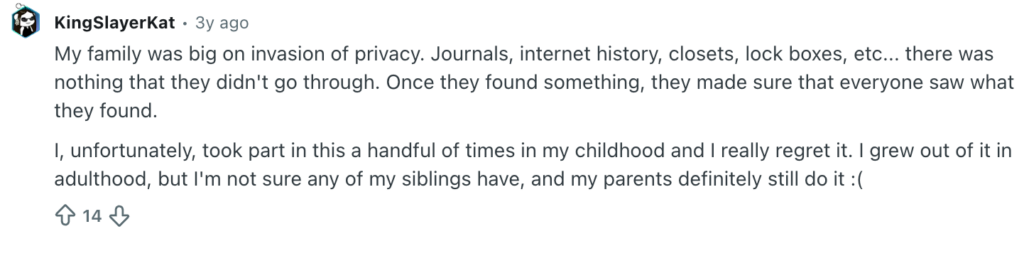
Reddit poster whose family went through journals, internet history, closets, and lock boxes — In a discussion about mothers reading journals, one Reddit user wrote that their family was “big on invasion of privacy,” saying there was “nothing that they didn’t go through,” including journals, internet history, closets, and lock boxes. The same person said that once the family found something, they made sure “everyone saw what they found.”
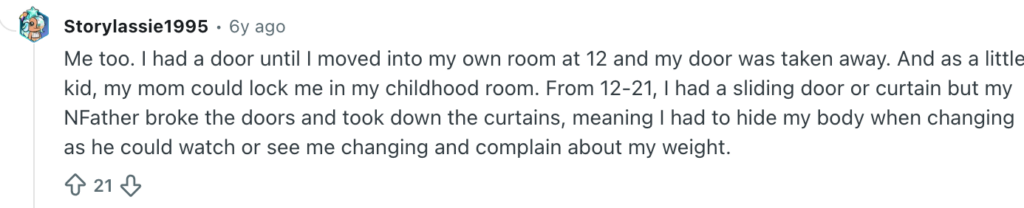
Reddit poster whose father took the bedroom door and curtains — In another self-reported Reddit story, a poster described losing their bedroom door at age 12 and later having even sliding doors and curtains removed after the father broke them. The poster wrote that this meant they had to hide their body while changing because the father could watch them and comment on their weight.
Reddit poster whose room was searched and door broken down — In another Reddit thread about “small privacy violations,” one user described having no lock on the bedroom door and said the door would be broken down or taken off the hinges if they tried to hide in their room. The same post also described regular room searches.

More Reddit Stories of Parental Privacy Violations
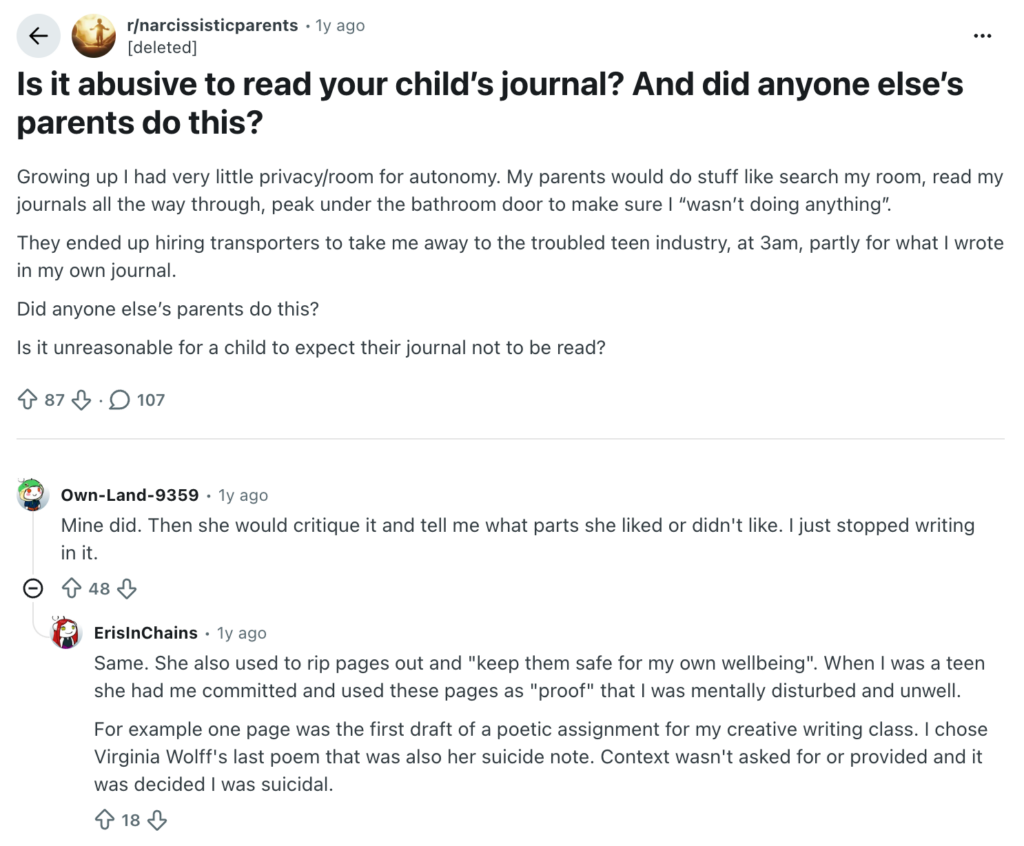
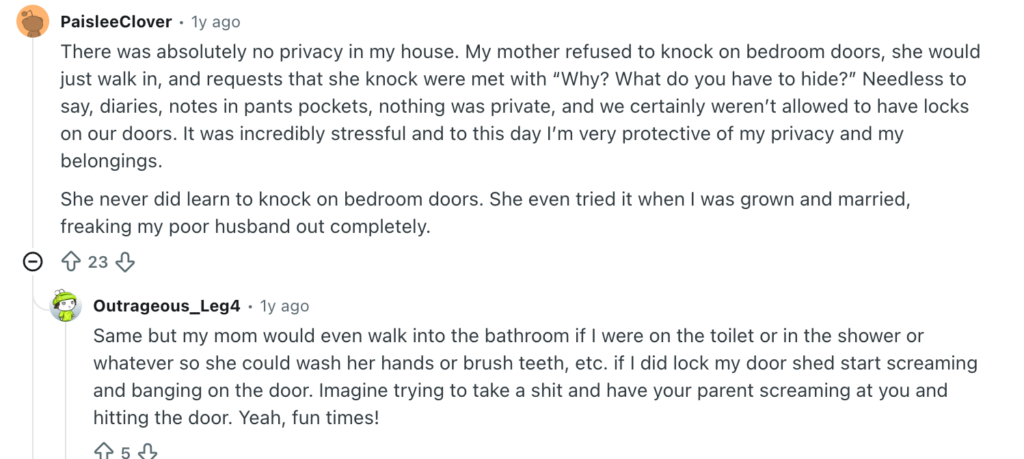
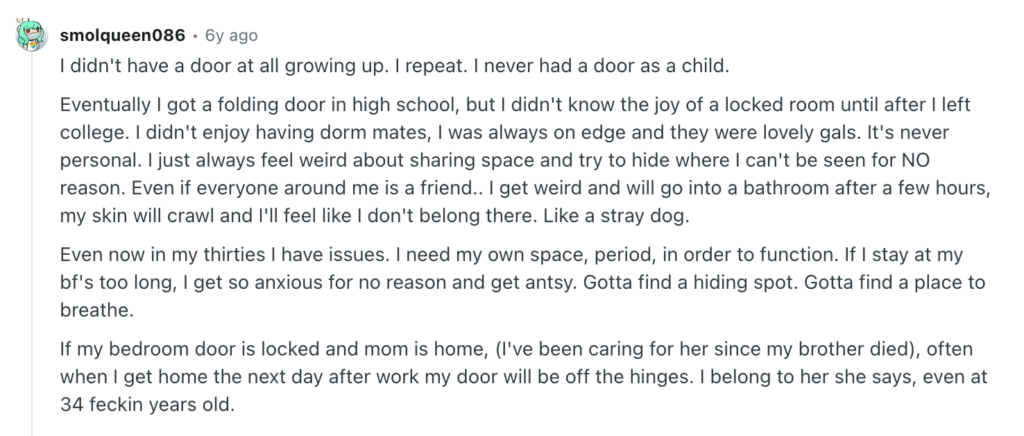
While these stories are only self-reported, so there is a chance they could be exaggerated or not entirely true, the fact there are so many of them and they all follow the same common themes speaks volumes about how much of an epidemic that parental oppression actually is. Every time a thread on reddit about parental privacy violations opens up, so many young people flock to the replies to share their similar stories of what happened in their lives growing up, and how it affected them. And despite this, there is little to no coverage of this in the media. The only place that these stories can really be found is over social media, because in communities like these are some of the only places where young people facing extreme parental oppression and privacy violations are actually validated for their concerns instead of being told that their parents’ behavior is simply “discipline” or “just parenting”.
In order to fight against this epidemic, it is important that extreme parental privacy violations such as these be considered abusive, and grounds to remove a child from their oppressive parents. Because these privacy violations can have long lasting, traumatic effects on the development, mental health, and social life of young people, it is imperative that young people have a pathway for escaping these oppressive home situations.