

Having equal access to businesses and public spaces is an important part of personal freedom as a young individual. This includes the ability to enter certain stores, shopping centers, attend concerns, and more. However, in the United States, young people are often rejected from entering certain businesses solely due to their age. These restrictions are oftentimes put in place for no particular reason other than the fact that business does not trust that specific age group to not cause trouble for them.
Along with that, many businesses such as Banks, Ridesharing apps, and online stores, refuse service to minors. When businesses refuse service to minors, this is usually because minors have limited ability to enter contracts. However, various businesses such as Hotels or Car Rental Companies refuse service to young adults, usually under 21 years of age, but sometimes up to 25 years of age. These companies view young people under a stereotypical, untrue lens that they are inherently destructive, troublemakers, unreliable and untrustworthy.
NYRA advocates for youth access rights in public spaces regardless of their age by promoting fair rules while also recognizing that young people are capable of responsibly participating in society.
Table of Contents
- Federal Laws on Age-Based Business Discrimination
- State Laws on Age-Based Business Discrimination
- Types of Business Discrimination Against Youth
- Statistics on Youth Bans in Businesses
- Age Restrictions on Concerts and Conventions
- Youth-Targeted Defense Measures
- Online Business Restrictions
- Court Cases on Age Discrimination
- Conclusion
Federal Laws on Age-Based Business Discrimination
There is no single federal law that prohibits age discrimination against young people in public spaces. The Civil Rights Act of 1964 prohibits discrimination in public spaces based on race, color, religion, and national origin. However, age is not included as protected.
The Age Discrimination in Employment Act of 1967 protects individuals who are 40 years of age and older and discrimination in employment. It does not protect young people, and it also does not apply to customers interested in entering an established business.
Because of this legal gap, businesses are unfortunately fully able to prevent individuals of a certain age from entering unless state laws provide additional protection.
State Laws on Age-Based Business Discrimination
State laws play a significant role in determining if age discrimination in businesses is allowed. Some states include age as protected in their public accommodation statutes. However, many of these laws have exceptions that allow businesses to place restrictions on youth.
Below are states that include age in their public accommodation statutes:
- Alaska – Alaska Stat. § 18.80.230
- California – California Civil Code § 51 (Unruh Civil Rights Act)
- Colorado – C.R.S. § 24-34-601
- Connecticut – Conn. Gen. Stat. § 46a-64
- Delaware – Del. Code Title 6 § 4504
- Illinois – 775 ILCS 5/5-102 (Illinois Human Rights Act)
- Maine – Me. Rev. Stat. Title 5 § 4591
- Maryland – Md. Code, State Gov’t § 20-304
- Massachusetts – Mass. Gen. Laws Ch. 272 § 98
- Minnesota – Minn. Stat. § 363A.11
- Nevada – Nev. Rev. Stat. § 651.070
- New Hampshire – N.H. Rev. Stat. § 354-A:17
- New Jersey – N.J. Stat. § 10:5-12
- New Mexico – N.M. Stat. § 28-1-7
- Oregon – ORS 659A.403
- Rhode Island – R.I. Gen. Laws § 11-24-2
- Vermont – 9 V.S.A. § 4502
- Washington – RCW 49.60.215
Read more about State Public Accommodation Laws
Even in these states, the law often allows businesses to place restrictions on youth depending on the situation.
Types of Business Discrimination Against Youth
Business discrimination can occur in many ways. If a business is restricting youth access, instituting parental chaperoning policies, or refusing services to young people, the business is engaging in business discrimination. the following types of business often have policies that restrict youth:
Malls – Malls are iconically known as a hangout location for teenagers, and for good reason. Malls offer shops, food, and other activities, all within walking distance, which makes them perfect locations for teenagers to get together with their friends. However, recently, we have seen an explosion of malls banning or restricting youth access in some capacity. These usually present themselves as mall “youth curfews”, where unaccompanied minors are not allowed in the mall after a certain time of day, or “Parental Guidance Policies”, where minors are only allowed to enter the mall if they are with an adult. These policies are blatant age discrimination, and hinder the abilities of teenagers to hangout in public and connect with each other, contributing to youth isolation.
For example, Willowbrook Mall in Houston, Texas recently became one of the most widely discussed examples of a mall implementing a youth restriction policy. The mall introduced a “Parental Guidance Required” rule requiring anyone 17 or younger to be accompanied by an adult age 21 or older after 2 p.m. on Saturdays. Security officers were stationed at entrances to check identification. Memorial City Mall in Houston, Texas also adopted a similar youth supervision policy shortly after Willowbrook Mall’s restrictions received public attention. Memorial City implemented temporary curfew-style rules requiring minors to either leave the property after certain hours or remain accompanied by a supervising adult.
While these policies were made to be temporary, several malls across the United States have permanent or long-standing youth escort policies that apply every weekend, every evening, or even daily. Many of these policies have existed for years rather than being temporary responses to specific incidents. For example, Mall of America in Bloomington, Minnesota has one of the oldest and most extensive permanent parental escort policies in the country. Its policy has existed in some form since the 1990s, and requires teens under 16 to be with an adult 21+ at all times.
Book Stores – Despite bookstores often being associated with education, literacy, and youth learning, many bookstores and similar retail spaces impose restrictions on young people based solely on age. Some bookstores prohibit groups of teenagers from entering without adult supervision, monitor minors more aggressively than adult customers, or remove youth from seating areas for simply socializing or browsing for extended periods of time. In some cases, young people are treated as potential shoplifters or disturbances by default, leading to increased surveillance, profiling, and restrictions that adult customers are not subjected to.
Concerts and Conventions – Concert venues, gaming conventions, anime conventions, and other entertainment events frequently place age-based restrictions on youth attendance, even when the events themselves are heavily marketed toward younger audiences. Many events require minors to be accompanied by a parent or guardian, restrict entry after certain hours, or completely ban unaccompanied minors from attending. Some venues also require attendees under 18 to purchase additional chaperone passes or remain under direct adult supervision at all times, limiting the ability of teenagers to independently participate in entertainment, fandom, and social events that are culturally centered around youth interests. Along with this, many concerts or conventions that serves alcohol ban anyone under 21 from entering at all, for the sole purpose of making the sale of alcohol easier.
Stores – Many retail stores impose policies specifically targeting teenagers and minors, including limiting the number of youth allowed inside at once, banning backpacks, enforcing bag checks, or removing young people who are perceived as “loitering.” Some shopping centers and large chain stores have implemented youth escort policies or reserve the right to deny entry to minors during evenings and weekends. These restrictions are often enforced broadly against all young people regardless of behavior, creating a situation where youth are treated with suspicion simply because of their age rather than any actual misconduct.
Restaurants – Restaurants sometimes implement policies that discriminate against youth customers by restricting access to dining areas, requiring adult supervision, or treating teenagers as less desirable patrons. Some establishments prohibit groups of minors from dining without an older adult present, especially during evening hours, while others enforce stricter behavioral expectations on teenagers than on adults. Youth may also face profiling from staff who assume they will be disruptive, fail to tip, or linger too long, resulting in unequal treatment compared to older customers.
Fast Food Locations – Fast food restaurants are among the most common businesses to place restrictions on young people, despite being popular gathering places for teenagers. Many locations prohibit minors from dining inside without adult supervision, especially after school hours or in the evenings. Some businesses lock dining rooms entirely to youth customers, remove seating areas to discourage teenagers from staying, or use security personnel to monitor and remove groups of minors. Along with this, some fast food locations have been known to restrict cash registers to customers 21 and over, for the purpose of dealing with lunch rushes. These policies often target young people collectively rather than addressing individual behavior, contributing to a broader pattern of age-based discrimination in public spaces.
Hotels – Hotels prevent minors from booking rooms independently of parents, since minors have a limited ability to enter into contracts. Along with this though, several hotels institute many more age discriminatory policies against young adults as well. Many hotels have minimum booking ages at 21+, or even up to 25 years of age. Anyone below the minimum booking age is not allowed to check into their room, and their payment for the hotel room is nonrefundable. Many other hotels often have higher surcharges or deposits that young adults have to pay in order to book hotel rooms. Some hotels enforce policies that force young adults’ parents to assume any damages caused by the young adult.
Uber and Ridesharing Apps – Ridesharing apps, like Uber, allow anyone to request a ride online, and conveniently be taken to different locations without the need for their own vehicle, or the dangers of public transportation. Because oftentimes minors lack access to their own vehciles, ridesharing apps seem like a perfect solution for them to be able to get around. However, these apps often restrict minors from using them, or put restrictions that prevent independent access. These limitations include requirements such as full parental controls, ID verification systems, and placement into “teen accounts.”
Banks – Banks oftentimes restrict their services from minors. One of the biggest examples of this, is when it comes to checking accounts. Despite checking accounts with no overdraft possibility having no risk for banks, most banks prohibit minors from opening independent checking accounts without an adult co-signer. This places the minor into a “teen” account, which comes with various restrictions, including allowing the parent (or whoever the adult co-signer is) complete access to the minor’s money.
Car Rental Companies – Car rental companies have some of the most blatant age discrimination policies of any industry in the United States. Young people under the age of 21 are not allowed to rent vehicles from most major car rental companies. Some car companies raise the minimum age so young adults under 25 aren’t even allowed to rent a vehicle. Along with this, when younger drivers (usually under 25) are allowed to rent cars with these companies, they must pay extra fees simply because of their age, and face additional restrictions, such as being barred from renting certain vehicles.
Online Stores or Websites – The internet isn’t a frontier safe from barriers either. Many websites and online services ban people from using their service if they are under a certain age, usually 16 or 18. This is usually justified by the business selling products that are 18+ in nature. However the online store completely bans minors from using the store at all, instead of just restricting certain products based on age. Along with this, there have been cases of blatent age discrimination on some websites, where younger users have been charged more for the same product compared to older users.
Statistics on Youth Bans in Businesses
Businesses are often responsible for discrimination against young people. For example, store bans are common. Across America, over 1,000 malls and shopping centers have banned young people in some capacity, often banning young people from being present without a legal adult on weekends. Bans on young people aren’t confined to malls either. A 7Eleven location in Washington D.C. only allowed two youths in the store at a time.
While large chains do not often have bans on young people, many individual stores, either part of a large chain of a local small business, often implement such bans; usually justified because one teen shoplifted, or by saying that young people are a nuisance to other customers. However, according to the National Association for Shoplifting Prevention (NASP), “Approximately 25 percent of shoplifters are kids, 75 percent are adults.” This shows that even though most shoplifting offenses are committed by adults, teenagers as a whole are the only ones facing these unfair restrictions.
Large malls such as the Mall of America have enforced parental escort policies at properties across the country. Under these policies, minors may be required to show identification, remain with a parent over 21 years of age, or leave at a specific curfew time. These rules apply to all teens, regardless of if they have engaged in any misconduct.
Age Restrictions on Concerts and Conventions
Age-based restrictions are also common in entertainment venues. Many concerns, conventions, and live events are labeled 18+ or 21+ only, especially when alcohol is served at the venue. Ticketing platforms such as Ticketmaster are known to place age restrictions for events across the country. Industry attendance data shows that about 65% of concert ticket buyers are between ages 18 and 34 years of age (Human and Health Services ND). This percentage includes a large number of individuals who are under 21 years of age but are still oftentimes blocked from entering a majority of these events.
In most states, alcohol laws do not allow individuals under 21 years of age to be served alcohol. However, these laws do not require banning minors from entering the venue itself. Instead of checking identification at the bar or using wristbands, venues often decide to just place age restrictions to easily enforce these rules.
There have been multiple instances of concerts and concessions restricting entry to those 21 years of age and older solely because alcohol is available at the event. Since the drinking age is 21+ all across the United States, many venues choose to enforce a 21+ policy instead of checking the identification of each individual. For example, in many smaller venues that serve alcohol, concerts are placed at 21+ entry only. This is because owners often do not want to separate alcohol areas from the audience, so they instead block all fans under 21 years of age from attending (The Daily Wildcat).
In these situations, young people are excluded from events they should be legally able to attend.
Youth-Targeted Defense Measures
Some businesses use youth-targeted defense measures designed specifically to block teenagers from gathering near their property. One widely known example is called the “Mosquito” anti-loitering device developed by Compound Security Systems.
This device produces high-frequency sounds that are often seen as annoying to chase away teenagers from public areas. The purpose of this device is not to prevent any illegal behavior; instead, it is used to discourage all young people from being in that specific area altogether.
The website lists that the mosquitos have a specific, “Teen Setting”, which “produces a high-frequency tone that can only be heard by people under 25. It is successful at getting rid of teenagers whose presence is threatening and anti-social.”
Businesses using devices like this is blatantly discriminatory and outright cruel to specifically target young people. Young people deserve to have free access to businesses just like everyone else does, without the fear of targeted defense measures meant to drive them away from places.
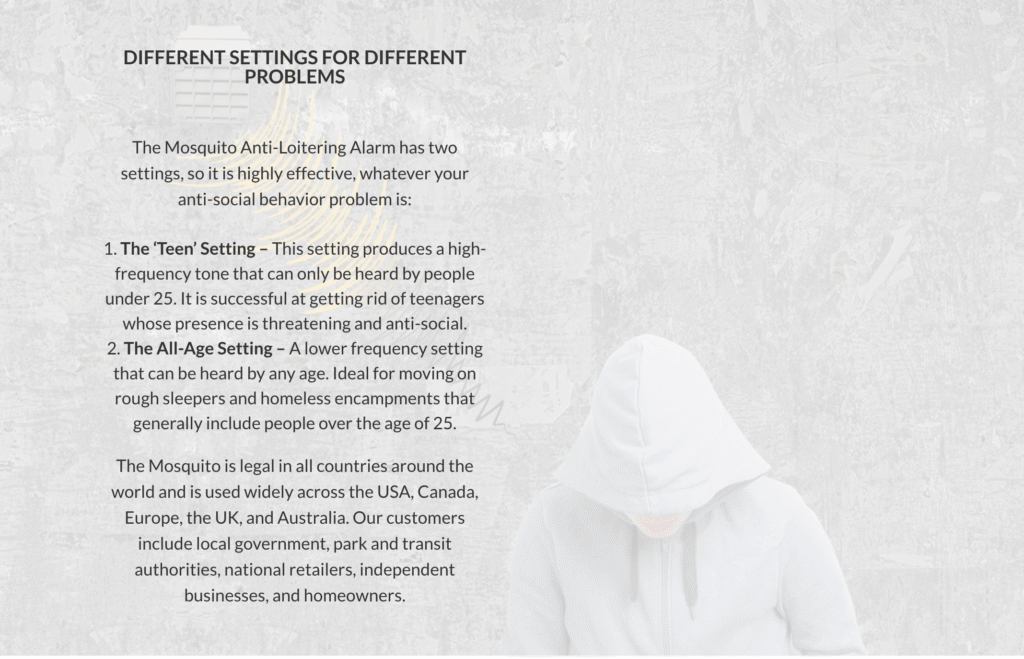
These devices have been placed outside many stores and shopping centers in numerous states across the U.S.
Online Business Restrictions
The internet isn’t a frontier safe from barriers either. Many websites and online services ban people from using their service if they are under a certain age, usually 16 or 18. ActBlue, an online service that handles donations to several politicians, doesn’t allow people under 18 to donate through their service. Even the OpenWeatherMap API requires you to be 16 to use. Why does one need to be 16 to access weather data?
Many of these restrictions are justified by referencing the Children’s Online Privacy Protection Act. However, federal law oftentimes only applies to children under 13 years of age, and businesses have been seen extending these age limits far past this requirement.
Court Cases on Age Discrimination
| Case | What the Court Decided |
| EEOC v. Wendy’s (2025) – The EEOC sued a Wendy’s in Columbus, Ohio for allegedly firing and mistreating employees due to their age or disability. | The court allowed the case to move forward. Wendy’s was accused of breaking the Age Discrimination in Employment Act (ADEA) and the Americans with Disabilities Act (ADA). |
| Tan v. Homewood Suites Nashua (2019) – An individual 20 years of age sued a hotel for refusing him a room because he was under 21 years of age. | The court allowed the case to move forward under New Hampshire state law (N.H. Rev. Stat. § 354-A:17). |
| Candelore v. Tinder, Inc. (2018) – A lawsuit over Tinder charging younger users more than older users. | The court allowed the case to move forward under California law (California Civil Code § 51). Treating customers differently due to age breaks the Unruh Civil Rights Act. |
Conclusion
This is symptomatic of a greater prejudice against young people founded upon baseless claims that young people are incompetent and irresponsible. If businesses used such policies against any other group, there would be public outrage, and rightfully so. So, why is it acceptable to do this against young people?
Business discrimination against youth only continues to grow across malls, stores, entertainment venues, and online platforms. Through advocating for fair and clear legal protections on individual behavior alone instead of restricting all youth, NYRA hopes to give young people more freedom and equal access across public spaces.
The National Youth Rights Association
If you’re interested in Youth Rights, consider volunteering with us. We are always looking for new members and would love to have you on board. If you have a personal story to share about business discrimination, or a general youth rights violation, consider sending us an email at nyra@youthrights.org, and we’d love to help get your story out to the world.