
Who is a member of “The Public”?
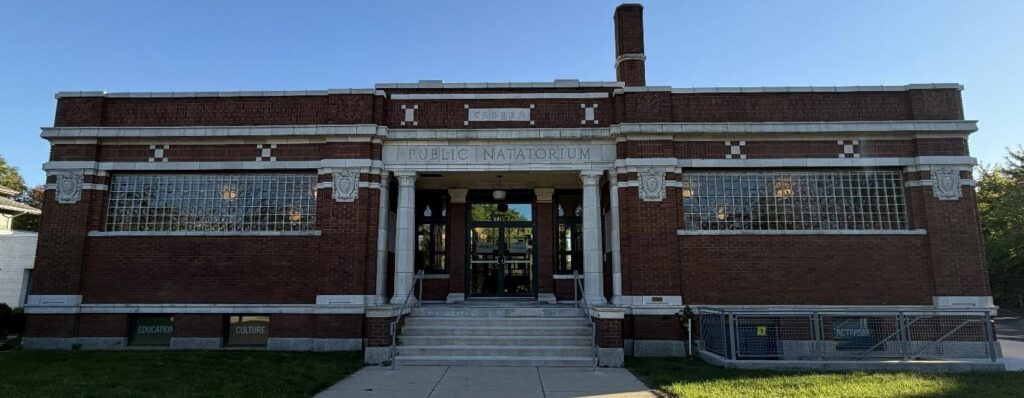
This is the question I was asked to reflect on when I visited the Indiana University South Bend Civil Rights Heritage Center. The building which the Center occupies was originally the Engman Public Natatorium, the city’s first swimming pool funded by taxpayer money. Although the word “public” is engraved in concrete above the front door, the pool was once a racially segregated facility.
“That word should have been eliminated from the front of the building, because it was not a public building,” says Barbara Brandy in the film Divided Waters. She describes her experience of being denied admission to the pool when she was nine years old: “As we walked up the steps, I looked at my mother and I said, ‘Why are they staring at us?’ because I had never been confronted with bigotry before… One of the gentlemen said, ‘You can’t swim today. There are certain times when you can swim and there are certain times when you can’t.’”
Most people today would agree that racial segregation was a shameful part of American history, but fewer object to age segregation that is now extremely common. According to sociologist Mike Males, “we can do all kinds of things to younger people [that] would be absolute violations of civil rights… if we tried to do it on the basis of race or gender. So I think the attack on younger people has intensified as the number of other groups available for attacks has diminished.” The most obvious manifestation of this double standard is the growing number of age restrictions in places designated as public.
Public Education
The institution that is most familiar to American youth is the public school system. Unlike the other places described in this article, school is not a place that young people are excluded from. On the contrary, it is usually very difficult to leave school, thereby preventing young people from interacting with the public in any other location.
Not only does compulsory schooling segregate youth, but it also contributes to economic inequalities that affect former students for the rest of their lives. While Brown v. Board of Education established that public schools must admit all students, schools still do not serve all students equally well. The legacy of racial segregation contributes to school funding disparities, which in turn influences the future career paths available to students.
The political turmoil during the 1960s school integration era led to the newly built, majority white suburbs gaining a reputation for having “better schools” than the inner city. There are undoubtedly disadvantages to attending school in an impoverished neighborhood, but it would also be a mistake to assume that students in wealthier districts are privileged because of their school. Student grades influence real estate prices, so young people in affluent areas are expected to provide adults with constantly increasing returns on investment in the form of academic success. These expectations filter down to students in “failing” schools to paternalistically “help them catch up” to standards that keep getting harder for all young people to attain.
In any case, the real beneficiaries of the public school system are older people who already own homes or have stable careers. Students’ interests are rarely considered by an institution that claims to serve them. Enfranchising young people by lowering the voting age, increasing student choice in education, and decriminalizing school truancy would do a lot to reduce inequities caused by schools.
Exclusion from Businesses
Many commercial properties ban young people from the premises. Some would argue that as private owners, they have a right to exclude anyone they want, no matter how unfair their reasoning may seem. Courts have rejected this argument in cases such as Heart of Atlanta Motel v. United States, ruling that privately owned facilities to which the public is invited must abide by anti-discrimination laws.
Young age is not a protected class under federal law, so hotels and most other businesses can legally enforce age restrictions with few exceptions. Stores located near schools are especially likely to exclude young customers because they believe that crowding at school dismissal time facilitates shoplifting or property damage. Alternatively, they may create rules such as “no backpacks” or “maximum of 2 minors in the store”. These rules could potentially be justified as anti-theft measures, but only if they applied to everyone regardless of age.
Most large shopping malls have also implemented a youth curfew policy, which is a complete reversal of their original business model that actively encouraged teenagers to spend time there. Managers didn’t necessarily have a problem with teenagers hanging out for hours, even if they weren’t spending money. Their presence made the mall appear bustling and desirable, which helped attract adult customers.
Increasing competition from discount stores and online shopping reduced the popularity of malls. In wealthier cities, malls promoted an upscale shopping experience to avoid associations with crime and low foot traffic that preceded the closure of malls in poorer areas. The decision to cater to affluent customers partly motivated youth curfews at malls, because few teenagers have high incomes, and prejudice against youth could potentially deter adults from shopping there. As a result, businesses that owe their existence to young people are now more likely to view them as shoplifters than shoppers.
Curfews and “Teen Takeovers”
Age restrictions aren’t limited to private businesses. Publicly owned locations often prohibit young people from ordinary activities like sitting on a park bench or walking at night. Most adults wouldn’t think twice about doing these things because they don’t need to provide authorities with a good reason for being in a public space.
Highly publicized “teen takeovers” have been a catalyst for implementing youth curfews in malls, parks, or entire cities. Mike Males has documented how media coverage often exaggerates the danger posed by groups of teenagers. For example, Houston police broke up a nonviolent teen gathering “to prevent them from joining [the] FIFA Fan Fest”, even though that event was advertised as free and open to everyone. In contrast, rioting in New York City that same weekend did not result in all adults being removed from the streets.
The phrase “teen takeover” implies that young people are invading a place that is reserved for adults, rather than utilizing their right to be in public. Withholding this right using curfew laws is alleged to be a crime prevention measure, even though they criminalize people for no reason other than being outside. In an analysis of Chicago’s curfew law, Nneka Ugwu explains that “curfew laws are the direct descendants of Anti-Black ‘sundown town’ laws”. Even today, most cities enforce youth curfews in a racially discriminatory manner. For example, activists have protested an exception to Chicago’s curfew for attendees of ticketed events like the Lollapalooza music festival, where underage substance use is common but tolerated due to the revenue the event generates. The disproportionately white, suburban teens who can afford a ticket are exempt from the rules applied to young city residents to “protect” them from these risks.
Online Age Restrictions
All the age restrictions in public places are causing young people to spend more time online instead. The internet had the potential to be like a virtual town square, but is now heavily regulated by commercial and political interests just as physical spaces are.
The most common justification for online age restrictions is that spending a lot of time online worsens mental health, but this argument reverses causation. The separation of young people from the public means that those who are trapped in homes or schools have nowhere else to go besides the internet. These young people have worse mental health outcomes because they are denied opportunities for leisure activities, escaping from abusive adults, and protesting oppressive policies like curfews.
Young People Belong in Public
In 2010, Barbara Brandy was invited into the former Engman Public Natatorium, the same building she’d been refused entry to decades earlier. The mayor of South Bend offered a formal apology for past discrimination at the grand opening of the Civil Rights Heritage Center. What was once a segregated facility has been transformed into a place that is truly open to the public.
Will governments ever apologize for today’s unprecedented levels of age segregation? If they do, the people currently affected by them will obviously not be young anymore. The “aging out” phenomenon, where people reverse their stance on ageist policies once they become adults, makes youth rights more difficult to advance than other causes.
However, age restrictions may be getting so extreme that enough people will soon be motivated to fight them. 85% of Australians under 16 are already defying their country’s social media ban. The same tactics used to protest racial segregation like business boycotts, sit-ins, and civil disobedience of curfews should be used by young people to demand their status as full members of the public.
The National Youth Rights Association
If you’re interested in Youth Rights, consider volunteering with us. We are always looking for new members and would love to have you on board. If you have a personal story to share, of how age restrictions in public have negatively impacted your life, or about a general youth rights violation, consider sending us an email at nyra@youthrights.org. We’d love to help get your story out to the world.
The text of Open to the Public (Unless You’re Young) © 2026 by Ian Golec is licensed under CC BY-SA 4.0.