
In most countries across the world, young people under the age of 18 do not have the right to vote. This means that they have no legitimate political representation, and are not respected as a legitimate constituent of the politicians who are supposed to be representing them. This has historically led to the concerns of young people going underrepresented in politics. Because of this, young people’s main way of political representation and getting politicians to listen to their needs is achieved through organizing and protesting. This makes protesting one of the most important fundamental rights for young people, as it is the main way of being represented in politics.
France is currently experiencing a major wave of student protests centered on deteriorating conditions in the country’s public schools. The movement began in mid-September, when students at a high school in Créteil, southeast of Paris, joined teachers in demanding additional staff and resources. According to Euronews, videos of the demonstrations spread rapidly on social media and helped inspire similar actions around the country. Students have complained about overcrowded classrooms, frequent teacher absences and shortages, poorly maintained school buildings, excessive school hours, and a broader lack of investment in education. Le Monde’s interviews with protesting students also show that many students are concerned about inadequate access to school health staff, inequalities between schools, and the pressures surrounding France’s Parcoursup university admissions system.
The protests have quickly expanded from individual schools into a national movement. Students have organized walkouts, demonstrations and blockades outside hundreds of secondary schools, while university students have increasingly joined the protests as well. Euronews reported on October 1 that university students had begun blocking around 30 campuses, while approximately 900 school blockades or related incidents were reported across the country that day. By early October, Reuters reported that roughly 400 schools had been closed as the unrest spread well beyond Paris. Teachers’ unions, some parents and other education workers have also supported the students’ complaints, particularly their demands for more teachers, additional school staff and improved facilities.
The movement has also become increasingly controversial because of clashes between protesters and police. Some demonstrations have involved burning barricades, vandalism and objects being thrown at police, while authorities have responded with riot police, tear gas, batons and crowd-control grenades. Reuters reported in early October that approximately 5,000 people, most of them teenagers, had already been arrested during the unrest. Although the immediate trigger for the protests was poor school conditions, the movement has begun developing into a broader expression of frustration among young people about France’s education system and their prospects within it. Students interviewed by Le Monde have described fears about their futures, and a sense that young people’s concerns are not being taken seriously. Student unions have also begun coordinating nationally: several major high school and university organizations created a common platform containing “10 emergency measures for youth”. The French government has acknowledged some of the complaints about school conditions but is simultaneously facing significant pressure to restrain public spending, making the students’ demands for substantially greater education funding difficult to resolve. As a result, what began as protests at several under-resourced schools around Paris has developed into a much broader youth-led confrontation over education funding, school conditions and the treatment of young protesters by the state.
Several videos of the protest circulating around social media have shown the clashes between the French student protesters and law enforcement, illustrating that the police have been using excessive force, and unnecessarily injuring student protesters—many of which were non-violent. Because of police recklessness and disproportionate use of force, students have been severely injured or almost killed, with their eyes destroyed, jaws broken, limbs lost, and other severe effects of police using tear gas canisters, rubber projectiles and batons against student protesters in inappropriate ways. Along with this, there have been instances of police attempting to murder students, or even sexually assaulting young student protesters. French students deserve the right to protest (non-violently) without having to fear dangerous or lethal action taken against them from reckless police officers—and when police officers are taking this action against them, they have every right to fight back.
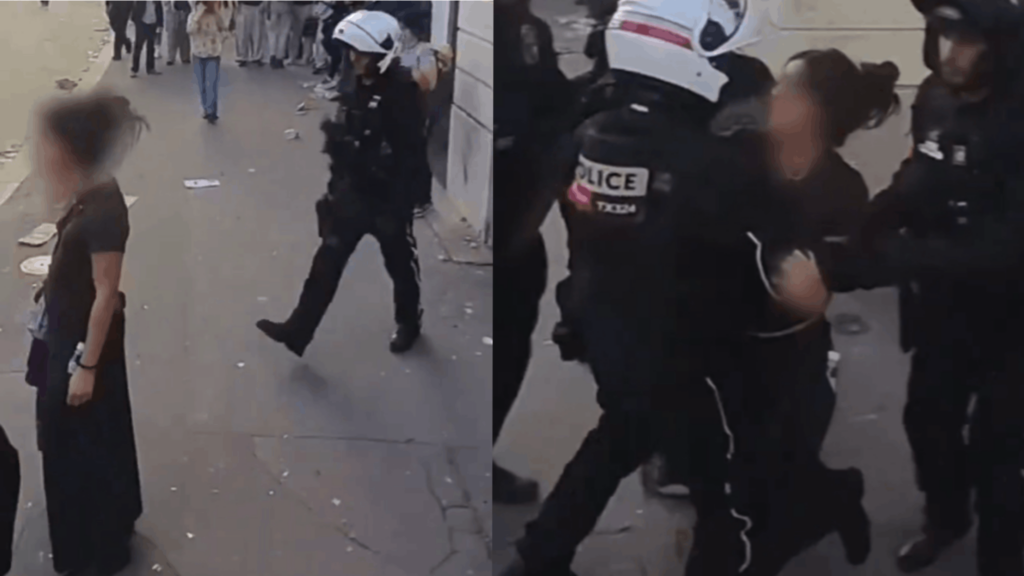
First of all, the police officers in France have been making unjustified arrests of young students who were not participating in any dangerous protests. A widely circulated video that appeared recently shows a young woman standing outside, minding her own business, not harming anyone or even actively protesting at the time. Police then targeted her, approached her from behind, grabbed her and arrested her. Incidents like this, where police arrest bystanders and non-violent protesters illustrate how they are not doing their job properly, and are silencing students’ right to organizing.
One of the most serious incidents of police brutality connected to the student protests occurred in Belfort on October 2, during a blockade near Lycée Gustave Courbet. A 17-year-old student was being pursued by a police commander when the confrontation moved into the shallow Savoureuse River. Video recorded at the scene shows the officer struggling with the teenager in the water and holding him down into the water, attempting to drown him. The student’s lawyer, Arié Alimi, later alleged that the officer forced the teenager’s head underwater and held it there, describing the encounter as an attempted drowning. RTL reported that Alimi said the officer “pressed my client’s head under the water” and announced that the teenager’s family would file a complaint for attempted murder. A reconstruction by StreetPress similarly reported that footage of the arrest appeared to show the teenager being held with his head in the water before he was handcuffed.
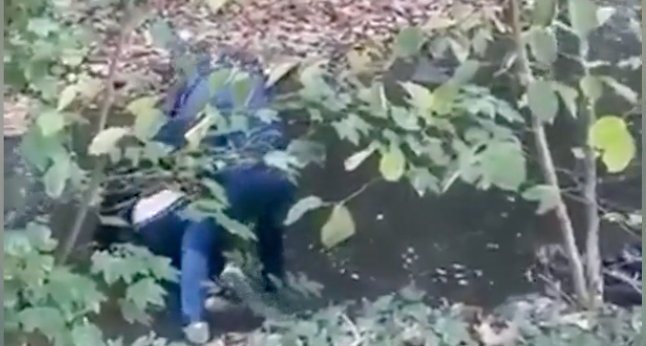
The allegation quickly became disputed by authorities. Belfort prosecutor Paul-Édouard Lallois initially said that the teenager had not told investigators that the officer deliberately tried to drown him and emphasized that the river was very shallow. RTL reported the prosecutor’s account, while the teenager’s attorney later accused the prosecutor of misrepresenting what his client had said. Alimi said that the teenager had, in fact, described having his head placed underwater and argued that communication problems may have affected the initial questioning because his client primarily speaks Russian and has difficulty expressing himself in French. The officer’s attorney has rejected the attempted-drowning allegation altogether, telling RTL that the officer was simply attempting to arrest the teenager.
Immediately after the confrontation in the river, the situation escalated further. The same police officer was surrounded and severely beaten by several people near the school blockade. The 17-year-old student and another minor were subsequently charged with aggravated violence in connection with that attack, and the 17-year-old was placed in pretrial detention. The violence against the officer was widely condemned, with many news sources focusing on that event, and using it to label all of France’s student protesters as dangerous. However, in doing that, they are ignoring the situation that led up to the attack—which clearly shows the office attempting to drown the student.
Another particularly serious incident occurred in Lens on October 5, during a student blockade outside Lycée Auguste-Béhal. A 15-year-old student was taking part in the demonstration when police moved in to disperse the group. According to Le Monde’s reconstruction of the incident, CRS riot police chased students back and threw a grenade at the students, which exploded while the 15-year-old student was holding or attempting to handle it, catastrophically injuring his left hand. Witnesses described a powerful explosion, and videos recorded immediately afterward showed the teenager severely wounded. He was rushed to the hospital, where doctors were ultimately forced to amputate his hand. RTL later confirmed through the mayor of Wingles, where the teenager lives, that the 15-year-old had undergone the amputation.
There remains some dispute over exactly how the grenade came into the teenager’s hand. An initial police account reported by Reuters said that the student had picked up a grenade fired or thrown by police before it exploded. Other witnesses have raised questions about whether it may instead have landed directly beside him or been thrown toward him. RTL reported that investigators were examining both possibilities. What is not disputed is that the explosive device was a police crowd-control grenade and that its detonation caused the teenager’s permanent injury. Le Monde reviewed and authenticated numerous videos from the scene and interviewed a witness who described an explosion consistent with one of the powerful grenades used by French police.
This instance is another devastating example of police brutality against student protesters. There is no reason for grenades to be used against protesters, especially when most of those protesters were unarmed, and not causing a direct threat to law enforcement offices. On October 7, Le Monde reported that the government had temporarily suspended use of the EF-SON stun grenade during student protests. The grenade had only been introduced into police service approximately a year earlier. Interior Minister Laurent Nuñez said there was a high probability that a police grenade was responsible for the teenager’s injury. Grenades, including these police stun-grenades, are still weapons of war, regardless of if they’re supposed to “stun” protesters or not. The incident clearly showed the devastating consequences of what can occur when police officers are using weapons of war against student protesters.
Another serious case of police violence was captured on video on September 28 outside the Château d’Épluches vocational high school in Saint-Ouen-l’Aumône, northwest of Paris. The student, identified as Eden, age 14, was participating in the blockade of his school when he became involved in a confrontation with police. Video from the scene shows several helmeted officers facing the teenager at close range. According to reporting by RTL and La Dépêche, one officer struck Eden, Eden responded by kicking toward the officer, and another police officer then fired a tear-gas grenade launcher directly toward him from very close range. The projectile struck Eden in the face and knocked him to the ground.
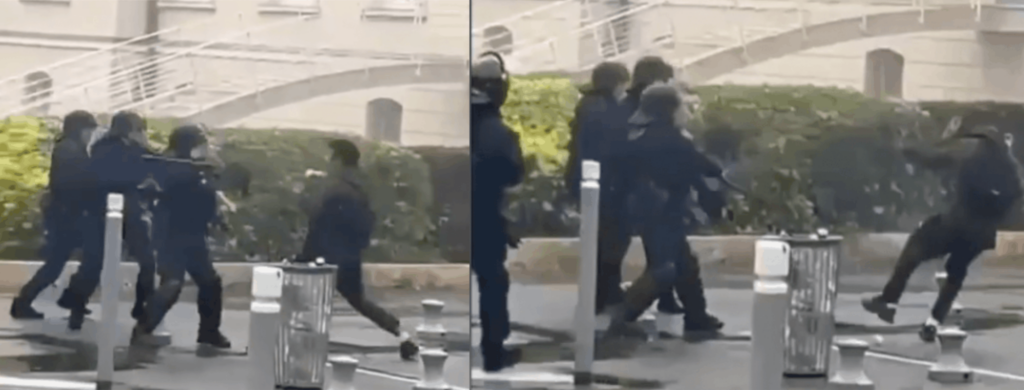
The impact caused catastrophic injuries. Eden suffered a double fracture of the jaw, had all of his upper teeth broken and several of his lower teeth torn out. His family said that doctors had to seal his jaw following surgery, leaving only enough space for a straw, meaning that he was temporarily unable to speak or eat solid food. His mother told RTL that he was surviving on liquids and suffering panic attacks after the incident, while his father said that he repeatedly woke during the night reliving what had happened. The family’s attorney, Elsa Marcel, said that Eden could have been killed by the shot and described him as fortunate to have survived. She subsequently announced that the family would file a complaint alleging attempted intentional homicide, as well as violence with a weapon against a child under 15. Le Parisien reported the family’s complaint and the extent of Eden’s injuries. On October 6, the officer who fired the grenade was taken into custody by the IGPN and then formally charged with violence by a person holding public authority resulting in mutilation or permanent disability. RTL reported that the officer was placed under judicial supervision, while TF1 reported that he was prohibited from performing police duties until further notice.
Placing the officer on “judicial supervision” seems to be an underreaction, as this officer was directly violating safety instructions on how tear gas canisters are supposed to be used. French policing rules are designed specifically to prevent this kind of direct impact. The French Ministry of the Interior has stated that “direct fire” of tear-gas grenades is strictly prohibited, and that grenades are supposed to be launched on a curved trajectory so they fall to the ground rather than strike a person directly. France’s Défenseur des droits has also criticized police for aiming tear gas directly at protesters’ faces at close range, particularly when the people involved are minors. International human-rights guidance is similarly clear: Amnesty International says tear gas must never be fired directly at protesters, because the canisters and grenades can cause severe head, eye and facial injuries when used as impact projectiles.
However, these rules have not stopped French police from continuing to use tear gas canisters as direct weapons against student protesters. In another video widely circulated, a police officer fires a tear gas canister directly at a student’s face, where he narrowly dodged it. In the video, you can clearly see that he is not a violent protester; he’s not attacking police officers, property, or any other individual. Therefore, the law enforcement had no reason to even administer the tear gas in the first place—regardless of the fact they were using it inappropriately. If the student did not dodge the tear gas canister, he could have most likely ended up with severe injuries to his face, just like Eden did. These videos show how French police officers are acting with reckless disregard for the safety of the students, and using disproportionate force against non-violent protesters.
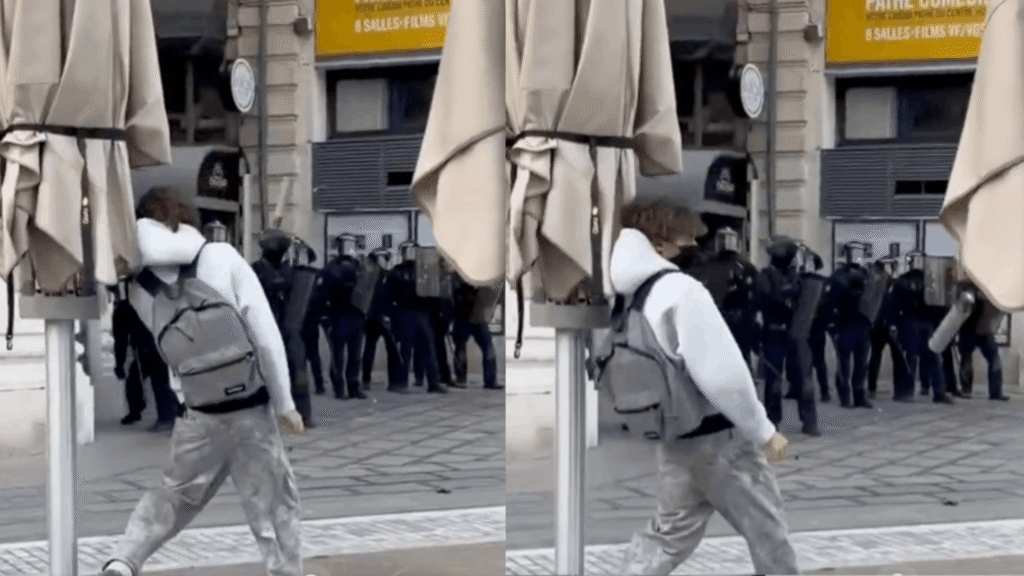
Another weapon French police officers have been using against student protesters are LBD projectiles, which are just as dangerous. LBDs, or lanceurs de balles de défense, are French police weapons that fire large rubber or foam projectiles intended to incapacitate or push back individuals from a distance without using conventional ammunition. They are often described as “less-lethal” weapons, but the projectiles can still cause severe injuries, especially when they strike the head or face, including broken bones, eye injuries, brain trauma, and permanent disability.
Another student was seriously injured during the protests in Strasbourg, where police used LBDs during clashes with high school demonstrators. The incident shown in the video circulated by La Presse Libre appears to have occurred during the wave of school blockades and demonstrations in Strasbourg around October 1, when hundreds of high school students converged on the city center and university district. Contemporary reporting from Lutte Ouvrière described police charges, tear gas and LBD fire in Strasbourg that day and said that several young people were injured as police attempted to disperse the demonstrations.
According to the video circulated by La Presse Libre, a high school student was struck directly in the jaw by an LBD projectile during the Strasbourg protests. The footage shows a large group of young demonstrators gathered in the street shortly before the reported shooting. A statement published through Mediapart’s Club on October 6, signed by more than 1,200 organizations and public figures in support of the student movement, specifically referred to young protesters suffering broken jaws and other serious injuries during the police response.
Because of the fact that LBDs can cause dangerous injuries like the one shown in the video, French police are also subject to restrictions on where an LBD may be aimed. Guidance governing the weapons prohibits officers from deliberately targeting the head, with officers instead instructed to favor the torso and limbs. A joint submission concerning France’s use of force to the United Nations Universal Periodic Review noted that French LBD rules prohibit targeting areas such as the head, while documenting numerous cases in which protesters nevertheless suffered serious head and facial injuries. A projectile striking a student directly in the jaw therefore raises questions about whether the weapon was used consistently with those targeting rules, showing that most likely the police officers at the scene were once again using disproportionate force.
The risk posed by an LBD impact to the face is well documented in Strasbourg itself. In an earlier case, a 15-year-old boy named Lilian had his jaw broken by an LBD projectile near Strasbourg’s train station in 2019, even though an IGPN investigation later confirmed that he had not been participating in the Yellow Vest demonstration taking place nearby. RTL reported that he required surgery and metal pins in his jaw, while The Huffington Post reported that he was left with a facial scar and lasting loss of sensation. The fact that a student who wasn’t even protesting was injured by the police using these projectiles inappropriately shows that the police officers handling the protests are continuing to act dangerously and recklessly in the force they use.
In another incident involving LBDs, a 16-year-old high school student named Maël permanently lost the use of his right eye after being struck during a student protest in Tours on September 30. The incident occurred near the blockade of Lycée Balzac, where police had been deployed as students demonstrated and fires were reportedly set nearby. Video recorded shortly afterward and widely circulated on social media showed Maël sitting on the ground with blood covering the area around his face. According to Le Parisien, he was hospitalized following the injury and doctors later determined that he had permanently lost vision in his right eye.
Maël and several witnesses said that he had been struck by a projectile fired from an LBD, the rubber-ball launcher used by French police. Medical examinations subsequently supported that account. Tours prosecutor Catherine Sorita-Minard said that the injuries were “compatible with the impact of an LBD-type defensive bullet,” according to Le Monde and TF1. The prefecture said police had been responding to fires and were being targeted with thrown objects at the time, but that does not establish the circumstances in which Maël himself was struck or whether he was involved in those actions.
Maël’s family has specifically rejected suggestions that he was an activist involved in violent confrontations. In a statement reported by Boursorama, the family said that Maël had no involvement in any political or militant organization and described him simply as a teenager who became caught up in the events. He remained hospitalized several days after the shooting. Le Parisien reported that Maël and his mother were interviewed by the IGPN as investigators worked to determine who fired the projectile and whether the use of force complied with police rules.
Another especially disturbing incident occurred in Metz on October 5, during the ongoing high school protests. A video filmed near the Roi Georges bus stop, close to the Georges-de-la-Tour school complex, shows a plainclothes police officer restraining a 14-year-old girl on the ground after she was detained during the demonstrations. In the roughly 12-second clip, the officer holds the teenager down with one hand and his knee while running his other hand through her hair and then moving it down across her chest. RTL’s description of the footage and Libération’s CheckNews investigation both reported that the officer’s hand appeared to make contact with her chest three times.
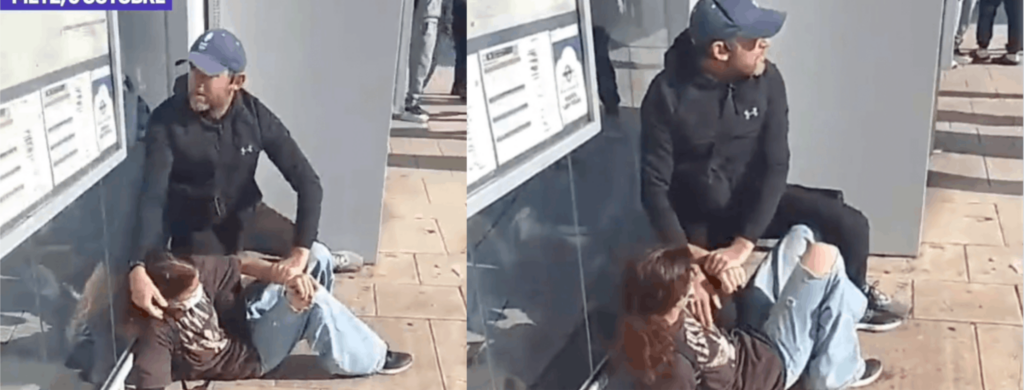
The video spread rapidly on social media and prompted allegations that the officer had sexually assaulted the teenager during the arrest. On October 6, the Metz public prosecutor opened an investigation and referred the case to the IGPN, France’s internal police inspectorate, with assistance from the country’s anti-cybercrime office to authenticate and analyze the footage. The prosecutor said investigators would examine both the circumstances of the girl’s arrest and whether any conduct amounted to sexual assault against a child under 15. TF1 reported the opening of the investigation, while Le Parisien reported that authorities were specifically investigating the apparent touching of the teenager’s hair and chest.
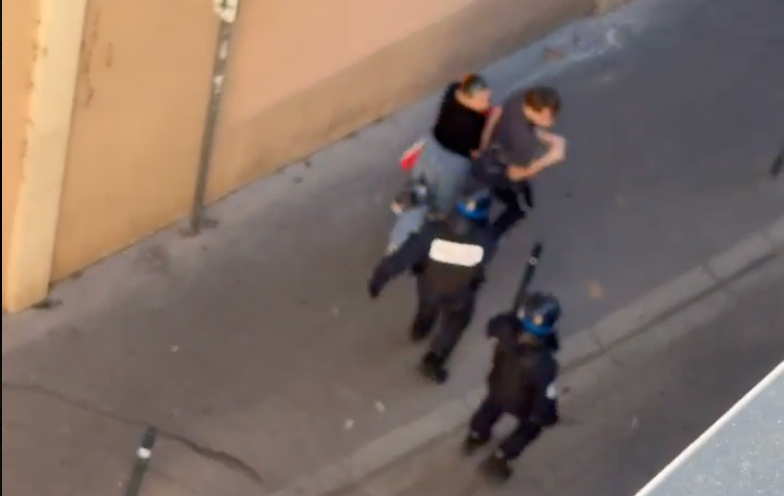
Another video taken by a bystander from a window shows two students walking through an alleyway, with two fully armored police officers following after them. As the male student was walking away from the police officers, he was struck several times with their baton and pushed by the officers, despite not being violent, not being dangerous, and not even participating in a protest at the time of the attack. This instance is another example of police officers using inappropriate force against young people, and profiling young people in general, as the video showed no evidence that they were participating in a protest or riot. The fact that he was struck and pushed from behind, as he was walking away showed that the police officer’s intention was to attack, not to deescalate the situation, since there was no issue that needed to be deescalated.
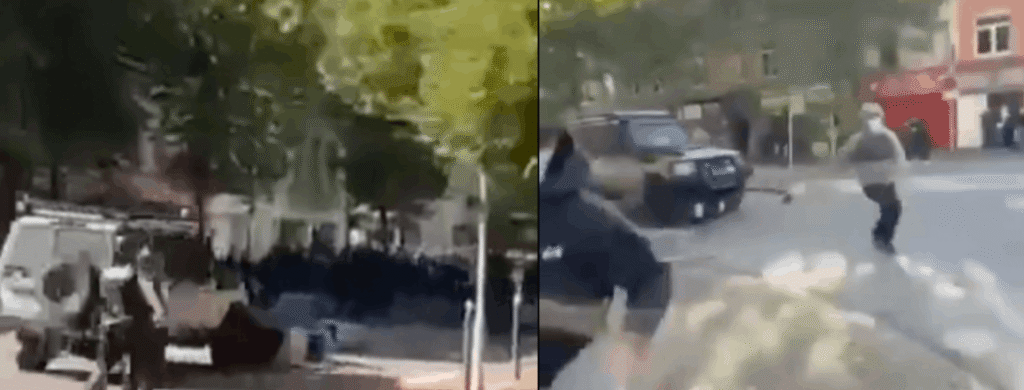
Likewise, another recent video shows a Police car speeding up and driving directly into a group of non-violent protesters. From watching the video, the protesters were not attacking police or destroying anything, they were just grouped up at the other side of the road, and the police began driving the car at full speed directly into the protesters to get them to disperse, while other armored officers followed along with the car. Another angle of the video from the students’ perspective shows the protesters screaming in fear and running to get out of the way as the car charges toward them. Again, this shows just how reckless the officers are, with little regard to the safety of the students, as this could have easily injured many protesters if they had been unable to get out of the way of the incoming vehicle.
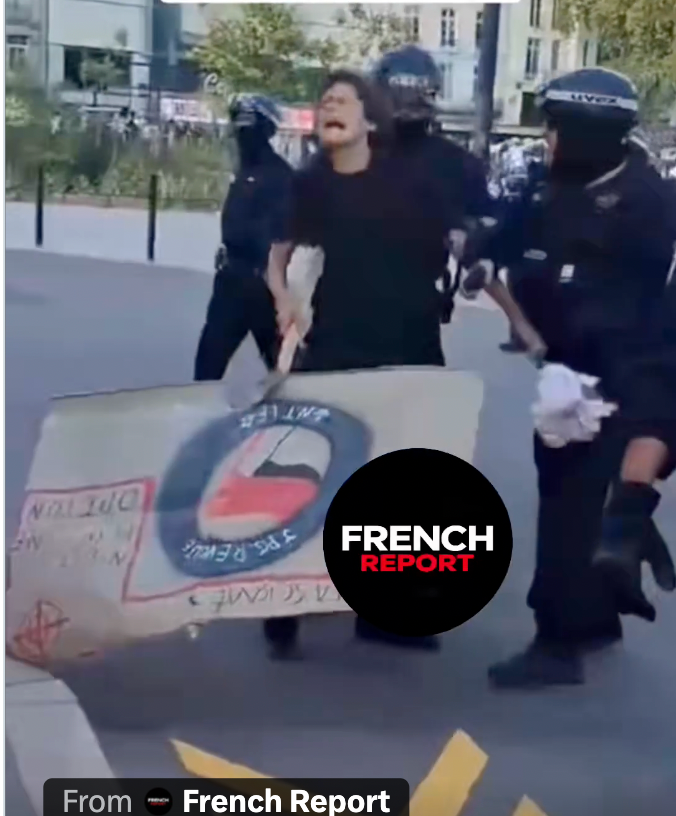
In another recent video of a non-violent protester being attacked, you see a group of police officers tase a student in the face while holding him. In the video, the student was carrying a sign and walking away from police officers—not striking them, attacking them, or damaging property in any way. When the police officers approached him, he turned his back and walked away—further showing how he wasn’t trying to cause a major disturbance or harm anyone. However, police officers grabbed him and held him, and as he attempted to struggle against them, he was tased in the face and screamed out in pain. While this was happening, the police officers attempted to block another non-violent bystander from recording the situation, showing how the police are attempting to cover up their own brutality. The fact that this non-violent protester had such a brutal method used against him, while he was attempting to walk away from police, shows blatant sadism by police officers handling the protests.
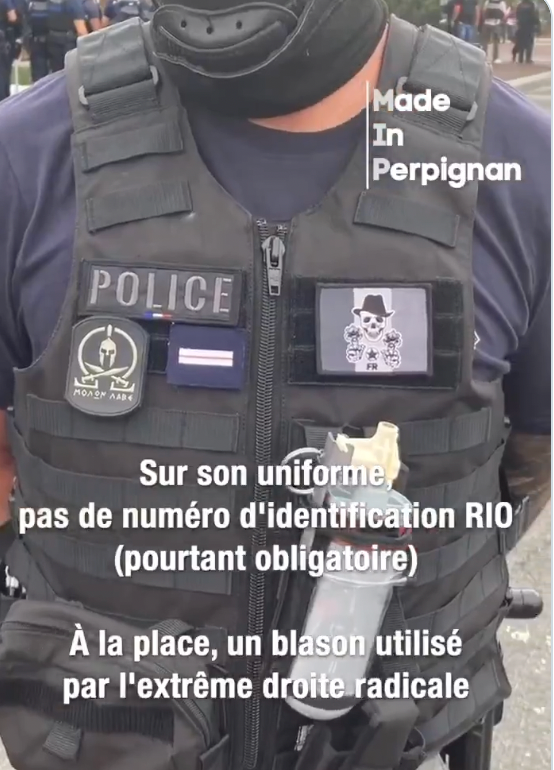
In another video that is particularly relevant when it comes to police sadism, a French police officer was filmed wearing “Neo-Nazi” patches on his uniform while combating protesters. The same officer was filmed making sexist and racist remarks. He also responded with “I like it,” in reply to a teacher who asked him to let go of her arm.
Further incidents of police brutality and disproportionate force causing injury to students have been reported all across the country. In Montpellier, the local civil-liberties monitoring group Observatoire des libertés reported that a 17-year-old girl standing with demonstrators outside Lycée Clemenceau was seriously injured during a police charge, suffering an eye injury and two facial fractures. Le Poing reported the case, noting that the organization said the charge occurred without a prior warning. In Argenteuil, a 16-year-old student suffered an eye injury suspected of having been caused by an LBD projectile. Le Monde reported that prosecutors opened an investigation and referred it to the IGPN, making it another case in which a teenager suffered a serious facial or eye injury during police operations around a school protest. In Alençon, video showed a 14-year-old girl being held around the neck by an officer outside Lycée Leclerc-Navarre. She later told France 3 that she had struggled to breathe and begged the officer to release her; La Dépêche reported on the footage and her account.
A similar incident occurred at Lycée Auguste-Renoir in Asnières-sur-Seine, where an 18-year-old student named Assia was filmed being pushed while an officer applied what teachers described as a chokehold. Teachers condemned the intervention and said police had also used tear gas and arrested four students. Libération and AFP reported on the video and the subsequent court proceedings. Assia was herself accused of striking and insulting an officer and is scheduled to face those charges separately. In Troyes, one of the most widely circulated videos showed an unmarked police vehicle driving rapidly toward a group of students while officers sprayed tear gas through the windows. Authorities initially said the vehicle was carrying out an emergency maneuver to extract officers who were under attack, but Libération’s CheckNews later located additional videos that it said complicated the prefecture’s account. The outlet found several recordings showing officers using tear gas from moving vehicles toward students at different locations.
At Lycée Blaise-Cendrars in Sevran, mounted police were deployed during a school blockade and students described being charged and tear-gassed. One student, Aylan, told StreetPress that four officers forced him to the ground after he kicked away a tear-gas canister, with one officer placing a knee against his head while another punched him. He said he was injured in the fall and later spent more than eight hours in police custody. At Lycée Freyssinet in Saint-Brieuc, Ouest-France reporting reproduced by L’Hermine Rouge described police charging and gassing students. At Lycée Jean-Pierre-Timbaud in Aubervilliers, Le Parisien documented repeated clashes and heavy tear-gas use, with gas drifting into nearby businesses as police responded to confrontations around the school.
There have also been allegations of violence continuing after students were taken into custody. Six attorneys representing detained students told Franceinfo that a 15-year-old student from Lycée Paul-Éluard in Saint-Denis arrived at the police station with his face bleeding, said officers had pressed his already injured face against the ground and alleged that he was slapped several times inside the station. His lawyers said he was not examined by a doctor until six hours into his detention. The same group of attorneys said a 16-year-old student was punched in the liver during his arrest and later slapped at the station, while another student alleged that officers struck him inside his cell. The attorneys announced complaints and referrals to the IGPN and prosecutors; these accounts remain allegations under investigation. In Essonne, a school administrator also described witnessing four officers holding one of her students on the ground and allegedly striking him. In an interview with Le Média, the CPE said she approached the officers and identified herself while trying to protect the student, after which she herself was violently pushed to the ground, allegedly kicked in the ribs and sprayed with tear gas while down.
At Lycée Jacques-Brel in Vénissieux, teachers and other school employees publicly accused police of violently arresting students and using tear gas around the school. Staff said some students experienced lasting physical effects and required hospital treatment following their arrests. Expressions Vénissieux reported that teachers subsequently refused to return to work until they believed the safety of students and staff could be guaranteed, while Lyon Capitale also reported the staff’s allegations of violent police interventions.
Because of the overbearing use of force by police against students, human rights and civil rights groups have aligned in condemning the law enforcement reaction to the protests. France’s National Consultative Commission on Human Rights (CNCDH) said it had “grave concern” about what it described as the disproportionate use of force against mobilized high school students. In an October 6 statement, the commission warned against treating the entire student movement as responsible for violence committed on the margins of demonstrations and said the state’s response must remain necessary, proportionate and adapted to the particular vulnerability of minors. It also emphasized that students’ rights to peaceful assembly and expression are protected by both the Convention on the Rights of the Child and the European Convention on Human Rights.
Amnesty International France has likewise condemned what it calls the disproportionate use of force against high school protesters, pointing to tear gas, grenade fire and mass arrests of minors and calling for de-escalation. The organization acknowledges that some protesters have committed acts of violence, but argues that this does not justify excessive or indiscriminate force against students generally. France’s Défenseur des droits has previously stressed that peaceful mobilization by minors deserves particular tolerance and that police force against students must be strictly necessary and proportionate.
Activists have also issued increasingly urgent warnings about the danger posed to teenagers. Youth activist Ilies Djaouti warned that “a young person will end up being killed if the police violence continues,” urging adults to pay attention to “how they treat your children” and to stand alongside the protesting students. That concern has been amplified by the accumulation of severe injuries during the demonstrations—including permanent eye damage, facial fractures, the loss of a hand and allegations of other serious police violence—which has shifted part of the public debate from the students’ original demands over education toward the state’s treatment of minors exercising their right to protest.
Indeed, a minority of protests have become riots, and there have been reported instances of student protesters acting dangerously as well. However, this does not justify police brutality against non-violent student protesters, like we have seen in a great number of instances. It is also important to consider that many student protesters have only become violent as a direct reaction to the police brutality. The police are now less legitimate as an authority due to their brutality, even if by a minority of officers. Ask yourself: are such acts of violence by police officers in self-defense? Or are these heavily armored officers lashing out at teenagers to get a sense of authority and power?. While such violence will deter some would-be protesters, it is absolutely encouraging others.
Along with this, there has been some political mudslinging from French politicians when it comes to the student protests. Marine Le Pen, a prominent solid-right politician in France with a track record of corruption, seems to shrug off police brutality. She accused the protests of being “riots organized by professionals” and blamed the hard-left, including Jean-Luc Mélenchon for deliberately “conflictualizing” political issues and creating a climate of violence. Mélenchon, solid-left, is popular with youth despite being in his seventies because he listens to their concerns, this set of instances as no exception. Mélenchon has called police violence against young people his “greatest concern” and described scenes from the protests as “unbearable violence”.
To avoid such protests spreading to the United States, those in power must listen to youth concerns before it is too late. Politicians need to stop trying to find scapegoats like “phones”, “social media” and “a lack of discipline” to blame young people’s problems on, and instead address the underlying issues that cause this type of unrest in teenagers. Pay teachers more to retain and motivate them, clean up unsanitary restrooms, improve education quality and allow more course selection and academic freedom for youth while eliminating egregious violations of student rights under state laws and school policies. Along with this, the voting age should be set to 16 years old (or younger) so youth voices feed directly into the government instead of bursting with protests like this. If the situation does not improve, let the protests spread, as this method is the only viable way that youth have found they can get the government’s attention in a system that does not listen to them.
Because protesting is the main way students can represent themselves in politics, protesting against government injustice is a fundamental right that should not be taken away from students, or from anyone. At a certain point, the only way for young people to get the government to listen to them and take them seriously is through major protests like we’re seeing in France, that only seem to be heating up due to the intense rounds of police brutality that has been observed. Several instances have already illustrated that the police are reckless, do not follow proper protocol, and will use disproportionate force on non-violent protesters (and even some non-protesters) simply because they’re young and were profiled. Many of these instances, such as a police officer’s attempted drowning of a student, or the launching of a tear gas towards a non-violent protester’s head, and police attacking students walking away with batons, are completely unjustifiable. This is—without a doubt—police brutality from officers that are power-hungry and even sadistic. Students deserve the right to protest non-violently without being attacked or severely injured by police officers, and they have the right to defend themselves from excessive force used by police officers against them.
The National Youth Rights Association
If you’re interested in Youth Rights, consider volunteering with us. We are always looking for new members and would love to have you on board. If you have a personal story to share about experiencing police brutality while young, or about a youth rights violation you’ve experienced, consider sending us an email at nyra@youthrights.org. We’d love to help get your story out to the world.
The text of Police Brutality & Excessive Force Against French Student Protesters © 2026 by Zane Miller is licensed under CC BY-SA 4.0.