



Cell phone bans in schools have become a hotly debated issue recently as many states have passed laws mandating that districts ban phones in schools in some capacity. While some schools have relatively looser bans, where students are simply prohibited from taking out their phones during class time, other schools have instituted extremely strict policies around cell phone use. Many schools have recently been enforcing “total phone bans”, which prohibit students from even possessing a phone on their person while on the school campus. Other schools have introduced lockable phone pouches, where students have to place their phone in a pouch at the beginning of the school day and cannot access it again until they leave.
These phone bans are usually enforced through “zero-tolerance” policies, where any violation of the rule, regardless of context, results in heavy disciplinary action for the student involved. Preventing a student from accessing their phone during school is dangerous for them in many ways, by restricting their communication with their families, hindering their ability to access emergency services in a crisis, and by preventing them from recording abuse by teachers and school administrators. Because of this, phone bans have been pushed back against by parents and students alike.
However, one Mississippi high school’s phone ban policy has crossed the line from strict… to dangerous, illegal and even outright theft of personal property. I recently interviewed Jessica Irizarry, whose child attends Thomas E. Edwards High School, a small school in rural Mississippi in the Sunflower County School District. Irizarry described the school’s phone ban policy and the methods they used to enforce it, discussing mandatory searches of students’ persons and their belongings every morning at the door to find cell phones, as well as seizing students’ cell phones for the rest of the school year if they were found after a certain number of violations.
NYRA urges Thomas Edwards High School and Sunflower County School District to remove their unconstitutional phone ban policy and the searches that go along with it. In the following article, NYRA will explain Jessica’s story regarding the school’s phone ban, and the way that this phone ban is harmful for both students and parents, by creating various safety concerns.
You can watch the full interview here:
Jessica started by explaining how the school’s harsh phone policy began last year, without the school directly informing parents of the change. Jessica said that she only found out about the new policy when the school began to institute mandatory searches of students and their possessions, every morning.
Jessica recounted that these searches were done inappropriately, stating: “In the beginning they would search the children with physical touch”…”Boys were complaining about their balls getting touched, they were lifting up the girls’ shirts”…”to search for cell phones in front of everybody, in front of all their peers at the door when they walk in.”
First of all, this type of search of students by school administrators is extremely inappropriate, and could even be considered sexual assault of students. This is a violation of basic student rights, as well as students’ bodily autonomy. In Safford Unified School District v. Redding, the Supreme Court held that as a search becomes more invasive, officials need specific reasons supporting that additional intrusion. A federal court applying that precedent in a Mississippi school case likewise explained that moving from searching outer clothing or backpacks to exposing intimate parts requires its own particularized suspicion. Conducting such searches openly in front of classmates further increases their intrusiveness and humiliation. Schools do not have unlimited power to conduct blanket or physically invasive searches of students, and since these searches were done without any reasonable individualized suspicion that a student was violating the policy, they were illegal. However, it wasn’t just students’ bodies that were being searched every morning, it was their possessions as well.
“They were searching inside shoes, making the kids take off their shoes, simply looking for cell phones.” Irizarry stated, “They go inside [the students’] backpacks every morning, looking for cell phones.”
Because this occurred at a public high school, the searches were subject to the Fourth Amendment’s protection against unreasonable search and seizure. Under the Supreme Court’s decision in New Jersey v. T.L.O., a search ordinarily must be based on reasonable grounds to suspect that the student violated a law or school rule, meaning it requires a school search to be both “justified at its inception” and reasonable in scope. The Mississippi Supreme Court has similarly recognized that public-school searches must be supported by reasonable grounds.
For randomized searches of student property, the methods of searching has to be minimally invasive such as using a metal detector wand or K9 unit. By contrast, randomly opening students’ backpacks and manually searching through their belongings is much more constitutionally intrusive. One particularly relevant case is Doe v. Little Rock School District, where the Eighth Circuit struck down a policy under which randomly selected classrooms were searched and school employees physically went through students’ backpacks and purses without individualized suspicion. The court held that the practice unreasonably invaded students’ legitimate expectations of privacy. Because the searches through backpacks and student property were not “random” (as they were done to every student), were not based on any particular suspicion of an individual student, and were not minimally invasive, these searches are likely to be deemed illegal under current law.
However, despite the constitutional flaws in this policy, when Jessica reached out to the superintendent to bring up her concerns, she was told that the staff are “following school district policies” when it comes to the searches of students at the door. Records of emails between Jessica and district administrators were supplied to NYRA:
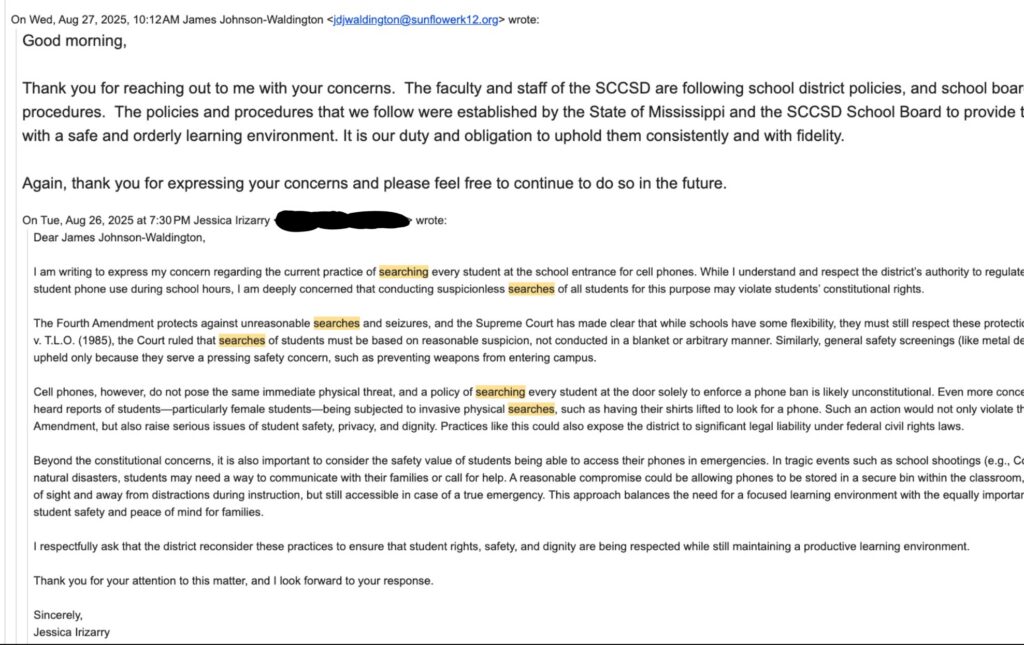
Along with this, the violations of student rights became even harsher when it came to the school’s policy of punishing students once phones were seized and confiscated from the illegal searches.
Irizarry explained that: “[the policy] says the first confiscation of the phone, the parent has to pick it up, second confiscation of the phone they take it for 10 days, third confiscation of the phone they keep it for 30 days, and the fourth confiscation of the phone they keep it for the rest of the school year.”
This means that under the school’s policy, they have authority to basically permanently seize a student’s cell phone as a punishment for having a phone on their person four separate times during the year. This isn’t just a violation of student rights, it now moves into the territory of outright theft of personal property. The school’s policy no longer is just governing what occurs inside of the school campus, but is enforcing overbearing control of the students’ ability to access their phone outside of school hours.
When Irizarry reached out to the school’s principal to express displeasure with the school’s policy, all they did in return was provide her with a copy of the policy, rather than addressing her concerns. Her emails with the school’s principal, as well as a “cell phone violation documentation sheet” she received were provided to NYRA:
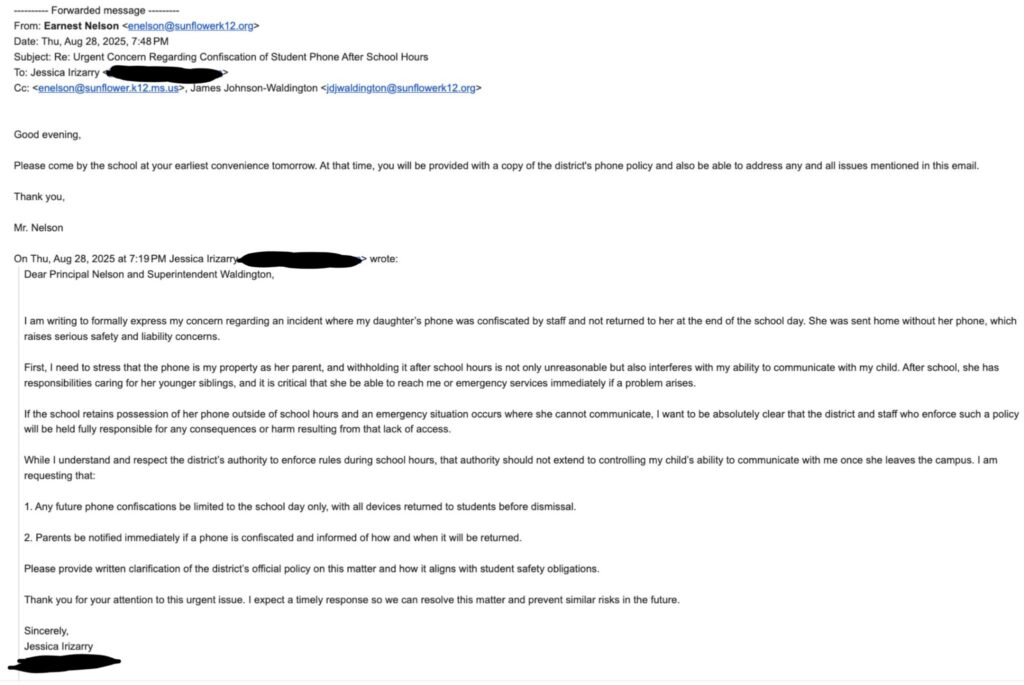
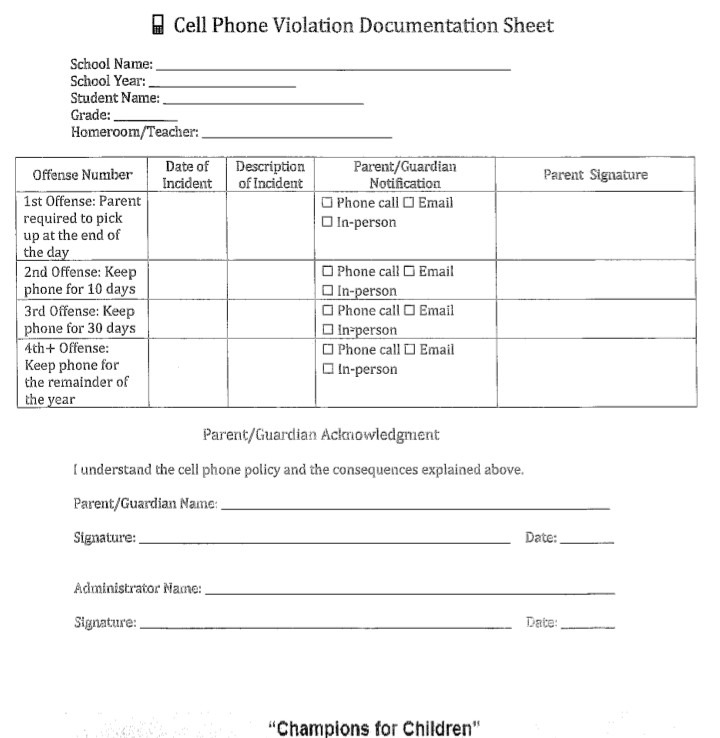
These records substantiate the claims that Irizarry made, proving that the district is currently using this oppressive, unreasonable phone confiscation system, as well as showing the school’s lack of action when it comes to addressing the blatant safety concerns that this policy would cause.
Jessica was extremely displeased with the school’s policy and handling of the situation, while being concerned about the safety risks that this could create for her children.
“You cannot keep something that is my property for the rest of the school year when we need it for emergency services, for communication,” she explained, “you’re leaving the children vulnerable, there’s children that walk home from school.”
Jessica went on to explain the various ways that preventing children from having access to their phones was dangerous and created unnecessary safety concerns.
“There’s cases where the phone is beneficial for police officers and detectives when they go to search for children, cause the first thing they do is find the pinned location on the phone and look at nearby cameras,” Jessica stated, “If they cannot do that”…”now it’s even harder for them to know what to begin with.”
Jessica’s broader point here has been supported by evidence: a missing child’s phone can sometimes give investigators one of their strongest starting points. If location sharing or a service such as Apple’s Find My is active, a parent may be able to provide police with the phone’s current or last-known location. Investigators may also obtain location information from cellular providers or online accounts through appropriate legal processes, and that information can narrow the search to a particular street, building, roadway, or other area. An example of this occurred in Atlanta in 2022, when a 9-year-old boy was kidnapped during a carjacking while he still had his iPhone. His mother used Find My iPhone to provide police with real-time location information, allowing officers to track the vehicle and rescue the child.
This instance shows how the location tied to a phone can be a perfect starting point for police during missing-child investigations, which perfectly illustrates one of the dangers of permanently depriving students of access to their cell phones outside of school hours. If a student had their phone seized for 10 days, 30 days, or even for the rest of the school year (as the policy permits) and happened to be abducted either inside or outside of school hours, police and investigators would already be at a disadvantage when it comes to locating them, compared to a student who had their cell phone on them.
“We have shootings like Columbine, where the phones were actually helpful. The children were calling their parents, letting their parents know where they were, that they were safe, they were giving this information to police officers”…”because they had their cell phones,” Irizarry added.
Jessica’s point is once again accurate, and Columbine provides a documented example. During the April 20, 1999 shooting, students trapped throughout Columbine High School used cell phones to contact both their families and law enforcement. The Washington Post reported that students and teachers called police and relatives to report where they were hiding and provide information about the shooters; one 16-year-old student hiding near the cafeteria reportedly remained on a cell phone with a police officer for roughly two hours. Other students called parents, who in some cases relayed information or emergency instructions between those inside the school and responders outside.
This is one of the main reasons that many parents oppose total phone bans in schools, as they limit a child’s ability to contact emergency services and parents in the event of a crisis such as a school shooting. The important distinction to note here, is that this safety concern arises not just from the school seizing cell phones of students outside of school hours, but simply from them not allowing students to possess their cell phones during the school day. This is another reason why phone bans in general threaten student safety, even when they aren’t accompanied by illegal searches and zero-tolerance confiscation policies.
NYRA’s research on phone ban policies has revealed other important reasons why students should be allowed to possess their devices during school hours. There have been many situations where teachers and staff members within a school exhibited dangerous or discriminatory behavior towards students, and the only reason that disciplinary action was taken was due to a student using their phone in class to record the behavior. For example, Gregory Salcido, a teacher in El Rancho, was recorded by a student making disparaging remarks about military service members. That video went viral, leading to protests and his dismissal by the district. In a more severe instance, in Hillsborough County, Florida, a teacher was filmed putting a student in a chokehold in class. The video led to the arrest of the teacher, along with the vice principal for not reporting the incident. In another instance, at Glendale High School in Springfield, Missouri, a 15-year-old student recorded a geometry teacher repeatedly using a racial slur. When the video was posted by the student, disciplinary action was taken on the teacher, but the student who recorded the video was also suspended for violating the school’s phone policy.
These stories illustrate just how necessary it is for students to be able to access their phones during school hours in order to record abuse, especially when schools tend to attempt to cover up mistreatment by school staff, and punish students for attempting to speak out against it. Phone ban policies in general are harmful for students and threaten their safety, which makes phone ban policies like the one at Thomas E. Edwards High School even more dangerous with the way it is enforced.
Jessica explained her fears when it comes to her children not having access to their phones in emergency situations that happen outside of school hours.
“If the phone is at school, there’s a fire at the house”…”[my children] are not gonna have a way to communicate because their phone is at the school,” she explained to me, “Sometimes they have to watch over siblings and need to be able to call me to let me know something’s going on, be able to call 911 if there’s an emergency.”
Her fears reflect a very legitimate safety issue created by the seizing of student cell phones like the school policy permits. Students who had their personal devices seized for an extended period of time would not have access to contact emergency services. Since the phone confiscations extend to outside of school hours, the safety concerns only compound with each increasing violation, especially considering how the “violations” originate from illegal searches of students’ bodies and possessions.
Irizarry also explained how cell phones are the only devices she and her family can rely on for this contact with emergency services, stating “I live in the country, my neighbours are 3 acres away”…”we don’t have house phone connection here”…”the only thing we have to rely on are cell phones.”
Her family’s personal living situation exacerbates the already blatant safety issues caused by her children not having access to cell phones. In the event of a crisis or emergency, her children would already be at a disadvantage due to their location, and the lack of a cell phone only expands the danger.
However, whenever Jessica had reached out to school administrators about the concerns, she was mostly left on deaf ears.
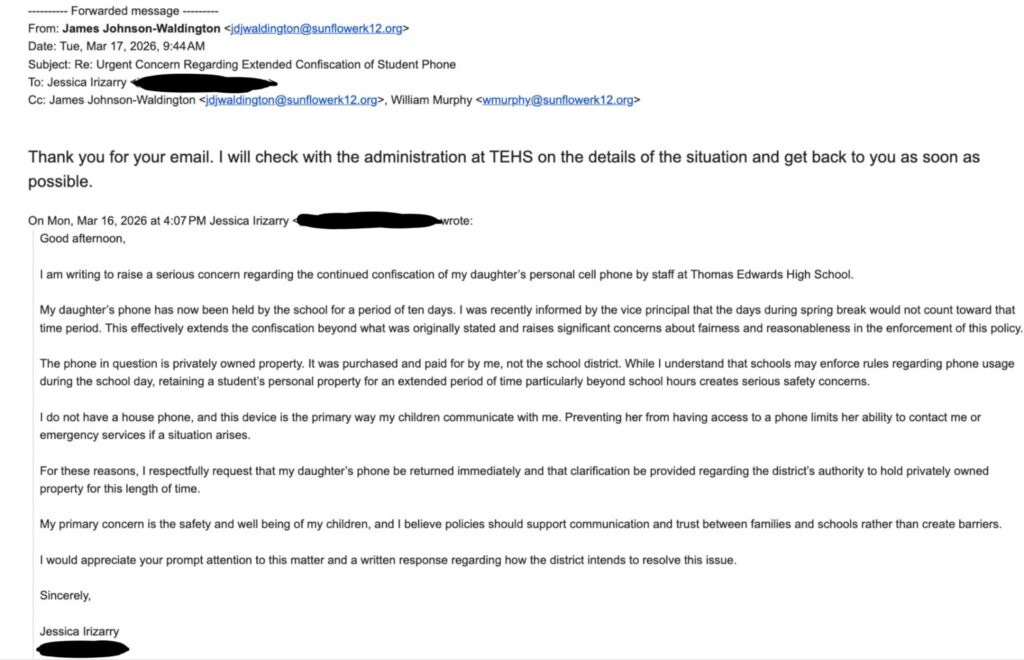
She added that whenever she discussed these concerns with administrators or the school board in person, they would often tell her that the solution is for her daughter to simply not bring her cell phone to school. Jessica informed me that she wouldn’t be as opposed to the school’s phone ban, if students were reliably being able to access the school’s phone in order to contact families for whatever reason needed. However, this was not the case.
“There’s been scenarios where the children go to the office to call their parents and the office doesn’t allow them to use the phone. It’s happened to my daughter”…”they tell her ‘well you don’t need anything, go back to class’, and I’ve seen it with my own eyes”…”there was a child who went to the office to ask to use the phone and she was told the same thing,” Irizarry recounted.
The instances that Jessica described show that students do not have unconditional access to a school phone in order to contact parents during the school day. Their access is conditional based on whether the school administrators view it as warranted. Once again, this creates a concern for student safety. For example, if a student is dealing with a personal issue, or is currently struggling with a problem in the family that would need them to have access to constant communication with their family, they would be negatively impacted by this policy. This is especially relevant, because these issues are likely to be sensitive and extremely personal—not the business of the school administrators.
“So how are we supposed to trust that they’re gonna do their part when the kids ask to communicate with their parents, when they’re kicking them out and not allowing them to use the phone”…”they could need me for any reason and they do not have to tell you what the reason is,” Jessica expressed her frustration.
The fact of the situation is that the school has proven that parents cannot rely on the school to do the right thing in order to keep students safe. If students cannot have their own phones in schools, get their devices permanently confiscated from them due to illegal searches, and then still do not have access to a school phone to contact their families, how are students and parents supposed to feel safe with this policy?
Jessica informed me that her daughter was disciplined many times by the school for violating their phone policy, after her phone was discovered by an illegal search. This led to her phone being kept by the school for an extended period of time on multiple occasions.
“When they kept [her] phone for 10 days, I couldn’t leave the house. I had to leave my cell phone with her so she could have”…”a way to contact emergency services and I left the house without my cell phone and put myself at risk”…”without being able to call emergency services if I needed them just so they had something they could use,” Jessica stated.
She also explained how this issue resulted in her daughter’s phone being taken for the rest of the school year last year, under the most severe violation of the policy.
“They had it for about 2 and a half weeks, almost 3 weeks”…”we got lucky it was the end of the school year but if she was to get her fourth infraction now, they would keep it from now until the end of the school year,” Irizarry discussed.
Because of the major safety concerns that arose when her daughter did not have access to her cell phone, Jessica explained that she began instructing her daughter to refuse to turn in her phone when it was discovered through a search. Unfortunately, this led to greater disciplinary actions taken on her daughter, including a suspension and a disciplinary hearing. A copy of the disciplinary materials was provided to NYRA, which lists the phone being confiscated at 7:25am (right when school was starting), further substantiating how the phones are often discovered and seized during early morning mandatory searches of every student’s person and property, rather than a search based on individualized reasonable suspicion of a violation.
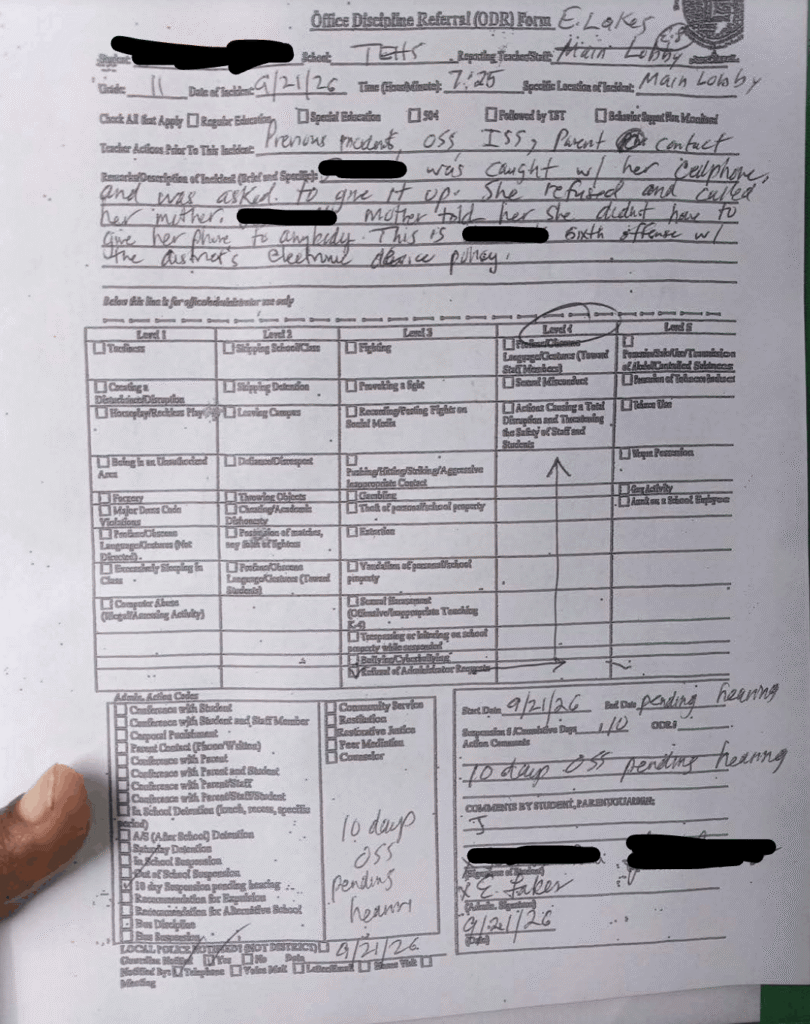
This excessive discipline from the school has left Jessica and her daughter with a hard decision: either bring the phone to school and risk it being seized or further disciplinary action for refusal, or don’t bring the phone, and risk having no contact in the event of an emergency or sensitive situation.
Jessica explained how other than the phone policy violations, her daughter was unproblematic in school and did not cause any other issues, even when it comes to cell phones.
“She does not get her phone confiscated during class, or because she’s on it or because she’s using it. The majority of the times she’s gotten it confiscated is at the door because they’re wrongfully searching her backpack,” Irizarry stated.
Other emails from Jessica to school administrators regarding the situation reveal that her daughter began to specifically be profiled in school due to her pushback against the school’s phone policy. According to Irizarry’s emails, comments like “that Mexican girl’s mom came and filed a complaint” were made about her daughter.
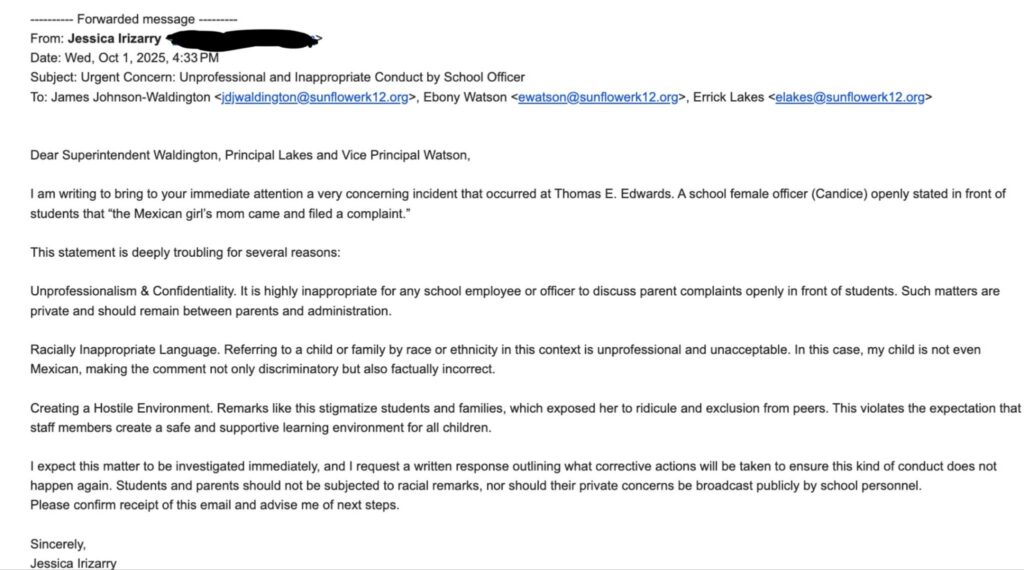
This instance is especially important to look at, considering the previous examples I showed of teachers using racial slurs against students, or making disparaging remarks about their family and only facing disciplinary action due to them being caught from a student recording it. If teachers at this school are comfortable using inappropriate language about students and their families, then that is yet another reason why students should be able to have access to their phones at school—to hold these teachers accountable.
Eventually, Jessica was able to get a meeting with the school board where she pushed back against the illegal searches and the phone ban policy.
“After all my pushback they reduced it to using the wands and searching the backpacks,” Jessica explained.
Even though the school began to refrain from the searches of students’ persons, the mandatory searching of backpacks at the beginning of the day is still illegal due to them not being based on any reasonable suspicion, and being conducted inappropriately. When it came to the phone ban concern, Irizarry informed me that her pleas to change the policy were continuously ignored by the school board, despite the growing safety concerns. Irizarry was informed that the phone ban was a “necessary” policy, due to a growing trend of students using their phones to record fights that happened at school and post them online.
“Faulting every child for the small few isn’t fair. Not every child records fights and posts fights,” Jessica stated.
The school’s reaction to students recording fights being to enforce an oppressive phone ban through illegal searches of students shows that they’re more concerned in protecting their public image than ensuring student safety. All students do not deserve to be punished with illegal searches and outright theft of their property because a few students were recording fights during school hours. This school’s policies, and handling of the situation were inappropriate, and dangerous for students and parents. Unfortunately, because they are in a small, rural community instead of a large city, they have the ability to get away with these violations of student rights without major pushback.
NYRA urges Thomas E. Edwards High School to revoke their dangerous phone ban policy, and end their unconstitutional blanket searches of all students’ persons and property. Students should not be punished for simply possessing a phone on them during school hours, when that phone could be their one lifeline in the event of an emergency, crisis, abusive situation, or family struggle.
The National Youth Rights Association
If you’re interested in Youth Rights, consider volunteering with us. We are always looking for new members and would love to have you on board. If you have a personal story to share about how your school’s phone ban policy negatively affected your life, or about a youth rights violation you’ve experienced, consider sending us an email at nyra@youthrights.org. We’d love to help get your story out to the world.
The text of Mississippi High School Illegally Searching Students & Permanently Seizing Phones Under New Policy © 2026 by Zane Miller is licensed under CC BY-SA 4.0.




I just like the helpful information you provide in your articles