

A parent doesn’t want his son talking to strangers on Roblox. So one father came up with a solution: he built his son his own version of Roblox. Honestly, that sounds pretty cool. Except the other “players” aren’t actually playing with him.
Developer Adam Lyttle recently posted on X that he had “vibecoded a safer Roblox” for his son. The game uses recordings of other people’s playthroughs to create the illusion that other people are playing alongside him, while ChatGPT generates responses during interactions. His son thinks he’s having a social experience with other people. He isn’t. Apparently, we have reached the point where protecting children from strangers online can mean secretly replacing those strangers with artificial intelligence and simply not telling the child.
And somehow, that isn’t even the craziest example from the past few weeks. Another parent recently posted about his toddler spending the night in the same room as her toddler cousin. The two children stayed awake talking for more than an hour, as kids at sleepovers tend to do. Except there was a microphone hidden in the room. Their entire conversation was recorded, and the parent then used AI to process the recording, organize what the children had talked about, and turn their private conversation into something the rest of the family could interact with.
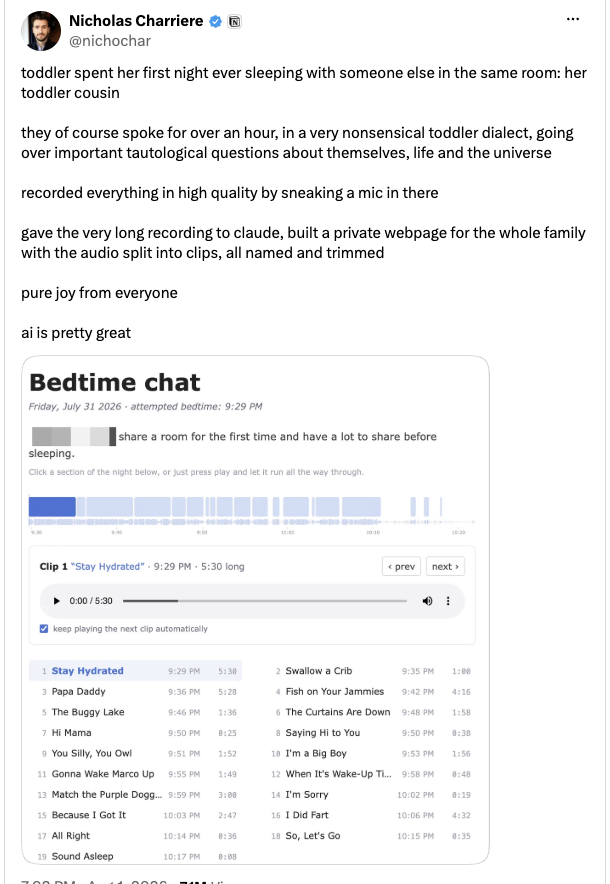
The post was presented as funny and interesting. I find it horrifying. Not because parents should never supervise their children, not because a toddler should have exactly the same independence as an adult, and not because artificial intelligence is inherently evil. It’s horrifying because children are people, and people deserve some part of their lives that does not belong to somebody else. Being someone’s parent should not give you unlimited access to their private thoughts, conversations, relationships, and experiences. AI is making it dangerously easy to forget that. Young people deserve a basic right to privacy, and this privacy should not be violated by their parents.
Table of Contents
- When Did Eavesdropping Become a Parenting Tool?
- Children Have a Right to Privacy
- “But I’m Just Keeping My Child Safe”
- Imagine If We Did This to Adults
- Privacy Is Part of Becoming a Person
- And Yes, Age Matters
- AI Didn’t Create This Problem. It Made It Scalable.
- Your Child Is Not a Dataset
When Did Eavesdropping Become a Parenting Tool?
Remove AI from the second story for a moment. Imagine someone casually announcing that they hid a microphone in their daughter’s bedroom during a sleepover, secretly recorded everything the children said, listened to the entire conversation afterward, took detailed notes, and distributed the interesting parts to their relatives. That sounds invasive because it IS invasive. Adding AI doesn’t somehow make it less so. If anything, AI makes the privacy violation more concerning because it removes practically every inconvenience that once limited this kind of surveillance.
Twenty years ago, a sufficiently determined parent could secretly record their child’s conversations. But then they would actually have to listen to those recordings. An hour of meaningless conversation meant parents sitting through an hour of meaningless conversation. Now, a parent can upload it, transcribe it, summarize it, ask for every person mentioned, every secret discussed, every disagreement, every statement considered “concerning,” or every friend AI thinks might be a bad influence. Suddenly, hundreds of hours of a child’s life are not hundreds of hours anymore. They are a searchable database.
And once we normalize that, why stop with sleepovers? A parent could record conversations in the car and have AI summarize them afterward. They could use device monitoring apps to feed a teenager’s text-message history into an AI model and ask it to analyze their friendships. They could scan a child’s journal and ask AI to identify emotional changes. They could analyze years of search history and generate a psychological profile of their child. They could automatically transcribe conversations and receive alerts whenever certain names, subjects, or words come up. None of this sounds particularly futuristic and amazing anymore. Some of these tools will inevitably be marketed as “parental safety.” That phrase should not make us stop asking questions. It should make us ask more.
Children Have a Right to Privacy
There is a strange assumption in conversations about children’s privacy that privacy is something adults own and gradually choose to give children. I think we have it backward. Privacy should be the default.
Parental interference with that privacy can sometimes be justified because parents have legitimate responsibilities toward their children. A parent absolutely should intervene when there is a credible reason to believe their child is in serious danger. Very young children obviously require much greater supervision than teenagers. Nobody is suggesting that parents hand a five-year-old an iPhone, wish them luck, and never check on them again. But needing supervision does not make someone rightless. Parental authority is a responsibility, not ownership.
There is an enormous difference between supervising a child and treating every part of their life as information you are entitled to collect. If your fourteen-year-old closes their bedroom door to talk to a friend, you do not automatically deserve a transcript of that conversation. If your child writes in a diary, the fact that you bought the notebook does not make its contents yours. If two cousins whisper to each other at a sleepover, their conversation does not become family property simply because both speakers happen to be children. And if your child is interacting with artificial intelligence while believing it is a real person, “I was keeping them safe” does not erase the fact that you deceived them. Children are not extensions of their parents. They are individual human beings. That distinction matters.
“But I’m Just Keeping My Child Safe”
This is the argument that will justify almost every technology I just described: safety. And safety is powerful because nobody wants to argue against it. According to parents, reading every text message could make a teenager safer in some situations; tracking their location every second of every day could potentially make them safer; recording every sleepover could reveal something dangerous. Analyzing private conversations for references to drugs, depression, bullying, violence, or dangerous people might reveal something genuinely important.
But we don’t organize childhood around eliminating every possible risk because safety is not the only thing children need. Never allowing your child to leave the house would probably reduce their chance of being hit by a car, but nobody would consider that a healthy childhood. Children need independence, trust, relationships that aren’t supervised by adults, opportunities to make decisions, and room to make mistakes. They need to say embarrassing things, change their minds, complain about their parents, and have conversations that disappear when the conversation ends. Most importantly, they need to learn how to exist without somebody constantly looking over their shoulder.
You cannot prepare a young person for independence by denying them every opportunity to experience it. Surveillance can also undermine safety in another way: it destroys trust. If a teenager discovers that their parent has secretly read and analyzed months of private messages, what lesson do they learn? Maybe it’s that their parent cares deeply about them. Or maybe it’s simply: don’t tell my parents anything I don’t want them to know. A relationship in which children feel comfortable voluntarily telling their parents when something goes wrong is far more valuable than one in which parents know things only because they secretly extracted the information.
A 2013 longitudinal study in PubMed, is explicitly titled, “I still haven’t found what I’m looking for”: parental privacy invasion predicts reduced parental knowledge. That same line of research has also been linked to increased adolescent secrecy, meaning that when parents use privacy-invasive strategies, children may hide more rather than less. Intrusive monitoring can undermine the very trust and disclosure that parents are often trying to create.
Imagine If We Did This to Adults
Sometimes the easiest way to recognize how invasive something is is to imagine doing it to literally anybody other than a child. Imagine your employer secretly recorded your conversations with coworkers because workplace harassment is a serious problem. Nobody at the company has time to listen to everything you say, so AI does it instead. Every Friday, your manager receives a summary informing them that you expressed frustration with management three times, discussed potentially applying for another job, appeared unusually stressed, and had a private disagreement with a coworker. Your employer insists the program exists entirely for your safety and well-being. Would that make you feel better?
Or imagine your spouse secretly installing a microphone because they’re worried about your mental health. AI analyzes your conversations and tells them whenever you sound depressed, whenever you complain about the relationship, and whenever you discuss something you haven’t told them. They love you. They’re worried about you. They have good intentions. It would still be an outrageous violation of your privacy.
Yet when the person being monitored is a child, “I want to protect them” often ends the discussion. It shouldn’t. Children may require greater supervision than adults, but childhood is not a blank check for surveillance.
Privacy Is Part of Becoming a Person
Think about the conversations you had growing up that you would have absolutely died if your parents heard. Maybe you talked nonsense with your cousin at midnight, complained about an unfair rule, told your best friend who you liked, admitted that you screwed something up, tried out an opinion and changed your mind ten minutes later, made an incredibly stupid joke, or talked about something embarrassing. Those conversations matter precisely because they aren’t performances for adults.
Children develop identities partly by having spaces where they can figure out who they are without constantly wondering how an authority figure will react. Surveillance changes that. People behave differently when they know they are being watched, and adults understand this intuitively. We close bathroom doors. We use passwords. We don’t give our bosses access to our group chats. We don’t livestream arguments with our spouses. We understand that having nothing wrong to hide does not mean having nothing private.
Reviews of parental monitoring and adolescent development note that adolescence involves a growing need for privacy, autonomy, and independent social relationships, and that parent-child relationships need to be realigned as those needs increase. When parents respond to that developmental shift with intrusive surveillance or privacy invasion instead of boundary setting, researchers generally treat that as a potentially harmful mismatch rather than it being justified supervision.
Children deserve that same basic recognition. A child should not have to prove that a conversation contains nothing dangerous before being allowed to have it privately.
And Yes, Age Matters
Obviously, a toddler and a seventeen-year-old should not have identical levels of independence. A toddler needs supervision. A teenager does not. But that actually strengthens the argument for children’s privacy rather than weakening it. Growing up is supposed to involve gaining autonomy.
Parents gradually stop holding their child’s hand while crossing every street. Eventually, the child stays home alone. Eventually, they go places with friends. Eventually, they make decisions their parents would have made for them years earlier. Privacy should develop the same way.
The disturbing possibility created by modern technology is that parents no longer have to surrender that knowledge. A parent can potentially know where their sixteen-year-old is at every moment, who they are texting, what websites they visit, what they search for, how long they use each app, where their car goes, and who appears on the doorbell camera. Increasingly, AI can take all of those scattered pieces of information and tell the parent what they supposedly mean.
Technology may soon allow parents to maintain a level of awareness over teenagers that previous generations could only maintain over toddlers. That doesn’t mean they should. The goal of raising a child should be to eventually create an independent person, not to perfect the technology required to supervise them forever.
AI Didn’t Create This Problem. It Made It Scalable.
Parents have invaded their children’s privacy forever. They have read diaries, listened behind doors, searched bedrooms, read text messages, interrogated friends, and tracked locations. None of this began with a software like ChatGPT.
What AI changes is scale. There used to be practical limits on surveillance because human beings have limited time and attention. You cannot personally listen to every conversation your child has. AI can. You cannot read 50,000 text messages and remember every person mentioned. AI can. You cannot easily compare years of journal entries looking for patterns. AI can. You cannot follow your child into every conversation, friendship, game, search, and private thought. Technology is getting disturbingly close.
That means we need to establish a principle before these practices become normal. And the principle should be simple: children’s privacy belongs to children.
Parents can interfere with that privacy when doing so is genuinely necessary to fulfill their responsibility to protect their child. But the burden should be on the adult to have a reason for invading it, not on the child to prove why they deserve privacy in the first place.
Because once surveillance becomes normal, refusing to surveil starts looking irresponsible. The parent who doesn’t track their teenager’s location might be asked, “Why wouldn’t you, if it could keep them safe?” The parent who doesn’t analyze their child’s messages might hear, “What if you miss a warning sign?” The parent who refuses to record their child’s conversations might eventually seem negligent for ignoring technology that could have told them something important.
That is how surveillance becomes ordinary. Not because everybody suddenly decides children don’t deserve privacy, but because every individual invasion can be justified as protection.
Your Child Is Not a Dataset
We are entering a genuinely strange period of childhood. Today’s children may be among the first generation whose parents can maintain searchable archives of their lives before they are old enough to understand what an archive even is. Their childhoods can already be photographed, posted, location-tracked, screen-recorded, backed up to the cloud, and preserved indefinitely.
AI adds something different. It doesn’t merely preserve childhood. It can interpret it. A child’s private conversations can become summaries. Their friendships can become patterns. Their emotions can become data points. Their mistakes can become permanent records. Their behavior can become something adults continuously analyze. Their social experiences can apparently even be replaced with artificial ones without their knowledge, all in the name of keeping them safe.
We should not accept this as the inevitable future of parenting. Children are not problems to be monitored until adulthood. They are not datasets for their parents to analyze. They are not less deserving of privacy simply because technology makes violating that privacy convenient. They are people.
Artificial intelligence is giving adults unprecedented power to watch, record, and analyze children. The answer should not be to surrender children’s privacy every time that power increases. It should be the opposite.
The more powerful surveillance becomes, the stronger children’s right to privacy needs to be.
The National Youth Rights Association
If you’re interested in Youth Rights, consider volunteering with us. We are always looking for new members and would love to have you on board. If you have a personal story to share, of being a victim of parental violations of privacy, or about a general youth rights violation, consider sending us an email at nyra@youthrights.org. We’d love to help get your story out to the world.
The text of Your Child Is Not a Dataset © 2026 by Hailey Lyu is licensed under CC BY-SA 4.0.