


Ever since I was a young kid, I had to endure relentless teasing and embarrassment from my family—particularly by my parents, when it came to having friends of the opposite gender, or really just interacting with any girl around the same age as myself. It was extremely frustrating and embarrassing at the time, but I assumed that it was a relatively isolated phenomenon—that this was something in particular that my parents did for the purpose of being annoying. However, recently I came across some interesting social media posts that illustrated just how common this type of behavior from parents actually is, and just how harmful it can be for developing children. Revisiting these old memories of what happened to me as a child began to lead me down a rabbit-hole of introspection… the constant teasing and belittling from adults while I was growing up had a major impact on my life, and discouraged me from being able to make strong female friendships for many years. Combining my own experiences with various stories that I have read from social media has led me to come to the conclusion that “Is She Your Girlfriend” teasing, and constant expectation of romantic relationships being pushed on developing children by parents is extremely harmful, and can majorly hinder their socialization.
Table of Contents
- How Parents Use the Idea of Romantic Relationships to Humiliate Their Children
- The Inherent Creepiness and Dangers of this Behavior
- How Humiliation by Parents Around Relationships Damages the Socialization of Children and Youth
How Parents Use the Idea of Romantic Relationships to Humiliate Their Children
First, it is important to realize just how broad of an issue this is. Parents and adults routinely over-romanticize interactions between extremely young children, forcing ideas of heteronormality on them, which can damage opposite gender platonic friendships. The first social media post I saw that led me down this rabbit-hole was a post on X with an image stating “straight people will say lgbtq is inappropriate for kids and then ask a toddler how many girlfriends he has”. Another post quoted the original, stating “God help you if you grow up with a best friend from the opposite gender, because the way my family still calls her my “girlfriend” even over a decade later drives me mad”. This post received over 60 thousand likes, and the original post received a massive amount of comments and quotes from other people sharing their personal stories of how parents pushed unwanted romanticization onto their innocent opposite gender friendships and interactions while they were still very young. The sheer amount of engagement that these posts acquired shows just how much of a relatable issue this is, and shows how normalized this type of parental behavior is, despite the amount of stories around its negative effects.
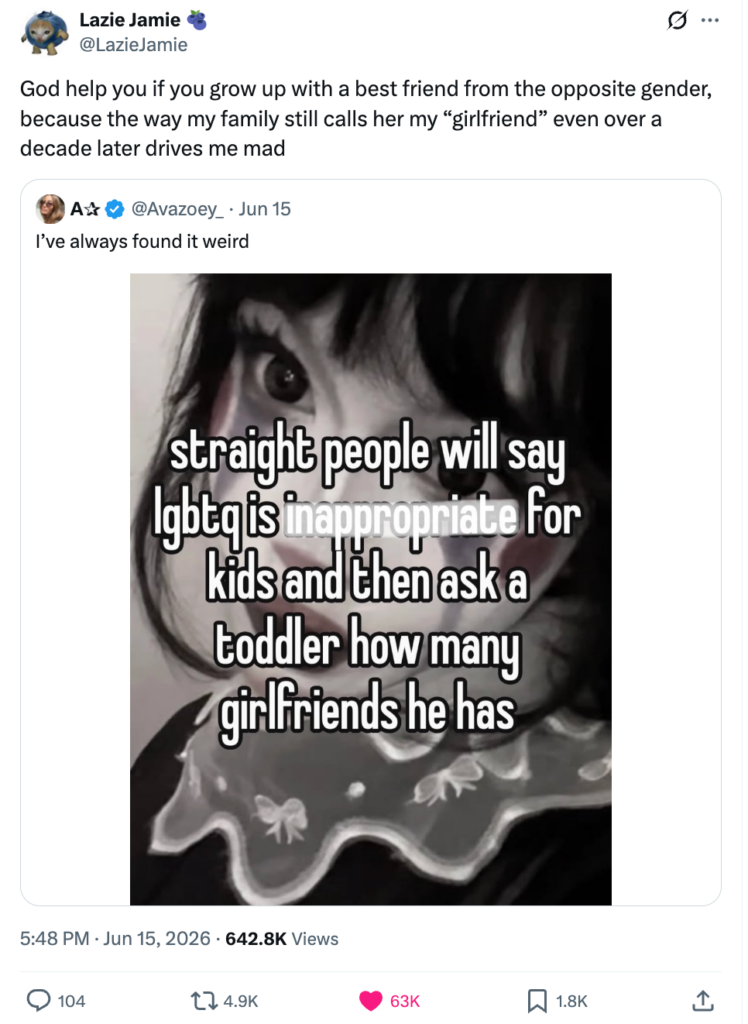
Now, before I go into describing the problems that this can have for children, I want to make it very clear that I am not opposing parents being open with their children about sexuality and relationships. I think that parents having healthy communication with young people about sex, relationships, and related topics is actually very beneficial. In fact, parents going in the opposite direction and being extremely closed off, protective, judgemental, and controlling when it comes to their children being in relationships can be just as, if not more, damaging. However, the point I’m trying to make is that these types of conversations should be based on honesty and support, not done in a teasing way that is meant to embarrass or humiliate the child. Along with this, parents should NEVER overly force romantic connotations onto their children’s interactions and friendships with others, especially when the child is very young or has made it clear that there is no romantic motivation present.
For me, this unsettling behavior by my parents started as early as pre-school. When I was a young child, I found it naturally very easy to make close friends of the opposite gender. My best friends in preschool, and going into kindergarten were always female. Of course, because I was very young, these friendships were strictly platonic, and I had no thought in my mind that there was anything more to them… until my parents began to get involved. Once me and these friends began to hang out with each other outside of school, our parents connected, and my parents began to have knowledge of the friendships I was having, the humiliation ritual started. The comments were exactly what you would expect, constant teasing around us being boyfriend and girlfriend, constant embarrassment. The names of these friends began torturous, so much so that I couldn’t even stand to hear my parents bring them up in any context, because I knew that a humiliating comment would soon follow. She would describe the friends to my other relatives as “his girlfriends”, laughing about the fact I had more than one at a time. I felt ashamed, I felt embarrassed, I felt hurt…
I, of course, made it clear to them that we were not boyfriend and girlfriend, but that didn’t seem to matter. Even though I was young at the time, these memories stuck with me, I remember exactly how I felt—feeling like I needed to shield these friendships from my parents, or else I would receive humiliation in return. But as a small child, your ability to interact with your friends is mostly dependent on either school, or your parents’ willingness to plan “playdates” between the two of you. So keeping the parents out of the equation was impossible.
The hypocritical aspect of this was that my parents clearly weren’t acting like this because they wanted me to date—no—they actually just wanted something to make fun of. The way they worded their comments wasn’t in the way of being happy or proud to believe that these girls were my “girlfriends”, they were just using it as a source of entertainment, in order to humiliate me. This type of behavior doesn’t just embarrass children for their platonic friendships, it also teaches them that dating is something to be ashamed of. It teaches them that romantic relationships are an object of ridicule. There have been many other stories of parents publicly humiliating their young children for having crushes, or immediately outting them to their relatives, because they find the idea of their kid having a crush to be funny. This may seem minor to the parents, but to the child, this is devastating. This doesn’t just make young people have unnecessary stress around platonic friendships, but also can hinder their ability to form strong romantic relationships as they develop into adolescence, because dating and crushes are objects of ridicule in the household. In these situations, parents aren’t being supportive to their young children about dating and entering relationships, they’re acting as a barrier, which is putting permanent hindrances on the young person’s life. Children should know that their parents are safe places to express questions and seek support about dating and romantic relationships in order for them to healthily learn about these things—but that becomes impossible when dating is associated with ridicule and embarrassment.
But I was not the only one to have these problems, in fact several stories have revealed to me just how common these are. One user on X, in response to the previously mentioned posts, stated: “Back in kindergarten, I made two girl friends. They were my first friends. I’m still being taunted every now and then by my relatives for simply making girl friends…”
This story is incredibly similar to my own, and I relate to it heavily. This story is just another example of how this type of behavior starts early—even in kindergarten—when young people are making their first innocent friendships. Then, once this humanity roots itself in the young person’s head, it permanently lasts,
Another similar post in response to parents asking about young children’s girlfriends, states: “me and a friend had a minecraft world where we made a huge diamond block castle and named ourselves king and queen and when we enthusiastically told our families about it was all they’d talk about for like 2 months until i think i actually cried bc of how insistent they were”
The implication here is obviously that once the two friends presented the project to their parents, the parents could only talk about how the young children were dating, or in a relationship. This one is especially upsetting, because it shows the negative impact it can have on a developing young person. Even though the parents believed it was just “teasing”, it wasn’t that to the kid. To the kid, it was torture that brought them to tears. All they wanted was to show their family about an innocent project they created together, as a reflection of their bond, and they were immediately drowned in unwanted romantic connotations that devastated them. Do you think they thought of the idea of being in a relationship when they decided to make the minecraft castle? Obviously not—that idea probably never crossed their mind. And now, it was permanently in their head even driving one of them to tears. Their innocent fun, ruined by forceful romantic pressuring and humiliation.
Another post shares a similar story, stating: “when i was like 8 my uncle always asked if i had a boyfriend already (jokingly, but still) and i always ended up screaming and crying and running away from him because the idea of it disgusted me so much it confused me a lot. i didnt want to have a bf nor my privacy invaded”
This story reflects the fact that this behavior by family members doesn’t even have to occur in reaction to a platonic friendship. These questions can just be randomly brought on at any time, in an attempted joking way… but the impact is nothing to laugh at. In fact, it disturbed her so much that she ran away crying out of disgust at the idea. Everyone in the family probably thought it was in good fun, and that she was overreacting, but when behavior from family members causes this much of a visceral impact on a young child, that should be all the evidence they need to know that it is unacceptable. The poster also brings up another important point—pressuring young people with these questions is a violation of their privacy, which adds to how this should not be normalized.
Along with this, this behavior by parents isn’t just embarrassing and a violation of privacy, it can also be creepy and have dangerous consequences.
The Inherent Creepiness and Dangers of this Behavior
This issue is interesting, because it is rooted in this intense over-normalization of the idea that all male-female interactions should be done for the purpose of dating and acquiring a romantic relationship. A disturbingly large number of people believe that platonic opposite gender friendships do not exist or have any meaning, and that if a male interacts with a woman outside of his family, it should be for dating and nothing more. This idea is then applied all throughout society, even to young children. If they make an opposite gender friend, it’s automatically assumed by adults that the purpose is for a relationship—because that’s all they have the capacity to view cross-gender interactions as.
This has led to oddly culturally normalized behavior around over-romanticizing young children. Because of this, this behavior from parents can very quickly cross into the creepy and dangerous category once they go far enough. Several other stories from the post on X give a different perspective onto just how creepy this can get.
One post stated: “Ive been to a Bday party when i was younger, where adults were trying to get toddlers to kiss because ‘awww, they have a crush on each other’”.
I’m starting off with showing this story, because it’s actually on the tamer side of how adults use this behavior in creepy ways. The key aspect here is that the toddlers were “forced” to kiss. I imagine that in the situation, there was simply a male and female toddler, playing together as friends. The parents, who can’t possibly conceive of boys and girls being friends without some type of romantic intention—even in toddlers—deduced that they must have a secret crush, and then proceeded to humiliate the children into kissing for the parents’ enjoyment. If this doesn’t strike you as genuinely creepy, then I don’t know what would.
The next post stated: “wasnt a toddler but had a DOCTOR try to ‘joke’ with my ten year old brother one time saying that our mom was his wife and i was their child, weird. then he deadass looks my brother in the eyes and says ‘you like older women, huh?’”.
This story is especially concerning because this wasn’t even coming from a parent or family member. This was coming from another unrelated adult, an adult in a professional setting. And yet he still felt like it was okay to make those kinds of remarks in a joking manner. Again, that is not normal—that makes people uncomfortable, and should never be coming from a doctor.
The last post I want to look at is possibly the most troubling, and stated: “Literally in first grade, a boy in my class was STALKING ME (as much as a first grader can) and it eventually escalated to him kissing my cheek, putting a flower in my hair, and saying “we’re married now”. No I’m not kidding. My mother teased me about it for TEN. YEARS.”
This is where I would say this behavior can get into the potentially dangerous category. Of course, in first grade, there wasn’t much actual danger that the boy could pose to the girl. However, if this behavior is being excused and cheered on by his parents, then it could cause actual harm in the future. What I imagine happening from this situation, is that the boy would go about his stalking of the girl, and instead of the parents explaining why that is creepy and wrong, he was only met with silly jokes like “aww you like her”, “aw you have a little wife”. While the girl, who was obviously uncomfortable, went to her mother about it, and instead of being taken seriously, was met with teasing, for “TEN YEARS”.
So if the boy learns that stalking and forcefully kissing women is okay, and the girl gets dissuaded from reporting uncomfortable incidents to her mother, then this is a recipe for disaster when they’re older. Imagine the boy tries to replicate that behavior in middle school, or even high school. Of course, he should ideally know better at this point. But you’d be surprised how much of an impact a parents’ words can have on someone. If he genuinely believed this was acceptable because his parents never shut it down, then he could potentially cause all sorts of problems. And this is exactly why parents need to think before making these creepy comments about young children.
I can personally corroborate the story with one of my own. When I was young, probably around 7 years old, and still close with the previously mentioned female friends, I had been invited to a movie with one of them. My step dad, who had already relentlessly teased me about her being my “girlfriend”, then proceeded to make some of the most disturbing comments I’ve heard from him. It started off with him sitting me down for a lecture about going to the movie with the girl, and my step dad worded this whole thing like a pre-date pep talk—like talking to a highschooler before their first date with a girl. He told me about, and demonstrated, the “yawn technique” of forcing a yawn and using it to put your arm around a girl, then told me that I should use this on my female friend at the movie. And then, possibly the weirdest comment came next. He told me that if she ever put her hand on me or near me, I should take her hand and then demonstrated moving it towards his crotch, like I should be moving my 7 year old female friend’s hand near my groin in a sexual manner. Eventually, my mom stopped him from talking about it, and he laughed it off like it was all a joke. Of course, I never ended up doing any of those things, but just having to be a part of that conversation made me extremely uncomfortable, to the point that I still remember it to this day.
The part that’s creepy and dangerous, though, is imagine if a parent did this to another child, who didn’t know any better to realize that behavior was wrong. Imagine if he did that to a female friend while in elementary school… he would be ostracized, lose his close friendship, and everyone would blame him. However, the real culprit, the real source of the problem would be the parents, who thought it was okay to constantly act like these two children were dating, and then demonstrate romantic/sexual behaviors for him to copy. Once again, this is why parents should never engage in this behavior—because you’re setting your child up for failure.
Now, these stories establish just how common and creepy this behavior is, and the different ways that parents do this, but it is equally important to understand just how this can hinder the social development of children.
How Humiliation by Parents Around Relationships Damages the Socialization of Children and Youth
This behavior is inherently damaging to young children. When they form their first friendships in pre-school and kindergarten, they aren’t thinking about gender and romantic relationships, they’re just connecting to the people they find easiest to connect with. But once their parents poison their minds with this underlying idea that their bonds with the opposite gender should be resulting in romance, it overly stresses them out, and places unnecessary barriers on their ability to connect with others.
I can say, firsthand, that this directly happened to me. After having my strong connection with several female friends while I was a young child (4 – 7 years old), I ended up moving schools, and therefore leaving those previous friends I had made. I then ended up in a new school, and was forced to make new friends. Sounds easy, right? Surely, I would be able to connect with people just as easily as I had in kindergarten and pre-school, and re-establish strong friendships with no effort, right? Wrong. Because of how my parents had instituted the idea in my head that I couldn’t have female friends without them being “girlfriends”, every interaction I had with the opposite gender was underlined by it. Instead of looking at female classmates, and thinking that I could just be friends with them, my brain began swirling in scenarios of having to date them, and having to be in a romantic relationship with them. This idea was intimidating, and downright stressful for a 7 – 8 year old me. I didn’t know how to do that—I knew nothing about being in a romantic relationship. But because of how my parents had treated my last female friendships, that was all I could think about.
After that point, interacting with women at school became difficult. Despite how I was naturally able to connect with girls very easily when I was younger, that ability was clouded and poisoned by this over-romanticization of my platonic female friendships by my parents. When I was making friends with a male student, I never had to worry that I would be endlessly tortured and humiliated about “dating” them. But these worries were at the forefront of my mind when it came to interacting with women. Due to the inherent stress of this, I simply regressed away from making close female friends, and for a long time, all of my close friendships were male. Because of the fact that I had been humiliated for having platonic female friends, I felt ashamed to even try and make them, because I didn’t want to go through the same embarrassment that I had when I was younger. This shouldn’t have been something I had to worry about… these shouldn’t have been thoughts in my head… and yet they were, because of constant humiliation from my parents.
And this mindset wasn’t easy to grow out of—in fact, it persisted for years. By the time I made it to middle school, nothing had changed. I had become more socially awkward, less confident, and making platonic female friends was basically impossible. And now that I was getting older and closer towards the age where actual romantic relationships were on the table, my parents continued to use the idea of it as a way to humiliate me further. My father, especially, took every opportunity where I would even be around girls my age, to embarrass me. I genuinely couldn’t even walk by a girl without some weird comment appearing. I remember one particular instance where I couldn’t have been more than 11 – 12 years old, and me, my father and step mother had gone to this art festival. The entire time, when there was a girl my age even in the mere vicinity of me, they would power up their creepy comments about me being in a relationship with them. In one incident, there was a girl wearing a costume, dressed as Rey from Star Wars, and since they knew I was a fan of star wars, they latched onto this one like a leech. Every time the girl would come into view, their humiliating comments would explode, and become all I could hear from them. At one point, I had to end up walking on the other side of the street from them, while that girl walked by, because their comments had become loud enough to presumably be picked up by her. That whole time, I was thinking to myself just how much I wanted to be home, and away from the situation.
Any amount of confidence that I would have had to be able to approach girls my age around this time was completely sapped from me by the humiliation around dating, relationships, and merely interacting with the opposite gender. The more I think about these memories, the more I realize just how much this negatively hindered my socialization with women at this age. The idea of even being in the same premise with a girl my age petrified me—all because of the fact that my parents had correlated such an immense aspect of ridicule around it.
However, this behavior by my parents did not stop—it only intensified. My first years of high school were no different than the previous years. Only this time, now that I was at the age where relationships were a possibility, there was an expectation of one. My parents, especially my father would constantly pressure me with questions about why I haven’t gotten a girlfriend yet, and why I’m avoidant with women. Despite them being the exact reason for this, I was facing the ridicule and the questioning. My father, on multiple occasions even purposely thrust me into extremely awkward circumstances with girls my age, just for his own entertainment, then justified it by trying to “help” me get a girlfriend. This happened on a multitude of occasions, especially around my step mom’s students. My step mom was a teacher who often had high school girls around my age come over for lessons—which my dad used as a perfect opportunity to put me in an awkward situation with them.
There were several times where he physically forced me into the house to talk to them while they were simply trying to mind their own business and wait for their lesson. Of course, this wasn’t just humiliating for me, but extremely awkward for the girls as well—who just wanted to have their lessons in peace without being jumpscared by a surprise interaction with a random boy. And by no surprise, no meaningful connection ever came from those events—only embarrassment. And when I pleaded with my father to stop, he proceeded to make fun of me for being “scared” of women. The truth was, I was never scared of women, I was scared of being thrown into purposely awkward scenarios against my will. Meeting and connecting with others your age doesn’t happen when it’s forced and coerced, it happens under natural circumstances. But he didn’t care, he just wanted to entertain himself with my embarrassment.
In another incident, he forced me to go to a recital of all of the students happening at a coffee shop, where 95% of the audience was close friends or family members of said students. I didn’t know a single person there—I was the odd one out, the awkward bystander. So by no surprise, I mostly just stuck to myself and played on my phone to act busy. And after the event was complete, I was berated by my father for “not looking up from my phone” to interact with people. For some reason, it was impossible for him to understand the immense awkwardness that comes from being the one individual that absolutely nobody there knew. For some reason, parents often don’t seem to realize that bullying their child for having social anxiety isn’t just a magical fix to make it go away. In fact, it has the opposite effect. The more they are reprimanded for being uncomfortable in social situations, the more they associate social situations with fear and anxiety, creating a feedback loop where the parents’ punishments and ridicule only increases their stress level—and therefore increases their awkwardness.
In some cases, this behavior by my father became less so for humiliation, and more so for vindictive punishment. During the time I was around 15 years old, I was going through a brutal custody battle in which I had been refusing to see my father for unrelated reasons. He had sued my mother over it, and unfortunately, the court took his side and ordered me to go back with him. As one of the ways of exercising his control for revenge, he decided to book a concert with his wife during the weekend I was supposed to be with him. He then booked one of my step mom’s students who was the same age as me, as a “babysitter” for both of us. This was just horrendously awkward in and of itself. Imagine being a teenage girl being told that you’re supposed to be “babysitting” another boy your own age—it’s ridiculous and obviously awkward not just for me, but for her as well. I knew this was a ploy by my father to force me into an embarrassing situation as revenge. Obviously, when I found out about this, I didn’t even bother entering his house, and since he wasn’t there, I didn’t see a need to. After all, the “visitation” time was supposed to be spent seeing him, not awkwardly waiting at his house with my baby brother and some random girl who was told she’d be “babysitting” us.
However, he proceeded to call the girl, ask if I was in the house, and when he found out I wasn’t, he proceeded to call me, tell me I was in violation of the court order, and that if I didn’t stay in his house, he would launch another lawsuit at my mother for violating the custody agreement. So at this point, not only did he purposely design the situation to humiliate me, not only would it have already been extremely awkward in the first place, not only did he increase that embarrassment tenfold by communicating with her about the issue with me not being there, but he had directly showed me that his only motive for this behavior lay in revenge. And despite my efforts to resist, I was forced into the awkward situation, and it was just as embarrassing as I imagined. When my father returned, once more, I was made fun of when he found out that me and the girl didn’t spend much time together, I was made fun of when he found out I went into my room. Apparently, if I didn’t just immediately make this random girl my girlfriend, I was a failure and deserved ridicule.
Because of these constant embarrassing situations being put upon me by my parents, even in my early years of high school, the prospect of talking to women in person was basically impossible for my socially awkward brain after repeated humiliation. In fact, this entire string of events had caused me to develop extreme social anxiety, where being put in an uncomfortable social situation with anyone—regardless of gender—gave me feelings of panic. This social anxiety consumed a lot of my high school life, and still persists within me to this day. Maybe my parents aren’t all to blame. Maybe some of it’s natural. Maybe some of it is my fault. But I know that their humiliation played a major role in these feelings… I know that if I wasn’t being constantly embarrassed and ridiculed for uncomfortable social situations, I wouldn’t have feared them as much. The more I think back on this, the more I think of how confident I could have been, if that wasn’t robbed from me by my parents who just wanted a quick laugh. This is what parents who do this don’t understand. They think it’s funny, they think it’s no big deal. But what they don’t realize is that they’re permanently forcing barriers up in their child’s minds around dating, socializing and interacting with the opposite gender. What they think was an innocent joke to a young child could have a lasting impact on their socialization far into adolescence. And parents repeating the behavior as the child becomes a teenager is even more harmful. This teaches young people that they aren’t safe… that they can’t express genuine emotions, and that their parents are not supportive people they can come to with these topics.
This is exactly what happened to me growing up. I knew that my parents were not safe individuals to discuss anything related to dating or platonic female friendships with. But unfortunately, my parents were inherently tied into these in-person experiences that I would have… which is why the prospect of these in-person experiences filled me with so much anxiety. However, I began to introspect, and realize ways of mitigating this anxiety. One of the main ways I did this was through forming close friendships and relationships online, rather than in person. Online friendships had no burden of my parents being involved, and therefore no way for me to be humiliated by them. If I was ever forced into an uncomfortable social situation with a long-distance friendship or relationship, I wasn’t trapped—I could simply turn off the device and let myself calm down before I chose how to proceed. Forming friendships online was the perfect coping mechanism to my social anxiety which was induced by my parents. From then on, I was able to form so many platonic bonds with female friends over the internet, so much so that they began to outnumber my male friends by an increasingly drastic margin. It was only then when I reconnected with my kindergarten self—realizing just how much I could genuinely connect with women, forming deeper friendships than I ever had with my male friends. It was a stark realization of what I had been missing out on due to my social anxiety and avoidance.
This may be a little far from the original point, but this is just one of the many reasons why I often stress just how damaging social media bans and restrictions for minors can be. People often view online connections with “strangers” as inherently harmful for minors, and therefore believe that they should be restricted from accessing the social media necessary to form them. But this couldn’t be further from the truth. Sometimes, online friendships help socially awkward and anxious teenagers build strong friendships that they never could have dreamed of in person. And in building these friendships, they gain the confidence needed to carry over these social skills in real life. Taking away this ability is just another major harm of social media bans for minors, in which politicians do not realize that they’re damaging vulnerable young people’s ability to socialize.
For me, connecting with women my age over social media slightly lessened the anxiety I felt around interacting with them in person. By my sophomore year of high school, I had actually begun to make close female friends again, for pretty much the first time since second grade. However, my parents were still hindrances to this. At one point during my sophomore year of high school, these two girls that I had never spoken to before, randomly approached me and invited me to be part of this movie they were filming for part of their theater class.
Though being part of the project with people I had never met before still filled me with social anxiety, I accepted—because I wanted to put myself out there and hopefully make new friends. But of course, as a 15 year old, I couldn’t drive, and therefore had to rely on my parents for transportation, which meant answering the grueling questions about where I was going and who I would be with. When my parents—particularly my step father—found out that I had been invited by two girls to be part of this project, the humiliation ritual began once more. I remember when I got back from our first hangout, I came out of it feeling pretty satisfied. Yes, some parts were awkward, but I powered through. However, when I returned home, my step dad (and to an extent, my mother as well), sat me down, and proceeded with the most awkward string of questions that turned an innocent group of friends into a subject of embarrassment. The first question, and the one that sticks with me to this day, was “which one of them likes you?”.
This wasn’t said as a joke, this wasn’t said to humiliate me like how my parents had done in the past. This was dead serious. When I informed him that we were just friends, and, again, had only met a few days ago, my answer was apparently unsatisfactory. I then was forced to sit through a lecture about how the only reason that two girls would have invited me to participate in a project like that was if one of them secretly had a crush on me and this was their excuse to spend time around me. I informed him that first of all, I didn’t believe either of them liked me, and second of all, I didn’t care either way, because I was just happy to have friends, which still wasn’t satisfying. After a while of going back and forth, my mother began to suggest (or rather, more of a soft-launched demand) that if these two girls are my friends, I should invite them over to the house to swim this weekend.
Now, this may not seem bad in theory, but remember the context. I had just met these girls, and had only hung out with them outside of school once, for the main purpose of working on a project. At the time, we were still basically only acquaintances, not friends, and not nearly on the level of comfortability required to casually invite them over to my house. When I informed my parents of this, and denied their request to invite the girls over, I was seen as the problem. I was “being weird” or “scared”, or anything else they could throw at me. This interaction only reinforced the idea in my mind that I literally could not have my parents have any knowledge of my social life whatsoever, especially interactions with the opposite gender. Why? Because they will always find some way to make something uncomfortable, to humiliate me, to try and force me into an awkward situation. This taught me that my parents were not a safe place to go when discussing my social life, which only made me more closed off, and thus more awkward.
On top of this, the comments from my stepfather also illustrate just another instance of adults being unwilling to accept male-female interaction as strictly platonic, and instead trying to force romantic connotations onto friendships. And it’s especially important to note that he was wrong. Despite my stepfather alleging that there was no possible way that the girls couldn’t have liked me, and had to just be using the project as an excuse to spend time with me, none of this came true. In fact, those two girls became my closest friends for the rest of high school, and helped me open up and come out of my shell to make new friends. No romantic connection ever occurred, just simply platonic friendship, which is completely normal and should not be ridiculed or questioned by adults. Comments from adults like my stepfather about the nature of these relationships will only serve to degrade the connection, and force unnecessary awkwardness onto an innocent bond.
All of these behaviors by parents mentioned—whether they embarrassing their children with relationships, pressuring with “is she your girlfriend” type questions, forcing romantic connotations onto platonic friendships, making creepy comments, treating dating as an object of ridicule, and forcing young people into awkward situations—are oppressive, and emotionally abusive due to the negative mental impacts that they can have on children.
So what do we do about this, how do we fix this problem? Well firstly, I am in no way saying that we should be forced to keep an artificial “innocence” of children at the forefront of everyone’s behavior. No, it is not bad to expose children to romantic relationships. The more things children are exposed to at a young age, the better it is for them as they grow up. But this exposure must be done in a healthy way… not in a way that is inherently made to be humiliating. If a young person has a platonic friend of the opposite gender, parents should never force romantic connotations or pressure onto them about that friendship. Parents should never force confessions out of children regarding their romantic relationships. Parents should never ask a young child how many girlfriends they have. Most importantly, romantic relationships should never be pushed as the only way for children to interact with those of the opposite gender. Parents should push the idea that anyone can have strong, non-romantic bonds with opposite gender friends, with absolutely no pressure for it to go into dating. Parents should also make sure that their children know that dating is nothing to be ashamed of. Parents should never bully children for their crushes, or publicly out them to their relatives for experiencing romantic attraction. On top of this, parents should never force their kids into awkward social situations for the purpose of embarrassing them or trying to coerce a connection between them and another kid. All this does is make them throw up mental barriers, and develop negative associations with socialization.
So parents, if you’re reading this, don’t be part of the problem. Help your kids feel safe around you, because even if you don’t realize that something you view as an innocent joke about their friendships or relationships could be harmful, there is a good chance that it already has a lasting impact in their mind.
The National Youth Rights Association
If you’re interested in Youth Rights, consider volunteering with us. We are always looking for new members and would love to have you on board. If you have a personal story to share, of how this type of behavior by your parents has negatively impacted your life, or about a general youth rights violation, consider sending us an email at nyra@youthrights.org. We’d love to help get your story out to the world.
The text of How “Is She Your Girlfriend” Teasing by Parents Can Harm Developing Children © 2026 by Zane Miller is licensed under CC BY-SA 4.0.