
Young people in America have always faced discrimination and systematic disenfranchisement when it comes to voting, and having their voices heard by the government. It wasn’t until 1971 that the voting age was even lowered to 18 years old, when previously it was at 21, while the country forced thousands of young men to be drafted for war while not even getting a say in who ran their country. And despite the fact that people under 18 are affected by the laws of the country just as harshly, if not more so, than adults, they are still denied voting rights. However, even when young adults are given the right to vote, state governments have still taken steps to attempt to restrict this right for them, by closing voting locations, and placing unnecessary barriers on voter registration that disproportionately affects young Americans. Unfortunately, leading up to the 2026 midterm elections, we’ve seen a surge of these efforts to disenfranchise young voters and student voters in particular.
These barriers are particularly concerning because young people already face obstacles to political participation that older voters are less likely to encounter. Many college students live away from their permanent homes, move frequently, lack personal vehicles, and have limited experience navigating election procedures. Rather than addressing these disadvantages, many government officials have made participation more difficult. In our country, where the voting age is already set at 18 years old, (denying the rights of thousands of young Americans to vote), the young adults who do have the right to vote should have that freedom protected and supported by the government, not limited.
Table of Contents
- North Carolina Removes College Campus Polling Locations, Prompting Student Protests
- Texas Fails to Process Hundreds of Thousands of Voter Registrations
- Virginia Rejects College Students’ Voter Registrations Over Minor Technicalities
- Restrictions on Student IDs being used for Voter Identification
- New Hampshire Tightens Voter Registration Documentation
- Federal Government Restricts Funding for Campus Voter Registration Efforts
- Other States Have Previously Attempted to Restrict College Voting Access
- Research Shows Young Voters Face Disproportionate Voting Barriers
- Young Voters’ Constitutional Rights Must Be Protected
North Carolina Removes College Campus Polling Locations, Prompting Student Protests
One of the most visible examples of barriers to youth voting emerged recently in North Carolina, where election officials rejected or removed early voting locations at several universities ahead of the 2026 elections. The controversy began in January, when the Republican-controlled North Carolina State Board of Elections approved plans that excluded proposed campus polling locations at North Carolina A&T State University, the University of North Carolina at Greensboro, and Western Carolina University. Students and voting-rights advocates objected to the decisions, arguing that eliminating convenient voting opportunities would discourage participation among students who lacked reliable transportation.
The controversy continued ahead of the November midterms. In July, the Guilford County Board of Elections voted 4–1 to approve an early voting plan excluding on-campus locations at North Carolina A&T and UNC Greensboro, both of which had hosted early voting during the 2024 presidential election. The state election board subsequently approved the plan in August despite repeated objections from students. Although neither university had historically hosted early voting during midterm elections, the decision nevertheless removed voting opportunities that students had recently been able to access. Meanwhile, disputes over campus voting access also affected institutions such as Western Carolina University and Elon University.
On October 15, 2026, the first day of early voting in North Carolina, more than 100 students from North Carolina A&T and UNC Greensboro participated in a march to an off-campus polling location. Students at North Carolina A&T walked approximately 45 minutes to reach the Union Square early voting site in Greensboro, with some parts of their route lacking usable sidewalks. The demonstration took place in temperatures reaching approximately 85 degrees. Students from Bennett College also reportedly participated in the broader demonstration. Rather than simply crossing their campuses to cast their ballots, students organized a lengthy walk to overcome the loss of convenient polling locations.
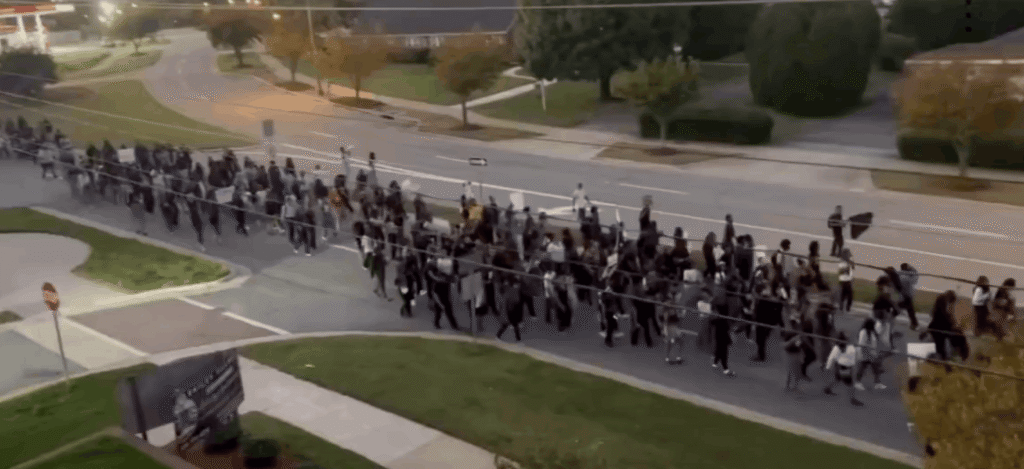
The North Carolina controversy illustrates how polling-place decisions can effectively make voting more burdensome without formally denying anyone the right to vote. A student with classes, work responsibilities, or limited mobility may not be able to spend an extended period traveling to and from a polling location. Although the students who participated in the march were able to cast their ballots, many eligible voters may not have the same flexibility. Government officials should be reducing these logistical barriers, not requiring young people to organize collective demonstrations simply to access the ballot.
Texas Fails to Process Hundreds of Thousands of Voter Registrations
While North Carolina students were protesting inaccessible polling locations, Texas was confronting a different election-administration failure. A major software problem involving the Texas Department of Public Safety prevented hundreds of thousands of voter registration records and updates from being transmitted to county election officials. Some of the affected applications dated back to October 2025, meaning the problem persisted for months before becoming a major public controversy shortly before the 2026 midterms.
The failure affected the state’s system for registering voters during certain driver’s license transactions, including renewals and address changes. Some applicants received confirmation receipts despite their registration information not being properly transmitted for processing. According to The Texas Tribune’s October 14 investigation, the problem created a backlog involving at least 500,000 registration records, while other reporting placed the figure at approximately 593,000. On October 9, the League of Women Voters of Texas and MOVE Texas Civic Fund filed a lawsuit against state officials, arguing that the registration failures violated obligations established under a 2021 settlement requiring Texas to maintain a functioning simultaneous driver’s license and voter registration process.
By October 16, state officials reported that counties had cleared the original backlog, according to the Associated Press. However, a separate technical problem involving approximately 15,000 additional registration records was subsequently reported. Clearing a backlog is an important corrective action, but it does not erase the consequences of allowing such a massive registration failure to persist so close to an election.
Although the registration failures affected Texans of all ages, young adults and first-time voters depend heavily on driver’s license offices and related systems to register. One of the biggest ways this disproportionately affects young voters is how it failed during updates to voter restoration regarding address changes. Young Americans are more likely to have to frequently change their addresses, due to moving out for college, transferring college, moving back in with parents, getting a new temporary apartment with roommates, etc, while older adults are more likely to remain at a stable address that doesn’t need updated for an extended period of time.
The Texas incident demonstrates that disenfranchisement risks do not always originate with deliberately restrictive laws. Administrative incompetence can also place voting rights in jeopardy. Citizens who follow the prescribed registration process should not have to investigate whether government computer systems successfully transmitted their applications. When those systems fail, the burden should fall on election administrators to correct their mistakes, not on voters who reasonably believed they had already registered.
Virginia Rejects College Students’ Voter Registrations Over Minor Technicalities
In Virginia, college students encountered a more direct obstacle when election officials rejected or delayed registration applications because students failed to provide unnecessary details about their campus addresses. Students living in dormitories were required by some local officials to provide information such as dormitory names, room numbers, or campus mailbox numbers, even when those details were not necessary to establish eligibility or determine the appropriate voting precinct.
The practice affected students at several universities, including historically Black institutions such as Norfolk State University and Virginia State University. Civil rights organizations argued that students were being denied registration despite providing the information legally necessary to establish their eligibility. In October 2025, the NAACP Virginia State Conference and Advancement Project filed a lawsuit challenging these practices.
On June 4, 2026, a federal judge approved a consent decree requiring Virginia election officials to stop rejecting otherwise eligible student applications solely because they omitted immaterial dormitory information. The agreement also required officials to provide additional guidance and training, revise registration forms, and pursue regulatory changes to prevent similar problems in future elections. The NAACP described the settlement as an important victory for college voting rights.
Virginia’s actions demonstrate how seemingly minor administrative requirements can become obstacles to political participation. A college student should not lose the opportunity to vote because an election official demands a mailbox number that has no bearing on their eligibility. The state’s eventual agreement to change these practices is welcome, but these unnecessary requirements should never have prevented eligible students from registering in the first place.
Restrictions on Student IDs being used for Voter Identification
New Hampshire has taken a different approach to restricting voting access among college students. In 2026, the state enacted House Bill 323, which removed student identification cards from the list of photo IDs expressly accepted for voting. Previously, qualifying student IDs had been an accepted form of identification under state law, providing an accessible option for students who did not have a driver’s license or other commonly accepted government-issued photo identification.
The change disproportionately concerns students because a college-issued ID may be the identification they use most frequently. Students living on campus may not drive or have ready access to alternative documents, even though their university identification establishes their identity for numerous everyday purposes. Eliminating these IDs as a standard voting option creates another procedural obstacle for eligible voters.
Voting-rights advocates challenged the law in federal court. On October 2, 2026, a federal judge declined to block the student ID exclusion itself but partially restricted the state’s implementation of the law. The ruling prohibited officials from categorically refusing to consider student IDs as supporting evidence under alternative identity-verification procedures. New Hampshire subsequently appealed the partial injunction, leaving further litigation pending ahead of the election.
The court’s decision did not establish that the statute itself was unconstitutional, and students still have alternative methods of establishing identity. Nevertheless, the policy raises a fundamental question: why should an identification card issued by an accredited educational institution be excluded from ordinary voting procedures when students previously relied on it successfully? Instead of simplifying voting for first-time participants, New Hampshire has made the process more complicated for a population already navigating unfamiliar election requirements.
Other states have also previously passed restrictions that limited student IDs’ ability to be used as voter registration. In 2011 in Texas, Republican Governor Rick Perry signed Senate Bill 14, which established strict photo identification requirements for voting while excluding student IDs issued by colleges and universities. Notably, the legislation allowed Texans to use concealed handgun licenses as acceptable identification while refusing to recognize student IDs, even those issued by public universities. Voting-rights advocates criticized the distinction for imposing unnecessary burdens on college students and younger voters, who may be less likely to possess alternative identification.
The legislation was initially blocked from taking effect after the U.S. Department of Justice and a federal court refused to approve it in 2012, but Texas began enforcing the restrictions following the Supreme Court’s 2013 decision in Shelby County v. Holder. Although subsequent litigation resulted in alternative voting procedures for individuals who cannot reasonably obtain acceptable photo identification, Texas law continues to exclude student IDs as standard voter identification for the 2026 midterm elections. The policy demonstrates how government officials have long imposed additional barriers on younger voters, even while recognizing other forms of identification that are less commonly held by college students.
This regulation in Texas also drew criticism for its potential for voter disenfranchisement based on political ideology. The party in power at the time this bill was passed in Texas was the Republican party. In Texas, students and younger Americans are more likely to lean toward voting in favor of the Democrat party, while avid gun-owners are more likely to lean in favor of voting for the Republican party. According to ABC News’s 2024 Texas exit polls, voters ages 18–29 supported Democratic Senate candidate Colin Allred over Republican Ted Cruz by 53% to 45%, while voters ages 65 and older favored Cruz by 59% to 40%. Meanwhile, Pew Research Center found that 45% of Republicans and Republican-leaning Americans personally owned firearms, compared with just 20% of Democrats and Democratic-leaning Americans. A study of concealed handgun license applications in Texas also identified a relationship between conservative political preferences and higher rates of handgun license applications. So the fact that a student ID (possessed by young Americans who vote blue), cannot be used to cast a ballot, while a handgun ID (usually possessed by older Americans who vote red) can, opens up the idea that this regulation was actually targeted disenfranchisement for voters.
New Hampshire Tightens Voter Registration Documentation
New Hampshire’s student ID restrictions are not the state’s only recent changes that could burden younger voters. In 2024, lawmakers passed House Bill 1569, which established stricter documentary requirements for voter registration and removed certain affidavit-based alternatives that previously allowed applicants to establish their qualifications.
Requiring additional proof of citizenship, age, or domicile can create particular problems for college students and young adults. Students may have left birth certificates and other important documents at their family homes, while those living independently may have difficulty obtaining replacement records or satisfying residence documentation requirements. First-time voters may not discover these barriers until they attempt to register.
The law has generated litigation, and subsequent court decisions have affected its implementation. Nevertheless, the policy reflects a broader pattern in which lawmakers respond to election-security concerns by imposing additional documentation burdens on eligible voters. Rather than assuming young adults can easily produce every requested document, election officials should recognize that these requirements can prevent otherwise eligible citizens from participating.
Federal Government Restricts Funding for Campus Voter Registration Efforts
In August 2025, the U.S. Department of Education rescinded previous guidance that allowed federal work-study funding to compensate college students for certain voter engagement activities, including nonpartisan voter registration assistance. The department’s new policy prohibited institutions from using federal work-study funds for the political activities covered by the guidance.
Department officials defended the change by arguing that federal financial assistance should support employment and professional development rather than political activism. However, the previous guidance had also permitted nonpartisan civic engagement work intended to help eligible citizens register and participate in elections. Treating voter registration assistance as an inappropriate activity for federal work-study funding threatens an established way for universities to support student participation.
The policy does not prohibit universities or student organizations from independently conducting lawful voter registration drives, and its precise effects will depend on how institutions respond. Nevertheless, rescinding the funding authorization removes a potential resource from campus civic engagement efforts ahead of the 2026 elections. For students who may be navigating registration for the first time, assistance from peers and campus organizations can make an important difference. The federal government should not unnecessarily discourage universities from helping students understand and exercise their voting rights.
Other States Have Previously Attempted to Restrict College Voting Access
Although several of these controversies are unfolding during the 2026 election cycle, attempts to restrict college voting access are not new. Earlier cases demonstrate that disputes over campus polling locations, student identification, and registration requirements have persisted for years, sometimes resulting in judicial findings that government officials violated voting rights.
In 2024, Republican officials in Tarrant County, Texas, attempted to eliminate several early voting locations on college campuses, including sites at the University of Texas at Arlington and Tarrant County College. County Judge Tim O’Hare defended the proposed cuts as a cost-saving measure because the affected locations had relatively low turnout. Critics argued that removing these sites would disproportionately burden young voters and students of color. Following public opposition, the Tarrant County Commissioners Court voted 4–1 to preserve the locations and add another voting site. As The Texas Tribune reported, the proposal ultimately failed, but it demonstrated how easily college voting access can become a target for local government decisions.
In 2018, students at Prairie View A&M University, a historically Black university in Texas, sued Waller County over an early voting schedule that provided no voting location on campus or elsewhere in Prairie View during the first week of early voting. Students argued that the arrangement disadvantaged predominantly Black student voters compared with residents of other communities. The county eventually expanded campus voting hours. However, a federal judge ruled in 2022 that the county’s 2018 arrangements had not violated federal voting protections.
Florida provides an especially consequential historical example. For several years, state election officials interpreted Florida law as prohibiting early voting locations at facilities associated with colleges and universities. In 2018, a federal judge blocked that interpretation, ruling that excluding otherwise eligible campus facilities violated constitutional protections, including the Twenty-Sixth Amendment’s prohibition on age discrimination in voting. The decision in League of Women Voters of Florida v. Detzner established an important example of the constitutional problems that can arise when governments single out campus voting locations for exclusion.
Wisconsin has also maintained special requirements for college-issued voter identification. Student IDs used for voting must meet particular standards involving expiration dates, issuance dates, and signatures, requirements that ordinary campus identification cards may not satisfy. Students at institutions such as the University of Wisconsin-Madison may consequently need to obtain separate university-issued voter IDs to participate. These rules illustrate how a state can technically permit student identification while still requiring additional administrative steps that may discourage young voters by placing unnecessary barriers upon them.
Taken together, these earlier cases show that young voters have repeatedly been forced to defend their access to the electoral process against policies that create unnecessary barriers. Some restrictions have been defeated through public opposition, others have been overturned in court, and some have survived legal challenges. Regardless of the outcome, the recurring disputes show how much effort young people and voting-rights organizations must devote simply to preserving accessible participation.
Research Shows Young Voters Face Disproportionate Voting Barriers
These government actions are particularly troubling because young adults are already more likely to experience circumstances that complicate voter registration and participation. Research from Tufts University’s Center for Information & Research on Civic Learning and Engagement (CIRCLE) demonstrates why seemingly neutral restrictions can disproportionately affect the youngest eligible voters.
According to CIRCLE’s April 2026 analysis, approximately 70% of young people register through driver’s license agencies or online systems, making failures or restrictions affecting those systems especially consequential. The organization also found that more than one-quarter of young people had moved during the previous year, while fewer than half possessed a passport. Young people move approximately twice as frequently as older adults, increasing the likelihood that they will need to update their voter registrations or provide additional residency documentation.
These findings are directly relevant to the current controversies. Texas’s failure to process driver’s license-related voter registrations affects a process that young people heavily depend upon. New Hampshire’s documentation requirements place additional burdens on individuals who may not have passports or ready access to original citizenship documents. Virginia’s rejection of student applications over dormitory information illustrates how ordinary college living arrangements can create unexpected bureaucratic difficulties. Similarly, removing campus polling locations can disproportionately affect students who lack access to cars or flexible schedules.
Young voters also face substantial challenges simply becoming registered. A September 2026 CIRCLE analysis found that voter registration among Americans ages 18–29 was approximately 2% higher than at the comparable point before the 2022 midterms in the 42 states examined. However, registration among newly eligible 18 and 19-year-olds remained lower, suggesting that the transition into electoral participation continues to present difficulties for first-time voters.
These challenges should be reasons for election officials to make registration and voting more accessible. Instead, restrictions on identification, campus voting locations, and registration procedures can compound the disadvantages younger voters already experience.
Young Voters’ Constitutional Rights Must Be Protected
The Twenty-Sixth Amendment to the U.S. Constitution prohibits federal and state governments from denying or abridging the voting rights of citizens who are at least 18 years old. Yet more than five decades later, controversies involving student voting rights continue to emerge across the country. Governments should not treat young people’s access to the ballot as less important simply because they are students, move frequently, have less access to complicated identification. When state governments make a particular law that directly restricts voting access for college students, they are directly discriminating against American voters based on their age.
The events surrounding the 2026 midterms reveal how fragile voting access can become when election officials prioritize restrictive rules, administrative convenience, or political disputes over accessibility. Students in North Carolina should not have to walk 45 minutes to a polling place because officials refused to maintain convenient campus locations. Eligible Virginia students should not have their registrations rejected over irrelevant dormitory details. New Hampshire and Texas students should not face additional uncertainty simply because their primary identification was issued by a university. And Texans should not have to worry that government computer failures left their registration applications unprocessed.
The right to vote should not depend on whether a young person owns a car, possesses a passport, understands complicated registration procedures, or can afford to spend hours overcoming barriers created by election officials. Young Americans deserve an electoral system that welcomes their participation rather than placing additional obstacles in their way. Protecting youth voting rights requires more than allowing citizens to cast a ballot in theory. It requires governments to maintain accessible polling locations, administer registration systems competently, accept reasonable identification, and avoid unnecessary bureaucratic government restrictions. The upcoming midterm election is one of the most tenacious, politically charged and therefore important elections of America’s political history. That means everyone’s voice should get to count, and everyone’s vote should be cast. State governments have no right to place unnecessary barriers and hindrances that directly affect the ability of students and young Americans to cast their ballots during this vital election.
The National Youth Rights Association
If you’re interested in Youth Rights, consider volunteering with us. We are always looking for new members and would love to have you on board. If you have a personal story to share about how your voting rights were disenfranchised because you were young, or about a youth rights violation you’ve experienced, consider sending us an email at nyra@youthrights.org. We’d love to help get your story out to the world.
The text of How Young Voters are Being Disenfranchised in the 2026 Midterm Elections © 2026 by Zane Miller is licensed under CC BY-SA 4.0.