
A clip from a campaign event for Florida Republican gubernatorial candidate Byron Donalds recently went viral online and has created some interesting discourse regarding parental estrangement from young adults. During the event, an older woman in the audience became emotional, breaking down in tears while describing an estrangement from her adult daughter that had prevented her from seeing her grandson. The woman said she had not been allowed to see him for roughly two months and attributed the situation to what she described as her daughter being “petty” over political disagreements. As she began crying and raising her voice, she argued that grandparents should have legal rights to maintain contact with their grandchildren and demanded that Donalds support legislation that would prevent parents from completely cutting grandparents out of their grandchildren’s lives. The clip was later widely circulated across X as an example of the increasingly public debate surrounding family estrangement and so-called “grandparents’ rights” as political issues demanding government attention. In this article, we’ll be taking a deeper look into parental estrangement, the reasons for it, and the harms of the idea that the government should be enforcing parental control over adult children.
Table of Contents
- Parental Estrangement – Why Has it been Increasing?
- Oppressive Parents Want Control over their Children’s Choices Instead of Taking Accountability
- Grandparents’ Rights as a Culture War Issue for Conservatives
- The Impact of LGBTQ Discrimination on Parental Estrangement as a Culture War Issue
- Parental Rights are just as Harmful
- Let the Youth Make the Decisions
Parental Estrangement – Why Has it been Increasing?
This incident occurred in the midst of a wider growing discourse about the increasing rates of young adults cutting off their parents, and how parental estrangement has become increasingly acceptable in society, much to the displeasure of older generations. A 2025 YouGov survey of 4,395 U.S. adults found that 38% were currently estranged from at least one close relative and 16% were currently estranged from a parent. Among people estranged from a parent, they were about twice as likely to say that they themselves had initiated the cutoff as to say the parent had done so. Related data has found that young adults (especially LGBTQ adults) are more likely to cut off their parents.
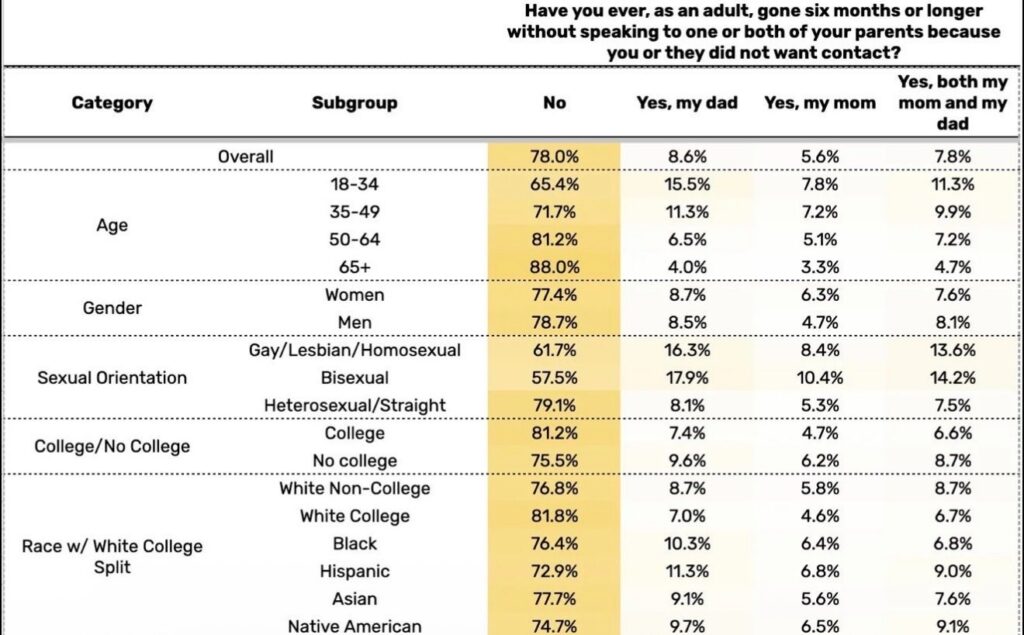
A recent article by the The Wall Street Journal reported on parents who regard the growing acceptance of “no contact” as deeply distressing and sometimes see contemporary therapy culture, social media, concepts such as “toxicity,” and changing expectations about family obligations as encouraging adult children to sever relationships that parents believe could have been repaired. This type of reaction from older adults regarding their adult children cutting contact with them, exactly reflects the behavior of the older woman in the video from Byron Donalds’ event. She complained that her daughter cut her off, and instead of trying to work things out with her, she berated her daughter, called her “petty”, and begged the government to step in and force their contact. This attitude is incredibly dangerous, because it reflects the continuing trend that parents do not believe they should be held accountable for their actions towards their children, and want the government to stop in and grant them ownership over their children to control their actions.
The increasing rate of estrangement makes much more sense when you actually look at the reasons as to why young adults are cutting off their parents, rather than listening to the parents’ side of the story which usually involves shouting, name calling, and calls of “ungratefulness”. The clearest recent data on why adult children cut off parents comes from the 2025 YouGov survey. Among respondents estranged from a parent, the two most frequently cited causes were manipulative behavior (34%) and physical, emotional, or sexual abuse (34%), followed by lies or betrayal (31%). That is useful because it pushes against the idea that most adult children are ending relationships simply because of ordinary political disagreements or minor differences in lifestyle. Recent research summaries reach a similar conclusion: adult children commonly describe estrangement as the culmination of a longer pattern of conflict, attempts to establish boundaries, and unsuccessful efforts to make the relationship workable rather than as an impulsive decision over one incident.
Another particularly useful 2026 Washington Post article by sociologist Rin Reczek draws on 68 in-depth interviews with estranged adults. Reczek reports that participants often had difficult childhoods and some had experienced abuse, but they generally described the immediate reason for going no-contact as problems continuing into adulthood: relatives refusing accountability, disregarding boundaries, failing to show mutual respect, or making the relationship feel emotionally unsafe.
Oppressive Parents Want Control over their Children’s Choices Instead of Taking Accountability
Looking at the data and studies, it puts things in perspective for the young adults cutting off their parents. They’re not just becoming estranged for no good reason, their decisions were based on their childhood mistreatment from their parents, and how the parents still fail to act in a way that is conducive to a healthy relationship when their child becomes an adult. The fact that so many older adults are so displeased about becoming estranged, and immediately shift the blame onto their child, is exactly the source of the problem. One of the main cited reasons for young adults cutting off their parents was “manipulative behavior”, which fits the condition here perfectly. Manipulators, especially manipulative parents often refuse to take accountability for their actions, and believe that their position as being a parent in a default state of authority somehow makes them immune from the consequences of their actions. They believe they can get away with mistreating their child throughout their childhood and into their adulthood, without having to face any pushback.
This attitude by manipulative parents directly reflects the concept of Parental Oppression, where parents believe children are their property, and want to be able to control every aspect of their life. Oppressive parents will mistreat a child throughout their entire childhood, often pushing overbearing rules onto them, emotionally abusing them, gaslighting them, guilt tripping them, and having no respect for their privacy or trust. This is because they fundamentally do not believe their child is equal to them as another human being; they believe their child is below them and should be treated as property rather than an individual. The grandmother’s reaction in the video basically confirmed that she is one of these parents, because her first thought was to beg for the government to step in and control her daughter’s decisions. She believes that since she is the parent of her daughter, her daughter should not be allowed to make decisions regarding cutting contact with her, and it is the government’s job to ensure her continuing control of her daughter, even when that daughter is now an adult. When you look at it from this angle, it’s no wonder why she was cut off—because she has absolutely no respect for her daughter’s autonomy.
A few users on X gained popular responses to the event, by calling out the ridiculousness of the grandmother’s actions, and comparing it to parental oppression and the growing epidemic of how parents expect the government to step in to guarantee them further control of their children.
One X user had a particularly interesting take on the event, stating: “This is so funny because it takes the stance that a child is the property of their parents even after reaching adulthood so they can choose lay claim to anything their child owns or has in the future. This is reflected through all conservative talking points regarding family”
Another X user stated: “This is actually a problem I’m seeing quite a bit. Parents not able to manage relationships with their kids or control their behaviors or lifestyles and are voting to have government step in to try and “fix” their kids. This is crazy.”
Grandparents’ Rights as a Culture War Issue for Conservatives
X user Matthew Chapman offered a more in-depth analysis of the issue, stating:
“As insane as it sounds, this is very, very likely to be one of the next big hot-button culture wars the right focuses on: stopping children from estranging their parents.
Spend a little time trawling through Facebook and you’ll find hundreds of “support groups” for estranged parents of adult children, who are fully convinced not only that they did nothing wrong to deserve the estrangement, but that there’s some sort of “estrangement epidemic” going on in America and that the therapy industry is evil and brainwashed their children to do it. You’re starting to see op-eds about this in places like the Wall Street Journal too”…
“But this sort of thing has real potential as a culture war issue for the GOP. A huge chunk of their base are aging Gen X and Boomers who are at the right age to lose access to grandkids if estranged. Studies show that ever since the rise of MAGA, liberals are more likely than conservatives to cut family members out of their lives. And something like 80-90% of mental health professionals — whom many of these parents blame for estrangement — identify as politically liberal.
All of the pieces are there for this issue to become a huge, center-stage grievance for the right. We could increasingly see Republicans push for new restrictions on therapy, or new laws to make it easier for grandparents to sue for visitation of their grandkids in estrangement cases.
And yes, keep an eye on Florida, the state all the country’s wealthy conservative grandparents retire to, if you want to look for where this movement might really start gathering steam.”
There is actually a lot of truth to the points that have been made in this post, and we’ve seen similar issues be taken as culture war stances and perpetuated by politicians. The restrictions on therapy are especially important to look at here, because we’ve already seen this start to take place. In many states, minors are not allowed to access therapy without parental consent. In states like Texas and Alabama, there have been even greater restrictions, which limited students’ ability to even access a school counselor without parental consent. In Idaho, there was an especially egregious law like this, which required parental consent for everything related to medical autonomy of minors, that even restricted their access to the suicide hotline without parental consent.
All of these bills and laws have been pushed on the basis of “parental rights”; that parents should be able to control a child’s access to therapists, counselors, medical professionals, etc, because of the conspiracy driven fear that these professionals are brainwashing their children. However, this has only led to worse outcomes for the children involved, as they are deprived of crucial services needed to support their mental health, are further isolated, and further stuck with their abusive parents having complete control of them. And surely, one would logically think that the conservatives that push for these regulations don’t actually want to support abusive parents, right? However, there have been important cases to look at which directly show that they value the rights of abusive parents to control children, over a child’s basic autonomy.
For example, there was a recent major controversy regarding the Kutzko family after their transgender child was removed from them. According to WBUR’s review of Westborough District Court records, the teenager reported to a school counselor that their father, Joseph Kutzko, of physically assaulting and threatening them at the family’s Southborough home on January 28, 2025. A police detective wrote that Kutzko allegedly punched the teenager in the shoulder, repeatedly pulled their hair, raised a clenched fist while threatening to punch them, and threatened to kill them during an argument connected to a birthday celebration. The teenager reported the incident to school personnel the following day, after which police became involved and Kutzko was arrested and charged with assault-related offenses and threatening to commit a crime. He pleaded not guilty, and the case was later resolved through pretrial probation rather than a conviction, with conditions including anger-management treatment, staying away from the teenager, and complying with a restraining order. The teenager’s mother, Arlene Kutzko, was also charged in connection with the incident. WBUR reported that she was charged with witness intimidation after pressuring the teenager to minimize or retract what had been reported to school officials, including telling the child to say they had been “exaggerating and being stupid.”
Instead of conservatives condemning the abusive parents, they began to support them, advocate for “parental rights”, and advocate against LGBTQ student rights, while only focusing on the controversy regarding the child’s gender identity. A Fox News Lighthouse Faith report stated outright that DCF removed the teenager “because” the parents would not recognize their child as a boy. The report states that the school “began to secretly transition her without their knowledge and removed her from home. Further Fox news reporting and other reports from republican/conservative resources only focused on the parents’ conflict with the school over the child’s gender identity, while completely ignoring the accusations of abuse which is what actually led to the child being removed from the home. Conservative commentators amplified that framing on social media. Popular conservative influencer and vocal anti-trans advocate Riley Gains posted on X, “State taking ownership of a child is a communists dream. In a just society, there would be a societal uproar. Parents should NEVER have to coparent with the government. Please help this family and their daughter”, in reaction to the story. Another conservative influencer, Gunther Eagleman posted on X: “🚨 HOLY CRAP! A devout Catholic family in Massachusetts is locked in a legal war to stop the state from transitioning their teen daughter without their consent. Joseph and Arline have not spoken to Sophie since 2024, after family services ripped her from their home because they would not affirm her as a boy. This can’t happen! YOUR KIDS ARE NOT THE STATE’S PROPERTY.”
Despite the fact that the child had reported abuse to a school consular, and the parents were arrested because of it, conservatives latched onto the issue as a culture war regarding the gender identity of youth, and used it to advocate against a school’s ability to help struggling children in need. When cross-referencing stories like this with the discourse around parental estrangement, the parallels become clear. The parents cause the abuse, they cause the mistreatment, they lie and manipulate their children. Then, when the children cut them off, they beg the government to jump in and control their children for them. In the previously discussed case, the parents most likely were acting abusive towards their transgender child, then proceeded to sue to prevent the government from stepping in and removing the child. The idea is all the same: parents believe they should be able to treat their children however they want, without having to face the consequences, because they genuinely believe they own their children like property.
So looking at all of this together, Chapman’s theory does seem to be scarily believable. Parental rights as a culture war issue for conservatives openly seeks to restrict children’s access to therapy and mental health support, so if grandparents’ rights picks up steam as a culture war issue, it could follow in the same path and create even greater restrictions for young people’s access to crucial services.
The Impact of LGBTQ Discrimination on Parental Estrangement as a Culture War Issue
This is especially concerning regarding LGBTQ youth and parental estrangement. There is also evidence that sexual orientation and identity conflicts play an important role for some young adults. The nationally representative longitudinal study found that gay, lesbian and bisexual adult children were more likely than heterosexual adult children to experience estrangement from fathers. More generally, research has found that family estrangement becomes more likely when parents and adult children diverge sharply on fundamental values or when a parent believes the adult child has violated an important family norm.
Again, considering that one of the leading reasons for children cutting off their parents is due to the abuse and mistreat they faced from the parents, it’s no wonder why there are higher rates of LGBTQ young adults becoming estranged from their parents. The fact is, a great many parents are discriminatory against their LGBTQ children’s identities. This can include berating them for their identity, physically abusing them over it, attempting to forcefully change their identity, shaming them, or even attempting to put them through “conversion therapy”, which has had horrible effects on young people. Yet, when they get cut off from their children, once their children become adults, they shift the blame onto the children, on therapists, and on LGBTQ identities as a whole rather than examining how their own behavior played into the decision.
Because there has been such a growing movement from conservatives against LGBTQ rights lately, with many laws going into place to restrict LGBTQ content for minors, and remove youth LGBTQ safe places, it’s safe to say that the impact of LGBTQ identities on parental estrangement makes it likely for it to become a major culture war issue. Simply put: parents do not have a “right” to have access to their adult children, especially when they were cut off for being abusive, manipulative or disrespectful towards boundaries. Any attempt from the government in the future to force these connections between parents and estranged children is now no longer just a violation of youth rights, but a violation of basic human rights, civil liberties and personal autonomy to make decisions.
Parental Rights are just as Harmful
One of the most interesting aspects of this discussion, though, is how the commonly circulated opinion among the internet, after the video of the estranged grandmother went viral, is that she was just a ridiculous boomer and that grandparents’ rights were laughable. Now, I do agree that the grandparents’ rights concept is harmful for young people, because it negates their decision making about their family choices. However, an even more harmful and prevalent issue is “parental rights” in general. Conservatives have repeatedly pushed “parental rights” doctrines in order to restrict therapy for minors, restrict access to school counselors for minors, and even restrict minors’ access to be treated by school nurses without parental consent. The notion of “parental rights” is extremely harmful for minors, as it removes their basic privacy and autonomy from their lives, yet it doesn’t get nearly as much backlash as a hypothetical “grandparents’ rights” movement.
To the average person, it’s fine when children are treated like property by their parents, as long as they are minors, but as soon as they’re an adult, then it becomes a heinous crime to even consider. And some may argue that children aren’t really treated like property in our society—to which I would heavily disagree. So many aspects of our society revolve around the notion that parents deserve complete control of their children, and that children should have no basic autonomy when it comes to resisting parental control. For example, there are several status offenses (offenses that only apply to minors) which criminalize “habitual disobedience of parental authority” or related behavior, in order to allow juvenile court intervention when a child is “unruly”. Along with this, runaway laws across the country make it so a child cannot even leave a parents’ home without permission or else they can be reported a runaway, forcefully taken into police custody and returned to their parents. Even if they were in a safe home environment that isn’t their parents’, police still have authority to forcefully remove them from that home and return them to their parents, which is incredibly dangerous for abused youth seeking shelter or escape.
The entire notion of “child custody” disputes completely disregard the rights of the minor in question. In custody disputes, juveniles do not have the ability to formally choose which parent they wish to live with, even when they are older teenagers capable of expressing clear and rational preferences. While some states allow judges to consider the wishes of the child, courts are generally not required to follow those wishes, and judges retain broad discretion to override the juvenile’s preferences based on what the court believes is in the child’s “best interests.” This can leave young people feeling powerless and unheard, especially in situations where they are attempting to avoid a controlling, neglectful, or emotionally harmful parent.
Several firsthand stories have also shown how custody disputes ignore the voices of children and treat them like their parents’ property, even in situations of abuse. For example, ProPublica documented the case of two Utah brothers, ages 12 and 16, who were sent into a controversial family-reunification intervention after repeatedly resisting contact with their father during a custody dispute. The boys had expressed extreme distress about being forced to live with or visit him, including threats of suicide, but a court-appointed guardian interpreted that behavior as evidence that their mother had alienated them from their father. Despite warnings from a therapist that removing the boys from their primary caregiver could worsen their mental health, the court ordered them into a four-day Turning Points for Families program in Texas and then required them to remain separated from their mother for at least 90 days. According to the boys’ accounts and records reviewed by ProPublica, the intervention involved coercive tactics: they were allegedly physically restrained, threatened with arrest or jail if they refused to cooperate, deprived of food and personal belongings to pressure them into participating, and forced to review material intended to change their views of their father and mother. The program disputed allegations of mistreatment. Afterward, the boys were also barred from receiving individual therapy under the program’s approach, which treated outside counseling as potentially reinforcing their resistance to reunification.
The boys’ mental health deteriorated further after they were returned to their father’s care. The 16-year-old was taken to an emergency room almost immediately because of concerns that he might harm himself or someone else, and he described the reunification program as a “brainwashing camp” while reporting that he felt unsafe. His 12-year-old brother was later brought to the hospital with suicidal thoughts and told staff that he felt “mentally broken down.” He said that if he were forced to return to his father’s house, he would find a way to kill himself, and he was admitted for inpatient psychiatric treatment. The younger boy also alleged physical restraint at his father’s home and later made a sexual-abuse allegation against him.
This story is a shocking example that reflects exactly how children are treated in society: as possessions of their parents, and nothing more. So if you watched the video of the grandmother calling her daughter “petty” over cutting her off, and demanding that the government intervene to control the daughter’s decisions, and youth thought that was ridiculous and laughable… keep that same energy when it comes to other instances of parents wanting to treat their children like property. Laws enforcing parental rights are just as harmful as laws enforcing grandparents rights, as they both remove rights and autonomy from a younger individual, and shift government power towards controlling others. They’re not actually giving rights to parents or grandparents, they’re simply removing rights from children to make their own decisions regarding who they want to have in their lives, what services they can access, and their own living situation.
Let the Youth Make the Decisions
Finally, I do want to provide some more nuance to the discussion about parental estrangement about its impact on grandchildren specifically. There is absolutely a harm to children in cutting them off from their grandparents if they have already built up a strong bond with them. And in some circumstances, the parent may actually be in the wrong to cut a grandparent off from having contact with their grandchild.
I have a personal story to go along with this to provide an example. When I was a teenager, I was living in an incredibly toxic and unstable home environment, where my step dad was oppressive and emotionally abusive towards me, while my mother allowed it and permitted him to act in that way. My grandmother (my mother’s mom) took major issue with this behavior from my step-father and called him out on this to his face, telling him that his mistreatment of me was not right. He responded aggressively by yelling at her, kicking her out of the house, and telling her that she was no longer allowed to see her granddaughter (my sister), while my sister proceeded to cry and beg my grandmother to take her with her. My grandmother and my sister were already very close at the time, and after this incident, my grandmother wasn’t able to see my sister for about 2 years, which devastated both of them.
It is in situations like these, where the parent is in the wrong, that the idea of “grandparents’ rights” becomes a bit more acceptable. However, I would still oppose any law that mandated a grandparents’ ability to seek contact with an estranged child or grandchild. From the data that I’ve previously shown, the circumstances like what occurred in my life are in the far minority, while the circumstances of grandparents being cut off due to abuse or manipulative behavior are the leading reasons. It would not be worth it to create legislation forcing parental authority over adult children to prevent instances like what I described, when it would most likely lead abusive and manipulative older adults back into their child’s and grandchild’s lives when they do not deserve it.
So what’s the solution to this problem? How do we combat situations like what I described, without creating a legal basis for grandparents’ rights that could be used by abusive and manipulative adults to control access to their adult children. The solution is simple: Let the youth decide. Instead of giving the grandparents the power to legally seek access to their grandchildren when that access has been denied to them, give the children the legal power to seek out access to their grandparents. If we focus on the children’s rights, rather than the rights of the grandparents, it maximizes the ability to mitigate the harm to the children of grandparent estrangement, while also not giving legal power for grandparents to control the decisions of adults.
This could be accomplished in a few ways. First of all, relaxing runaway laws for minors would be a great start. If a minor runs away to live with a grandparent, where they are safe and all their basic needs are met, parents and law enforcement should have no legal authority to be able to force their return to their parents’ home. Along with this, instead of giving grandparents the ability to seek out custody of their grandchildren, give children a legal pathway to change their custody from their parents to their grandparents’ even if they aren’t directly facing abuse from their parents. Lastly, create laws restricting a parent’s ability to use device monitoring/restrict software over their children, in order to make sure that parents can’t cut digital contact between a child and their grandparent as a method of control.
For younger children who may not be able to make these decisions yet, several states already have “grandparents’ rights” statutes for child custody disputes, that allow grandparents to seek custody of a grandchild if the parents are deemed unfit, or have created a dangerous environment for the child. By only allowing legal windows for grandparents in cases of abuse, while also empowering children’s legal rights to be in contact with grandparents despite a parent’s estrangement, we’re putting the best interests of the child first instead of giving grandparents legal control of their adult children. Parents do not deserve to have a monopoly of control on where a child can live and who they can access; but that control should not be given to grandparents instead. Children deserve to have these rights—because they are the ones who are being directly affected by the situation.
The National Youth Rights Association
If you’re interested in Youth Rights, consider volunteering with us. We are always looking for new members and would love to have you on board. If you have a personal story to share about having faced oppressive, abusive or manipulative behaviors by your parents, or about a youth rights violation you’ve experienced, consider sending us an email at nyra@youthrights.org. We’d love to help get your story out to the world.
The text of Grandparents’ Rights & Parental Estrangement as Political Issues © 2026 by Zane Miller is licensed under CC BY-SA 4.0.