


Parental Device Monitoring software or “Parental controls”, as many people know them as, are ways that parents can control and restrict the devices of their teenagers. These apps allow parents to read private messages between a teenager and their peers, restrict certain aspects of internet access, set limits on a teenager’s ability to use their own device, and even constantly scan the screen of the device for “keyword alerts”. This type of device monitoring software is marketed as a way to “keep children safe” by making sure they’re not using their device to do anything problematic. However, more often than not, this type of device monitoring software is used by oppressive parents as a tool of control, to violate the privacy of teenagers, and heavily restrict their connections to their friends.
When I was a teenager, I was involved in various online communities with teenagers with drastically different backgrounds. It became a recurring theme that I would notice in multiple people’s lives that they had some sort of device monitoring or restricting software implemented on their phone, computer etc. Another common theme that always seemed to be true with this, is that it had no visible positive impact whatsoever. In every single instance of this that I observed, the young people who had this type of monitoring and restricting over them were actually struggling with worse mental health, and had difficulty communicating with their friends due to the restrictions. Another common theme I noticed is that whenever the teenager was struggling with worse mental health, the parents always tended to increase the restrictions, and further monitor them, under the guise of “protection” or keeping them “safe”, when in reality the only measurable effect was that the restrictions was directly leading harming their friendships and ability to connect to others. However, possibly the most dangerous theme that I observed when it came to these parental control applications, is that the parents never used them because they were actually worried about the wellbeing of their children; in fact it was quite the opposite. From everything I observed, parents consistently used device and internet monitoring as a facet of control and oppression towards their children.
There are a few common ways this would occur. One of them is by the parents enforcing “screentime” restrictions onto the device, meaning it would shut off after a certain time of night, after it had been used for a certain amount of time, or whenever the parent wanted to remotely lock the phone. This was a major restriction on how a teenager could interact with their friends, because if their phone shut off by 9pm every night, they would never be able to enjoy the experiences of late-night calls and activities that friends would engage in over the phone, where important bonding occurred. Along with this, the parent being able to remotely shut off the device allowed them to effectively control the teenagers’ access to their friends, and hold it over their head as leverage. Given the fact that parents using the “you can’t see your friends until…” tactic of parenting is associated with negative outcomes for youth, it’s very clear that this harmed the development, mental health, socialization and overall wellbeing of the teenagers who were forced to deal with it. Parents using a teenager’s access to friends as a punishment should never be acceptable, especially when a teenager’s friends and peers act as their main support system if they are struggling.
A crucial aspect of these device monitoring applications is the constant surveillance. Parents use this to read all of a teenager’s private messages, track their location at all times, and know exactly who they are talking to. While some want to justify this on the basis of safety, it actually has negative effects on young people. A 2018 thesis focused specifically on Parental Privacy Invasions and Adolescent Depressive Symptoms noted that parents’ use of psychological control is associated with several negative outcomes, including adolescent depressive symptoms, and examined privacy invasion as part of that broader pattern of intrusive control.
Simply put, teenagers need to have privacy over their relationships, friendships, and communication with others. If teenagers know that every message they send is getting watched by their parents, they may be reluctant to actually be themselves and open up about their lives, especially if they are dealing with parental abuse. Obviously, if their parents are abusing them, they wouldn’t feel comfortable venting or opening up about this to their friends over messages if they knew their parents were watching—which unfortunately is a reason I’ve seen a lot of abusive parents use device monitoring software. It was never about protection—only about control.
Another major way parents’ usage of device restrictions leads to worse outcomes for the teenagers involved, is that parents often use these applications to enforce heavy restrictions on the internet, usually targeting social media and online communities. First of all, restricting social media for youth is inherently harmful for them. Online communities, usually accessed through social media platforms can provide critical emotional support for young people who lack a strong support system in their real life, including disabled youth, queer youth, and youth struggling with abuse. This is especially true for young people living in abusive or toxic home environments; as teenagers will often report that social media and online communities were their safe-haven for support while living in an abusive household.
In order to realize the gravity of why restricting access to these communities is so dangerous, it’s important to also realize the prevalence of parental abuse among youth. When surveying young people about their home life, The CDC found that among high-school aged teenagers, 61.5% reported emotional abuse, 31.8% reported physical abuse, 18.6% had witnessed intimate-partner violence in the household, 25.1% lived in a household affected by substance use, 28.4% lived with household poor mental health, and 14.5% had a parent or guardian who had been incarcerated or detained.
The most shocking part about this study is the fact that almost two thirds of young people were dealing with emotional abuse in the home, which is usually treated much less severely by authorities than physical abuse. The emotional abuse prevalence is so important to look at here, because it is coming from the home, meaning it is most likely being perpetrated by the parents. This takes me back to my original point that the majority of parents who use these device monitoring and restricting applications over their teenagers are actually doing it to exert control, and actively harm their children by taking away their freedoms, connections with others, and support systems, rather than trying to protect them.
If almost two thirds of teenagers are living in an emotionally abusive household, then it becomes much more believable that a large number of parents use parental controls as a tool of oppression, furthering their emotional abuse. This creates a sad reality of truth for lots of teenagers—the very individuals responsible for a teenager’s abuse, are the ones given direct control of the teenager’s ability to access support and friends, allowing the parents to then use this access as another tool of their abuse, while removing any semblance of privacy and freedom from a teenager’s life.
One of the most unfortunate aspects of this fact is that there is a major taboo in acknowledging the harms of parental control and monitoring of teenagers. Whenever I have advocated against these in the past, the average person usually responds with justifying them on the basis that parents have a duty to protect their children, and keep them safe from online threats like groomers. However, this assumption only is true in a perfect world where all parents have the best interests of their child at heart, while completely ignoring the fact that many parents can be abusive, oppressive and controlling, while actively wanting to restrict a teenagers’ access to support and connections with their peers. This struggle is worsened by the lack of academic research and studies onto the long-term effects of constant surveillance and device monitoring on youth.
So whenever a teenager comes forward with a personal story about how this type of monitoring affected them, I’ve always felt it was extremely important to get that story out to the world in order to show people exactly what this type of monitoring does to a young person—and more importantly—how oppressive parents use this monitoring to mistreat their children. Recently, NYRA received an anonymous message from a teenager going by the name of “Nikko”, who wanted to share their story about being a victim of constant device monitoring by their parents, and how it impacted their life. The story is as follows:
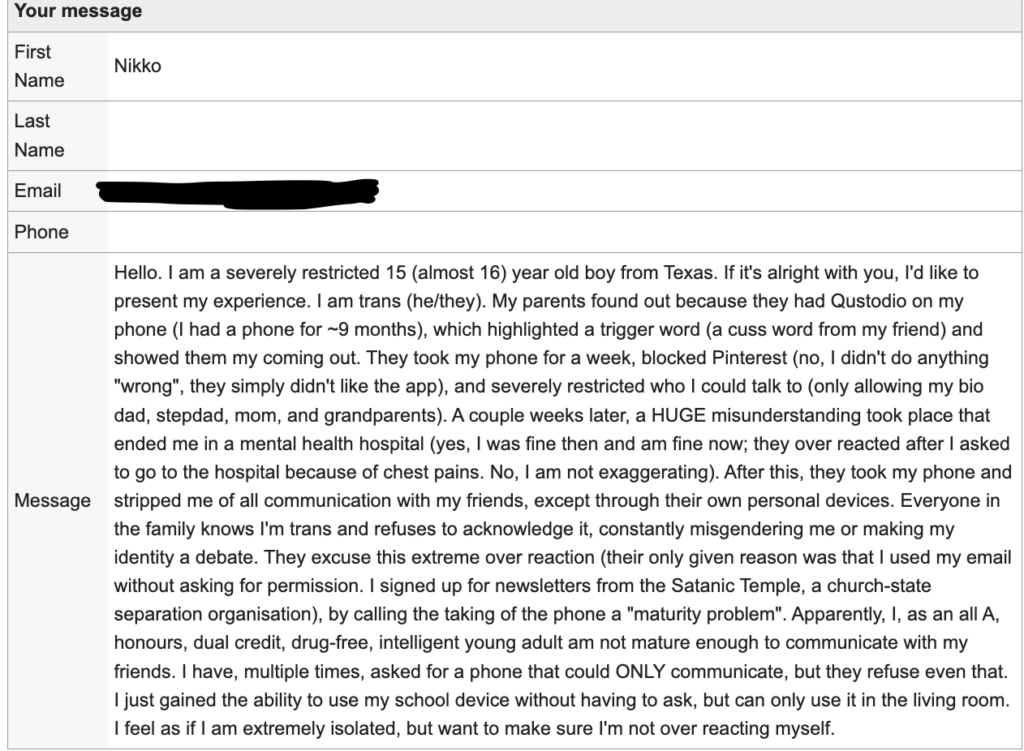
“Hello. I am a severely restricted 15 (almost 16) year old boy from Texas. If it’s alright with you, I’d like to present my experience. I am trans (he/they). My parents found out because they had Qustodio on my phone (I had a phone for ~9 months), which highlighted a trigger word (a cuss word from my friend) and showed them my coming out. They took my phone for a week, blocked Pinterest (no, I didn’t do anything “wrong”, they simply didn’t like the app), and severely restricted who I could talk to (only allowing my bio dad, stepdad, mom, and grandparents). A couple weeks later, a HUGE misunderstanding took place that ended me in a mental health hospital (yes, I was fine then and am fine now; they over reacted after I asked to go to the hospital because of chest pains. No, I am not exaggerating). After this, they took my phone and stripped me of all communication with my friends, except through their own personal devices. Everyone in the family knows I’m trans and refuses to acknowledge it, constantly misgendering me or making my identity a debate. They excuse this extreme over reaction (their only given reason was that I used my email without asking for permission. I signed up for newsletters from the Satanic Temple, a church-state separation organisation), by calling the taking of the phone a “maturity problem”. Apparently, I, as an all A, honours, dual credit, drug-free, intelligent young adult am not mature enough to communicate with my friends. I have, multiple times, asked for a phone that could ONLY communicate, but they refuse even that. I just gained the ability to use my school device without having to ask, but can only use it in the living room. I feel as if I am extremely isolated, but want to make sure I’m not over reacting myself.”
This story from a brave teenager who opened up about their experience illustrates precisely all of the harms about parental device monitoring that I have been observing throughout my life. From the story, it is clear that this teenager’s parents are not using the device monitoring as a way of caring about their best interests—they are using it as a tool of oppression, control, and punishment. They found out about their teenager’s gender identity, not through the teenager willingly opening up and telling them, but through a constant digital monitoring system that reads the private messages of the teenagers’ conversations with their friends, and reports it to the parents. The parents’ first reaction was not to sit down and have a meaningful conversation about gender identity—no—it was immediately to punish the teenager without question. Because of this, it’s not just clear that they’re emotionally abusive and exactly the kind of parents who use device monitoring for control, but also it becomes clear exactly why the teenager did not inform the parents of their gender identity willingly—because they knew this was the reaction they would receive.
Device monitoring and surveillance of teenagers’ private message is especially dangerous to queer youth for many reasons. First of all, many parents are discriminatory against their child’s queer identity. This discrimination can occur through emotional abuse or physical abuse, but most often presents itself with the parent punishing a child for learning that they belong to some type of LGBTQ community, whether that be a gender non-conforming identity or a sexual orientation besides hetrosexual. In extreme cases, parents have been known to react with kicking children out of their homes, extreme isolation, severe beatings, forcible institution into “Conversion Therapy”, and even torture and murder of their queer children. This behavior has been known to cause devastating consequences on the mental health of youth, and has even resulted in the suicide of queer children.
So if a transgender, gay or otherwise queer teenager was discussing their identity with their friends, over messages that should be private, but those messages were exposed to their parents due to device monitoring software, that opens up a dangerous threat for that teenager. If the parents were extremist, they may beat the child, or react with overwhelming punishments that could devastate the mental health of a young person that may already be struggling. This is exactly what we see here in Nikko’s story. Nikko’s parents responded directly to the knowledge of Nikko’s transgender identity by taking away his phone and further cutting him off from their friends, therefore restricting access to a crucial support system. Without access to friends, Nikko is therefore forced to only be able to rely on his parents for support, which as the story shows, is an absolutely terrible idea for his mental health, due to his parents’ oppressive and volatile nature.
It is also important to note that even if a queer teenager’s parents do not specifically use device monitoring software, their identity is still not safe. For example, in a Let Grow essay, a mother described a case from her daughter’s school in which one teenager was outed as gay because another girl’s mother had been reading her child’s Snapchat messages and then shared what she learned with others. The author said this was not a one-time emergency search but something the mother did regularly out of curiosity about middle-school life. The harm in that story was not only to the child being monitored, but to the other child whose private identity was exposed without consent. This story shows that due to the very concept of parental device monitoring being normalized, and violations of teenagers’ privacy being seen as acceptable by parents, no queer child is safe from being outed randomly. The fact that both of these processes are not more heavily tabooed is a major violation of youth rights, and potentially dangerous for youth living with extremist parents.
The next part of the story I want to look into, is when Nikko reported that “A couple weeks later, a HUGE misunderstanding took place that ended me in a mental health hospital (yes, I was fine then and am fine now; they over reacted after I asked to go to the hospital because of chest pains. No, I am not exaggerating). After this, they took my phone and stripped me of all communication with my friends, except through their own personal devices.”
This is, again, very disturbing to me, because it shows that after the parents believed Nikko’s mental health was threatened enough for them to take him to a mental hospital, they still reacted with punishment. Their reaction was not to actually help and support their child through a tough time in their life when they may have mental health concerns, their first reaction was to respond to the perceived mental health concerns with not just basic punishment, but with the specific punishment of completely stripping them from contact with their friends. This is extremely dangerous for young people, because friends act as a support system when they are dealing with mental health struggles, and taking away that support system can lead to isolation and worse mental health outcomes.
Nikko specifically stated that ”I have, multiple times, asked for a phone that could ONLY communicate, but they refuse even that.”
This line right here directly shows that Nikko’s parents do not value his connections to his friends, and choose to actively restrict those connections as punishment. This is extremely dangerous for parents to do to their children; and all teenagers deserve to be able to freely communicate with their friends without having to worry about a parent constantly monitoring them or taking away this access at the drop of a hat.
A 2026 Nature Communications study examining loneliness, social isolation, and health used several complementary analytical approaches and very large datasets. Across analyses, loneliness showed evidence of relationships with greater depression, anxiety symptoms, self-harm and suicide-attempt risk, along with lower happiness, meaning in life, well-being, and life satisfaction. Along with this, parental interference in youth relationships affects the quality of the friendships adolescents are able to develop. In “The Intervening Role of Relational Aggression Between Psychological Control and Friendship Quality”, researchers examined psychological control, relational aggression, friendship quality, and loneliness among middle adolescents and their parents. Greater parental psychological control predicted greater self-reported relational aggression by adolescents; greater relational aggression, in turn, predicted lower friendship quality and greater loneliness.
The fact that the parents react with punishment once again shows that their motivation is not rooted in making sure their child is supported, safe and healthy, but instead all rooted in control. Their teenager’s gender identity is a threat to them, and so is their access to friends, because having access to others removes the parents’ monopoly of control over their teenager’s life. That’s why parents default to using these device monitoring applications, because it gives them a socially acceptable way to control every aspect of their teenager’s life while still maintaining moral superiority under the justification of protection, while the teenager is left to the curb to suffer without any support.
Another aspect I want to look at with the story, is when Nikko reported: “They excuse this extreme over reaction (their only given reason was that I used my email without asking for permission. I signed up for newsletters from the Satanic Temple, a church-state separation organisation), by calling the taking of the phone a ‘maturity problem’”.
This part of the story shows that his parents are directly punishing him for wanting to support a political position that they disagree with—separation of church and state—most likely meaning they are heavily religious (explaining why they were hostile towards his transgender identity). This instance reflects both parental political indoctrination and parental religious indoctrination. If a teenager is punished by their parents for expressing support for a political position their parents disagree with, or expressing disagreement with their parents’ religion, then that is punishing an aspect of personal identity development and self expression. Young people deserve to be able to believe in (and express support for) political or religious opinions that directly counteract their parents’, without having to fear that doing so will lead to punishment, reprimanding, or further restrictions of their ability to contact their friends and support systems. Parents acting in this way towards their teenagers are oppressive, overly controlling, and not teaching healthy dynamics about self expression and intellectual freedom.
Continuing on with the point on intellectual freedom, there’s another line from Nikko that stuck out to me: “I just gained the ability to use my school device without having to ask, but can only use it in the living room.”
This specific part of the story reflects another form of parental oppression: purposely hindering education. In this day and age, where most schools provide students with school-devices, this allows students to get their work done at home, study easier and turn in work before the day ends. Previously, when most assignments had to be completely on paper, teachers would require the students to turn them in at the end of the class, however with school devices and online work being more regularly normalized, teachers will often let students finish online work from home, and set the due date for 11:59 pm.
Because of this fact, Nikko’s parents restricting access to his school computer is a direct hindrance to his education. Nikko mentioned how before recently, he would need to ask permission to use his school computer. This creates a major issue, because imagine a scenario where there is an important online assignment that needed to be completed by 11:59pm that night, but Nikko’s parents were asleep by 10:00pm. In this situation, he couldn’t just ask his parents for permission to use the device. So if he used the device without permission, he would risk further punishment, or more likely, he wouldn’t even be able to access the computer in the first place. So because of this, Nikko, or anyone else living in this situation, would be unable to complete their school work in the same way that a student living without oppressive parents would be able to.
In another, much more common scenario, imagine that Nikko is being forced to do intensive school work on his school device in the living room, per his parents’ wishes. However, the living room is for—well—living, meaning his parents are most likely also there, probably watching TV, talking or doing other tasks. Obviously, this is not a good, quiet, stable environment for a teenager to deeply focus on their schoolwork. Because of the unstable environment, and constant supervision, it is probably much more difficult for Nikko to be able to get his school work done with the same efficacy of if he was able to use the school device in his own room without parental supervision. The fact that the parents are directly hindering NIkko’s usage of his school device reflects how they do not care about his education, and value their constant control, monitoring and punishment over his ability to complete his school work and succeed. This is another instance of what I mean when I say that these types of parents do not care about the best interests of their child, and only care about control and having power over them.
Lastly, one of the things that Nikko said really stuck out to me as well: “Apparently, I, as an all A, honours, dual credit, drug-free, intelligent young adult am not mature enough to communicate with my friends”.
Putting the situation into perspective like this highlights the absurdity of this type of oppressive monitoring and overbearing restrictions that many parents put onto unproblematic children. In a world full of people who do drugs, join gangs, get into crime, and associate with various other dangerous activities, parents of children like Nikko should be grateful that they have a child causing them so few issues. The only issues that are existing in this dynamic, from what I have seen, are the issues that the parents specifically caused. Nikko identifying as trans was not a real problem until the parents turned it into one; and the same goes for all the other problems that they manifested. Parents like this want an excuse to create problems and demonize their otherwise unproblematic child to convince them they’re the source of all of the issues, as a way to justify the control used on them. However, the opposite is much closer to the truth.
Teenagers should not be treated like the enemy by their own parents, they should not be overly monitored and restricted—treated like prisoners in their own home—while their parents look for any excuse to strip them of basic privacy, freedom and autonomy. Parental device monitoring is a tool of oppression, used by emotionally abusive parents that can empower discriminatory control, restrict access to friends and support systems, and hinder the education of teenagers. Despite them being marketed for safety and protection, it is in the best interests of teenagers, if these parental device monitoring applications were abolished. Simply put, you cannot trust this technology in the hands of parents, when unfortunately, a large number of parents are abusive, oppressive, and actively want to hinder their children’s lives.
In order to actually fight against these types of controls, it is important to raise awareness of the struggles that they can cause for youth, in order to challenge the socially accepted notion that they need to exist for teenagers’ “own good” as “part of parenting”. We at NYRA will be leading the charge in advocating against parental device/internet monitoring and restricting, and are extremely grateful to have received such an insightful story from Nikko that illustrates these harms. As part of every webpage and blog that NYRA has been publishing recently, I’ve included a section encouraging those interested in youth rights to volunteer with us, or to contact us and share a personal story of a youth rights violation they have experienced so we can get it out to the world. And I mean that when I write it, every single time. We want you to share your stories with us; we want your personal experiences to be used to raise awareness of these harms, because we are the ONLY organization actively fighting against parental oppression, challenging parental device monitoring/restricting and advocating for the basic rights, freedoms and autonomy for minors across the country. We will not stop until the world understands the truth of parental controls, and is willing to take a stand to recognize that minors deserve the same basic rights as adults, despite their age. This issue is incredibly important to me, and I’m extremely grateful to take a stand.
Thank you everyone for reading.
The National Youth Rights Association
If you’re interested in Youth Rights, consider volunteering with us. We are always looking for new members and would love to have you on board. If you have a personal story to share about how parental device/internet monitoring or restricting has negatively impacted your life, or about a youth rights violation you’ve experienced, consider sending us an email at nyra@youthrights.org. We’d love to help get your story out to the world.
The text of Parental Controls & Device Monitoring are Tools of Oppression – Firsthand Story from a Teenager © 2026 by Zane Miller is licensed under CC BY-SA 4.0.