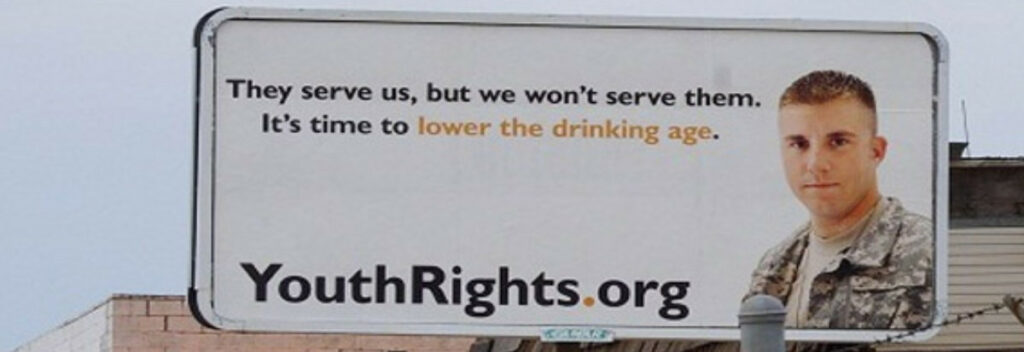

While the 21-year-old drinking age seems embedded in American society, it is a relatively recent innovation. Since it was signed into law on July 17, 1984, the National Minimum Drinking Age Act has significantly impacted the day-to-day lives of America’s youth. Most people do not know that the drinking age was only made a national law in 1984, and only after a determined battle by special interest groups.
The current minimum drinking age system in the United States is mainly based on the National Minimum Drinking Age Act, a federal law which is incorporated into the U.S. Code at 23 U.S.C. §158. This law influences state policies through financial conditions rather than directly ordering states to amend their laws.
Table of Contents
- The Drinking Age Before 1984
- The National Minimum Drinking Age Act and MADD
- A Congress Divided
- The Role of the Media
- Responses and Impact
- STOP Act of 2006
The National Youth Rights Association
If you’re interested in Youth Rights, consider volunteering with us. We are always looking for new members and would love to have you on board.
The Drinking Age Before 1984
The history of the National Minimum Drinking Age Act started before Prohibition. The temperance movement used selective prohibition (drinking ages) as a stepping stone approach to their goal of outlawing all alcohol. Finally, they did achieve the goal of total Prohibition of alcohol, and in 1919 the 18th Amendment to the constitution was ratified. Although due to the seeming ineffectiveness of Prohibition and the change in public opinion, the 18th Amendment was repealed in 1933 by the 21st Amendment. What followed was a compromise with the lingering temperance movement and the modern drinking age. As sociologist Mike Males pointed out in his book, The Scapegoat Generation: America’s War on Adolescents, “The political failure of general Prohibition meant that American adults would increasingly focus justifications for alcohol policy less on the perils of drunkenness and more on the tenuous concept that adults can drink properly but youths cannot or should not.”
From the end of Prohibition until 1984, drinking ages were determined by the states; many of them had the age at 21 while several lowered the age to 18 for the purchase of beer. This was changed due to the baby boom generation and the Vietnam War. Between 1970 and 1975, nearly all states lowered their legal ages of adulthood, including thirty that lowered their legal drinking ages as well, usually from 21 to 18. If people were required to fight and die in a foreign war, then they should be allowed the privilege of drinking alcohol. This generation exercised previously unheard of clout and political muscle, and through years of protest and many valid arguments this generation of youth gained back some lost liberty. After this period, however, public sentiment changed. The baby boomers were aging and the freedoms they for which they fought for themselves no longer seemed important when they involved someone else.
Key Legal Principles
The actual bill required “States to prohibit persons under 21 years of age from purchasing or publicly possessing alcoholic beverages as a condition of receiving State highway funds.” States were given two years to comply with the law and would lose five percent of their federal highway funds in the third year and ten percent in the fourth year for failure to do so.
The NMDAA does not directly stipulate that each state must set the drinking age at 21. Instead, it uses financial incentives. The law states that if a state allows individuals under the age of 21 to purchase or openly possess alcoholic beverages, the federal government can deduct a certain percentage of the federal highway construction funds from that state. The deduction rate is 5% for the 1987 fiscal year, and it will increase to 10% after 1988. Since federal highway funds are of great significance to the transportation construction of each state, eventually, the states choose to raise the drinking age to avoid losing these funds.
- Minimum drinking age: 21 years old has been established as the minimum legal drinking age.
- Purchase and Public Holding Restrictions: States must prohibit people under 21 from purchasing alcohol and restrict their possession in public places.
- Federal Funding Conditions: States that fail to comply with this policy will face cuts in federal highway funding.
Special Circumstances of the U.S. Overseas Territories
The U.S. overseas territories such as Puerto Rico, Guam, the U.S. Virgin Islands, and the Northern Mariana Islands have different drinking age regulations from those in the mainland of the United States. Puerto Rico and the U.S. Virgin Islands have never fully adhered to the federal standard of 21 years old and have chosen to endure the continuous reduction of federal highway funds. The legal drinking age in Puerto Rico has long remained at 18 years old, while that in the U.S. Virgin Islands is also 18. Guam has a 21-year-old drinking age but the enforcement is significantly weaker than that in the mainland states. Tourism is of great significance to the local economy, and a more lenient drinking age is believed to be conducive to attracting young tourists for consumption. Therefore, these overseas territories have long been a gray area in the implementation scope of the NMDAA.
The National Minimum Drinking Age Act and MADD
This loss of a powerful ally allowed the modern prohibitionist movement led by Candy Lightner, the founder and then-president of Mothers Against Drunk Driving (MADD), to gain strength in this country again. The late seventies and late eighties were marked with an excess of highly publicized studies that claimed teenage alcohol was out of control and was turning into a devastating problem of epidemic proportion. This and the national mood produced an environment primed for the anti-youth, anti-alcohol legislation that became the National Minimum Drinking Age Act of 1984.
The person who had the most impact upon this legislation was Candy Lightner, founder of the MADD organization, after a drunk driver killed her daughter in 1980. After that traumatic event, Lightner turned her grief into revenge and founded the powerful lobbying organization that claimed a membership of three-hundred thousand in 44 states by 1984. Another highly visible person was the president of the United States, Ronald Reagan. Initially Reagan had threatened to veto the bill, citing that the provisions that punished states that didn’t comply was an infringement upon states rights. Reagan later changed from opposition to support, formally announcing this on June 13, 1984.
Many congressmen were involved in the long process that created this piece of legislation. First, Sen. Frank R. Lautenberg, D-N.J. was the senator who proposed the senate amendment to house bill H.R. 4616. Sen. Gordon J. Humphrey, R-N.H. proposed an opposing amendment to Lautenberg’s; one that offered benefits to states that complied rather than penalties to those that didn’t. Opposition was further led by Sen. Steven D. Symms, R-Idaho. Rep. James J. Howard, D-N.J. chairman of the Public Works and Transportation Committee, maneuvered the Senate amendment onto the House calendar before the upcoming recess. Rep. Glenn M. Anderson, D-Calif. proposed H.R. 4616 that later became the vehicle for the drinking age amendment. Sen. Lowell P. Weicker Jr., R-Conn. held up Senate action because he felt that raising the drinking age wasn’t doing enough for the problem of drunk driving as a whole.
The drinking age legislation can be primarily attributed to the efforts of Candy Lightner and the MADD organization. After its founding, MADD set out on a massive campaign to raise the drinking age on a state by state basis, and then finally on a national level. Lightner’s national campaign started when, according to Stephen Gettinger’s report in the Congressional Quarterly Weekly, she “buttonholed congressmen while representatives of MADD chapters flooded their offices with letters and telegrams.” Lightner gained the support of New Jersey Rep. Howard, who proposed an amendment to the transportation bill, H.R. 5504, which involved the allocation for funds for highway and road projects around the country. On June 7, 1984 the House voted 297-73 in favor of the amended highway bill. However, Lautenberg was blocked from bringing his amendment to the floor by Sen. Weicker, who had “held up Senate action because he wanted a broader approach than the focus on the minimum drinking age.” A compromise was then reached, and other provisions regarding adult drunk driving were added to the amendment.
A Congress Divided
The most passionate and heated discussion over the drinking age amendment occurred on the Senate floor. Several conservatives fought Lautenberg‘s attempt to blackmail the states into following the national government. The opposition, led by Sen. Humphrey and Sen. Symms, proposed an amendment to counter Lautenberg’s amendment. Humphrey’s amendment offered positive incentives to states that complied rather than threatening them with penalties, such as loss of significant funding.The Lautenberg opponents considered his amendment to be an infringement on state’s rights; their arguments, made on June 26, taken from Thomas’ Senate Vote Analysis, are as follows:
The pending Lautenberg amendment, however, which would coerce States into establishing a 21-year-old drinking age, should be rejected because it would result in Federal encroachment into areas that have been reserved to the States under the Constitution. It is clear that all powers not specifically delegated to the Federal Government by the Constitution are reserved to the States and to the people. Nowhere in the Constitution has the power to regulate the sale and consumption of alcoholic beverages been delegated to the Federal Government. Those who want to expand the power of the Federal Government beyond that granted to it by the Constitution have found various mechanisms for achieving their objective. Almost every Federal tax dollar returned to the States has strings attached; the Lautenberg amendment would tighten the knot. This practice, as embodied by this amendment, is nothing short of blackmail by the Federal Government. It is inconsistent with the Constitution, contrary to sound principles of federalism, and not in the best interest of our country. Therefore, the Lautenberg amendment should be rejected. “Senate Record Vote Analysis.”
In addition to the state’s rights arguments, opponents to the legislation maintained that any attempt to deny someone the right to drink alcohol was age discrimination. “Why the magic age of 21?” asked Sen. Patrick J. Leahy, D-Vt. “Why not 25? How about 30, 35, 40?”
In the end, however, these arguments fell on deaf ears. Supporters of the Lautenberg amendment accused the Humphrey amendment of taking “half measures”. The Humphrey amendment lost by a margin of 35-62, and the Lautenberg amendment passed by a margin of 81-16. The votes were largely non-partisan, although there was more Republican support for the Humphrey amendment. The breakdowns, taken from Republican Policy Committee’s Senate Record Vote Analysis, are as follows:
on the Lautenberg amendment –
| YEA | NAY |
| Republicans (45 or 82%) | (10 or 18%) |
| Democrats (36 or 86%) | (6 or 14%) |
on the Humphrey amendment –
| YEA | NAY |
| Republicans (25 or 45%) | (30 or 55%) |
| Democrats (10 or 24%) | (32 or 76%) |
The non-partisan approval of this legislation can be most accurately described by this knowledgeable Senate source, “The 21-year-old minimum drinking age is now seen as good public policy, one you can’t lose on, and this is an election year.” The mass hysteria over this issue so enveloped the congress and the country; even the President, who had previously condemned this amendment for being an infringement on states rights, reversed his stance. On June 13, he formally endorsed raising the drinking age. After approving of Lautenberg’s amendment, it was sent back to the House where it silently passed through with no objections over the Senate version of the bill. This action made the drinking age public law on June 28, 1984. It seems that most of the leaders of the drinking age idea were from New Jersey, from Lautenberg in the Senate to Howard in the House. That could be because not long before this issue was introduced in Washington, New Jersey had just raised its drinking age to 21, so the idea was very politically popular in the state of its originators.
The Role of the Media
The media played an important role in this too, much over-hyping the statistics and studies, which inflated public opinion on the issue and no doubt affected the votes of more than a few congressmen. The statistics used in this public relations battle had several problems with them as well. For example, we will dissect one set of statistics that were used to debate on the Senate floor in favor of the Lautenberg amendment:
“Young drivers are involved in one of every five fatal auto accidents. Almost 60 percent of fatally injured teenagers were found to have alcohol in their blood; 43 percent of those were legally intoxicated. Five thousand of those killed on our highways each year are teenagers – one fifth of all auto fatalities – although teenagers account for only 10 percent of all drivers and travel only 9 percent of all miles driven.”
These statistics, taken from Thomas’ Senate Vote Analysis, said that 5,000 killed on our highways are teenagers, one fifth of the total, which would mean the total is 25,000. Then look where it says that 60 percent of that number, 5,000, had alcohol in their blood, so that’s 3,000. Of that number, 43 percent were legally intoxicated. .43 * 3,000 = 1,290. So 1,290 drunk teens out of 25,000 total accidents – that is 5 percent not 20 percent as they imply. It is unknown how many of those were actually driving. Some of those 1290 could be sitting in the back seat while their parents were driving. Therefore statistics were used by MADD and other drinking age proponents to obscure the truth in order to win their goal of further depriving youth of their liberty.
Responses and Impact
State Responses and Implementation
The NMDAA stipulates that each state must complete the legal amendments by October 1986; otherwise, they will face a reduction in federal highway funds. Most states responded promptly, and by mid-1988, all 50 states in the United States and the District of Columbia had raised the minimum drinking age to 21. California and Oregon had already set the drinking age at 21 as early as 1933, being the first states in the country to implement this standard; while South Dakota and Wyoming were the last two states to complete the amendment process, and both only completed compliance in the spring of 1988.
There are significant differences in the methods and attitudes of each state in amending laws. Louisiana is a typical example: The amendment provisions passed by the state in 1987 only met the minimum requirements of federal laws and had numerous loopholes. It allowed businesses to sell alcohol to consumers aged 18 to 20 without bearing legal responsibility. This loophole was not revised until 1995, and in 1996, the Louisiana Supreme Court once ruled that the purchase age of 21 violated the state constitution, temporarily lowering the legal age back to 18. Three months later, the court overturned its own ruling.
The Continuous Divergence of Law Enforcement Standards Across Different States
After compliance with regulations, each state still retains considerable autonomy in implementing the federal framework. Some states (such as Alabama, Arkansas, Idaho, New Hampshire, and West Virginia) have extended the law to impose a complete prohibition on alcohol consumption for individuals under the age of 21, including private consumption; while other states allow minors to drink alcohol in private places or specific public places with the accompaniment of parents or legal guardians. Ohio, Texas, Massachusetts, and Louisiana all have such regulations.
The Impact of the Act
The minimum drinking age is discriminatory based on age, and it goes against the constitution by forcing the states to comply with the federal government. This legislation was disastrous for the concept of federalism, because it was one of the first steps that allowed the federal government to “blackmail” the states in this way. From this time deals like this that coerce states became common legislation on the hill.
It seems that politicians are too eager to jump on bandwagons that promise good publicity and easy votes. It also seems that special interest groups such as MADD can exert tremendous influence upon legislation and the public mood on an issue. President Reagan also had an interesting role. His declarations of support and opposition helped shape public opinion and helped motivate congressmen in his party.
The National Minimum Drinking Age was a key defeat, both for state’s rights and for youth rights. A massive public relations battle was fought by MADD and opponents had no time to prepare before this battle was won. This legislation affects millions of people everyday, and has since it was passed in 1984.
STOP Act of 2006
As time went by, legislators gradually realized that relying solely on age restrictions could not completely solve the problem of underage drinking. Therefore, in 2006, the United States passed the Sober Truth on Preventing Underage Drinking Act (STOP Act). Compared with the NMDAA, this law placed greater emphasis on prevention and public health strategies.
The main goal of the STOP Act is to reduce underage drinking and enhance prevention nationwide. This law emphasizes reducing the opportunities for teenagers to access alcohol through education and community intervention.
Core measures of STOP Act
Inter-agency coordination mechanism: The federal government establishes a cross-departmental coordination committee — the Interagency Coordinating Committee on the Prevention of Underage Drinking (ICCPUD) — to integrate the actions of educational, public health and law enforcement agencies.
Research and report: The federal government releases reports on underage drinking, providing detailed data for the public and the government.
Community prevention program: Federal funds support local efforts in implementing alcohol prevention programs for teenagers.
Through those measures, the STOP Act shifted the issue of underage drinking from a purely legal issue to a public health concern.