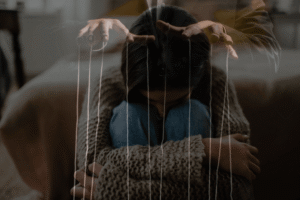
On Monday, June 29th, 2026, the US House of Representatives voted 267-117 to pass the KIDS act. This is the makings of a dystopian future, opening the door wide for the government and big tech to force age verification across the entire internet, begin censorship, and implement a plan of mass surveillance. The KIDS act includes a package of regulations for social media and internet platforms, requiring heavy restrictions on how minors are allowed to use them. These restrictions are meant to especially crack down on young people communicating with “strangers” over the internet, by restricting their messaging abilities, ability to connect with others, and by giving parents overbearing control of minors’ social media accounts.
The KIDS Act threatens everyone’s rights and privacy, regardless of age, but some of the most egregious harms of this bill are being completely ignored. Much of the KIDS act’s opposition is coming from digital rights advocates, who focus on the threats to adults’ privacy online—when the most crucial threat is to vulnerable youth. While the KIDS act is marketed for the purpose of “protecting children” by prioritizing their safety online, it actually does the complete opposite. The KIDS act will NOT “keep kids safe online”, the KIDS act will only cut off vulnerable youth from their vital online support systems that they need to help them through struggles in their home life when they have nobody else to turn to. In my last article, I discussed how the KIDS act will harm vulnerable teenagers, by describing all of the situations in which young individuals rely on online communities for support—and the drastic negative impacts that removing these will have on their lives. However, now that the KIDS act is inching ever closer to being passed, many youth have spoken up about their personal stories of how the KIDS act will ruin their lives as well. In this article, I’ll be discussing a few of these stories. These stories all show a dangerous theme—that the KIDS act will KILL kids. Hopefully, reading these stories first hand will communicate the message of the true dangers of the KIDS act—and illustrate why people need to not just speak up for the digital rights of adults, but for the rights of youth as well.
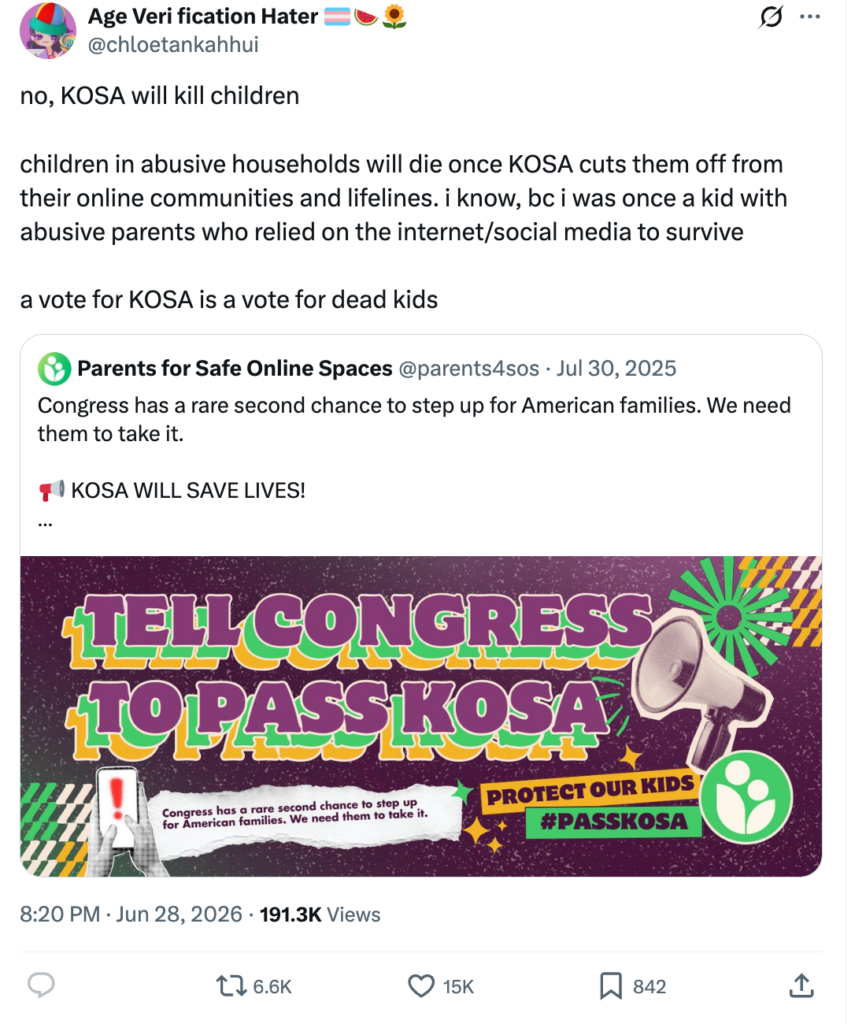
The first big push of this message was a post on X in response to KOSA (A related kids online safety act), which stated “No, KOSA will kill children. children in abusive households will die once KOSA cuts them off from their online communities and lifelines. I know, bc I was once a kid with abusive parents who relied on the internet/social media to survive. A vote for KOSA is a vote for dead kids.” The post amassed mostly positive feedback, and gained a whopping 15 thousand likes, far more than any other post I’ve seen actually talking about how the KIDS act will harm vulnerable youth.
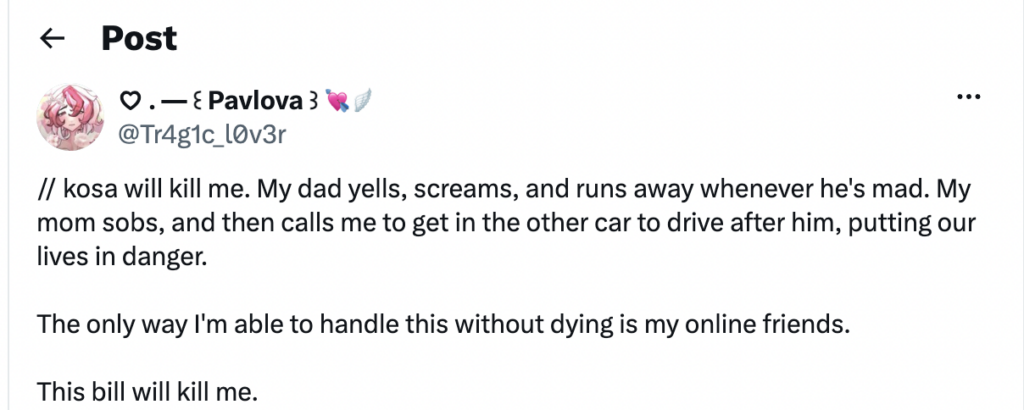
This post sparked several others, where youth on social media voiced their concerns and gave their personal stories of how KOSA and the KIDS act will ruin their lives, and even push them to the brink of ending it. One story that I want to focus on in this article, is a story from X User Pavlova, who expressed a similar stance on the bill. They made a post, stating:
“// kosa will kill me. My dad yells, screams, and runs away whenever he’s mad. My mom sobs, and then calls me to get in the other car to drive after him, putting our lives in danger. The only way I’m able to handle this without dying is my online friends. This bill will kill me.”
This story is so disturbing and terrifying to hear, because it expresses the real-life effects of the exact concerns that myself and other youth rights advocates have been voicing about the KIDS act. Teenagers in vulnerable situations, with toxic/abusive home lives often do not have a strong support system in the real world. Because of this, they turn to online communities for support, the one place they can feel safe and comforted, since it does not share the chaos of their in-person world. Once you take access to those communities away from these vulnerable youth, you leave them with nothing…stranded…isolated. The most vulnerable teenagers are the ones whose lives will be ravaged by this bill, and the government doesn’t seem to care.
After seeing this teen’s story, I reached out to them to interview them and get more details about their situation. They proceeded to tell me their entire story, making it extremely clear just how bad of a situation they were in at home, just how vital their online friendships are to them, and just how drastically it would impact their life if those were taken from them. This is their full story:
“So, my mom had me when she was very young and she never really got support from her family, meaning she moved out and lived on her own with me when she was still a teenager. While I was growing up, she tried her hardest to take care of me, but she’s always had very abusive boyfriends. I remember when I was really young them being in a screaming match and her boyfriend was throwing shoes and stuff at her. She broke up with him soon after, and sent me to live with my aunt and uncle for a while. My whole family (besides from my mom) are very religious, which means I was stuck having to attend a church that I never fully believed in, but now I constantly have terrifying thoughts about God and other things. Don’t get me wrong, I love my family very much, they’re just not the best. My mom started dating my current dad a while ago, and he’s always had an explosive temper. For my whole time knowing him it was like he was a ticking time bomb, one moment he would be laughing with me and my mom and then the next he would completely shut down and be mad at anything we did. He used to be very busy with work, meaning for a few years I wasn’t able to properly hang out with him. Whenever he tried hanging out with us, he got mad because he was missing out on making money. With the constant screaming, and throwing things, and everything I’ve come to be absolutely terrified of loud noises. Whenever I hear a loud noise now, I completely shut down unable to speak and almost unable to move. I remember one time he was very mad at something and he ruined the whole area where we were and he took the car. We weren’t at home so me and mom were stuck. That’s just one instance of his behavior. Him and my mom have almost broken up many times, even recently. All this through my whole life has caused me to develop specific mental disorders that neither of my parents even try to listen to, which is why I’m in a constant state of fake claiming myself and thinking I’m going insane. I’ve tried taking my own life many times, my youngest attempt being at 10 years old. I didn’t have any social media at the time, and I was absolutely miserable. The most contact I’ve had with people my age was school, and I was constantly being bullied, beat up, and have had many lies made up about me. I then moved to homeschooling, and that was even worse. I had no contact with anyone my age, my only friends were my 30 year old neighbor and my parents. I finally got a phone when I was 12 nearly 13. I was a big fan of genshin impact at the time, and gave one of my friends my number. Then, when I turned 13 I was able to get discord. I joined a server, and instantly made friends. These friends gave me reason to live, protected me, and comforted me in my worst times. Being on Twitter has helped me find people with the same struggles as me, and helped me make even more friends. These friends listen to me vent about my issues, and even share their own experiences to show that I’m not alone. If I’m unable to have access to my friends, I’d be back in the exact same place I was when I was 10. I’ve had to learn how to become a ghost in my own house 24/7 because I’m absolutely terrified of my dad being angry and taking it out on my mom. My mom tells me all about this, and is directly the cause of me being a victim of emotional incest. If I have to survive in this household with the blaming, screaming, sobbing, and everything without my friends, I don’t think I’d survive to be able to go to college. My dream is to be a voice actor and to go to fashion school, but if this bill gets passed I will never live to see the day I get my diploma, my diagnoses, or even the day I learn to ask for help. This bill will kill me if it passes”
This story is a striking example of all of the harms of the KIDS act on vulnerable teenagers—specifically on teenagers who are living in abusive/toxic homes, teenagers who are living with strict and oppressive parents, and teenagers who are bullied and ostracized. From the story, it is clear that Pavlova is living in an abusive home environment. Not all abuse by parents comes in the form of physical abuse or neglect, one of the most common types of abuse that young people face at home comes in the form of emotional abuse. A household filled with constant screaming, contempt, hostility, and verbal aggression can itself be emotionally abusive, especially when the child is directly targeted or forced to live in a climate of fear and instability. Even when a parent does not strike the child, constant verbal attacks can damage the child’s sense of safety and emotional development. The AAP notes that psychological maltreatment may be verbal or nonverbal and active or passive.
The simple fact that this teenager is living in a chaotic home full of tension, conflict and fear, is proof that they are experiencing emotional abuse—which is made especially apparent when reading the story. However, the scary part about living in a toxic and emotionally abusive home environment, is that it is especially hard to escape from. Child Protective Services often fail to intervene to remove minors from emotionally abusive homes, because of emotional abuse not being seen as directly threatening, and their policies prioritizing keeping a child in their original home. With escaping the abusive environment practically impossible, teenagers are forced to figure out ways to cope with their home situation, which can also be incredibly difficult. Oppressive and emotionally abusive parents often isolate children and cut them off from support systems, which we see in the story.
According to Pavlova, “All this through my whole life has caused me to develop specific mental disorders that neither of my parents even try to listen to, which is why I’m in a constant state of fake claiming myself and thinking I’m going insane.”
This part of the story is especially disturbing, because it illustrates how these abusive parents cut vulnerable children off from the vital support they need. Not only is this parental medical neglect, but this also puts the life of vulnerable children at risk. Because of this, Pavlova “tried taking [their] own life many times, [their] youngest attempt being at 10 years old.” This story shows the direct impact of what occurs when parents not only throw their children into toxic living environments, but also do not provide proper support for their struggles—and instead only use it as a method to shame them. This behavior by parents will KILL kids.
Because of these discriminatory government policies, young people don’t even have the option to receive professional support in any capacity without their parents’ consent. This further cuts off young people from support systems, and harms only the most vulnerable of youth.
From Pavlova’s story, it was clear that getting support from in person friends was off the table as well. According to their story: “The most contact I’ve had with people my age was school, and I was constantly being bullied, beat up, and have had many lies made up about me. I then moved to homeschooling, and that was even worse. I had no contact with anyone my age, my only friends were my 30 year old neighbor and my parents.”
This part of their story further compounds how they were vulnerable—due to bullying from peers in person—and then further isolation by their parents. They have absolutely no way of being supported in person. Their parents refuse to believe them about their issues (that the parents were directly responsible for causing), they can’t legally consent to receiving therapy, don’t have friends in person, and can’t even access a school counselor due to being homeschooled. This means that the ONLY way for this teenager to be supported, and helped through the struggles caused by their toxic home and abusive parents, is for them to be a part of online communities. This is where online support systems are crucial for these vulnerable youth. In fact, these online support systems may be the difference between life and death for these children.
Pavlova stated: “If I have to survive in this household with the blaming, screaming, sobbing, and everything without my friends, I don’t think I’d survive to be able to go to college.”
So when bills like KOSA and KIDS cut children off from their online, they are giving parents a monopoly on the support that children are allowed to receive. But not all parents are good—hopefully this has been illustrated enough from the heartbreaking story. Some parents are abusive, some parents create toxic home situations, some parents deny their children access to support, some parents berate and shame children for their struggles, some parents control and isolate their children from any place they could seek help. Simply put, we cannot trust parents to put the best interests of their children at heart. We cannot live in delusions that giving more power to parents, and less freedom to youth will make them safer and happier.
When youth don’t have support at home, they seek it out in any place they can, because that’s the only option they have. This option should not be stripped from them under the guise of their own safety. The people that teenagers meet in online places aren’t predatory strangers that want to harm children. The people teenagers meet online, more often than not, are fellow teenagers, who are also trying to seek support for their struggles, and seek community in those who are similar to them.
According to Pavlova: “These friends gave me reason to live, protected me, and comforted me in my worst times. Being on Twitter has helped me find people with the same struggles as me, and helped me make even more friends.”
Do not fall for the propaganda that connecting with others online is inherently harmful for teenagers, because the reality of the situation is that it’s not. Online friendships, online communities, online support systems and safe places are vital for teenagers. Taking that away will ruin lives, and push struggling teenagers into a worse mental state with no way to cope with the struggles of their lives. Unfortunately, these are not the stories that you hear about, as big media corporations artificially amplify the negative stories of teenagers’ experiences on social media. But these positive stories about how social media has helped young people are far more common than some may think.
Outside of Pavlova’s story, there are many others. I recently interviewed Otis, a young person who described his personal experiences on social media. As an autistic teen, making friends at school was exceedingly difficult for him, leading him to not have a strong support system in person. However, social media mitigated this problem, by allowing him to make many friends and “unmask”, feeling like he can truly be himself around people in his online communities. Whether teens have trouble making friends in school due to being bullied, like in Pavlova’s case, or whether it is because they’re autistic, disabled, or simply just awkward, social media allows them to have access to a much more forgiving environment to socialize with people who will accept them.
However, Otis also described his friend’s situation, which was much more troubling. His friend is a 15 year old transgender teenager, living in a physically abusive home, where his parents are unsupportive of his gender identity and substance abuse is common. According to Otis, this friend has 8 online friends who he considers his “brothers”, who are there for him at all times, and help him through the struggles of his toxic home life. Otis said that losing his friends would be devastating to the teen, who has no other real support system in person. Again, this just shows another instance of the dangers of these social media restrictions—where the youth who are vulnerable are being the ones especially affected by them. If you take a young person who is being physically abused, living in an unsupportive home, exposed to illicit substances on a daily basis, and has no support system in person, imagine what would happen to them if their only support system and friends were ripped from them. The outcome would most likely be devastating.
You can watch the full story here:
So when teenagers voice their concerns about KOSA, the KIDS act and social media bans for minors, you need to take them seriously and understand the consequences of the government pushing these restrictions. Teenagers don’t just need social media to sit on their phone and doomscroll, which many people in the older generation argue is all teens use it for. Vulnerable teenagers fundamentally rely on social media for connections with online support systems—which in many cases is the only support system they have. The KIDS act will KILL kids, and in order to protect the teenagers who are already living in harmful environments, it is imperative that it does not pass.
The National Youth Rights Association
If you’re interested in Youth Rights, consider volunteering with us. We are always looking for new members and would love to have you on board. If you have a personal story to share, of how social media bans and restrictions will negatively impact your life, or about a general youth rights violation, consider sending us an email at nyra@youthrights.org. We’d love to help get your story out to the world.