


Young people deserve freedom of movement and a basic right to have choice over their own living situation, and which home they reside in. However, current runaway laws make this freedom unattainable for minors. Runaway laws vary by state, but there are certain themes that are continually followed. A minor being caught as a “runaway”, usually gives law enforcement the authority to take them into custody, where the primary goal becomes reunification with their parents. In most states, running away is considered a status offense, which allows juvenile court intervention and supervision into the life of minors labeled as runaways. Runaway conduct can usually result in “valid court orders”, legally ordering minors to stay with their parents, and enforcing juvenile detention as a punishment for violation. Along with this, most states have “harboring a runaway”, or “interference with custody”, laws which criminalizes adults allowing “runaway” minors to stay in their home without their parents’ consent. Together, these laws make it extremely difficult for young people to have any choice over their living situation.
NYRA advocates for fair and reasonable runaway rights for minors, to ensure that they get to choose the home they reside in, as long as there is no threat to their safety. In the following webpage, the National Youth Rights Association explains the process that law enforcement and child welfare services use to handle runaway minors. We will also explain the ways runaway laws harm youth, and the ways to improve these laws to protect youth freedom.
Table of Contents
- What Happens when a Minor Runs Away from Home?
- What Happens when Youth Resist Going into Police Custody?
- Running Away as a Status Offense for Youth
- Harboring a Runaway and “Interference with Custody” Charges Against Adults
- Runaway Laws State by State
- Why do Young people Run Away from Home?
- How Runaway Laws Harm Youth
- Ideal Runaway Rights that Youth Should Have
The National Youth Rights Association
If you’re interested in Youth Rights, consider volunteering with us. We are always looking for new members and would love to have you on board. If you have a personal story to share, about how runaway laws have harmed your life, or about a general youth rights violation, consider sending us an email at nyra@youthrights.org. We’d love to help get your story out to the world.
If you want to listen to a real story where runaway rights where necessary in a young person’s life, feel free to watch the following video:
What Happens when a Minor Runs Away from Home?
In general, when a minor runs away, the first legal response is usually law-enforcement pickup. Many states expressly allow an officer to take a runaway youth into custody based on reasonable grounds to believe the child left home without permission. That is true in systems that expressly label running away as a status offense, such as Texas’s “conduct indicating a need for supervision,” and in systems that use family-crisis or protective-custody statutes instead. Washington, for example, authorizes officers to take a child into custody in specified runaway situations, and New Mexico authorizes law enforcement to locate, return, or temporarily hold a runaway child even though running away is handled as a family-services issue rather than a delinquency offense. Officers are usually allowed to physically recover the youth and control the situation long enough to decide where the child should go next.
Once a runaway is located, the next question is usually whether the child must be released, sheltered, or temporarily detained. Across the country, the law tends to treat runaways as status offenders or non-delinquent youth, which means states often restrict secure detention. Many runaways are held only briefly for identification, safety screening, transportation, or paperwork rather than being jailed like criminal offenders.
Even in states that do permit some detention, the detention is usually short, conditional, and tied to safety or court-order enforcement. South Carolina, for example, limits detention for a pure status offense to a short period and allows longer secure detention mainly when there has already been a valid court order violation. Tennessee also sharply limits detention time for unruly children, including runaways, absent further judicial findings. Further detention usually comes after the youth has violated an existing juvenile-court order.
The usual goal of the initial police response is reunification with a parent or guardian. In these situations, officers or intake staff contact the parent, confirm legal custody, and release or transport the child home unless there is a reason not to. Ohio’s custody statute reflects this common model by directing release to a parent, guardian, or custodian unless detention or shelter care is warranted. South Carolina similarly requires officers to notify the parent, guardian, or custodian as soon as possible after taking a child into custody. Utah also requires parental notification when a child is taken into temporary custody. Reunification in practice often includes more than simply dropping the child off: it may involve intake screening, safety questions, referrals to counseling, and warnings or conditions intended to prevent another runaway episode.
State policies on reunification vary. Some states see parental notification and return as the primary goal, without putting much thought into the youth’s situation. Some states give parents a lot of control over what happens to the runaway youth after they have been taken into police custody and reunited with their guardians. For example, in Connecticut, the child welfare agency is directed to provide services to the runaway youth, however, the parent can reject those services. However, other states build in alternatives such as shelter care, crisis residential centers, foster or group placements, or family-crisis services. Washington’s framework is a good example: after pickup, a child may be taken home, to a crisis residential center, or to another authorized placement, and licensed shelters must usually contact a parent within a set time unless abuse-related exceptions apply. New York’s runaway-youth statutes similarly emphasize crisis services, shelter, counseling, parental notice, and reunification efforts when appropriate rather than automatic forced return in every case.
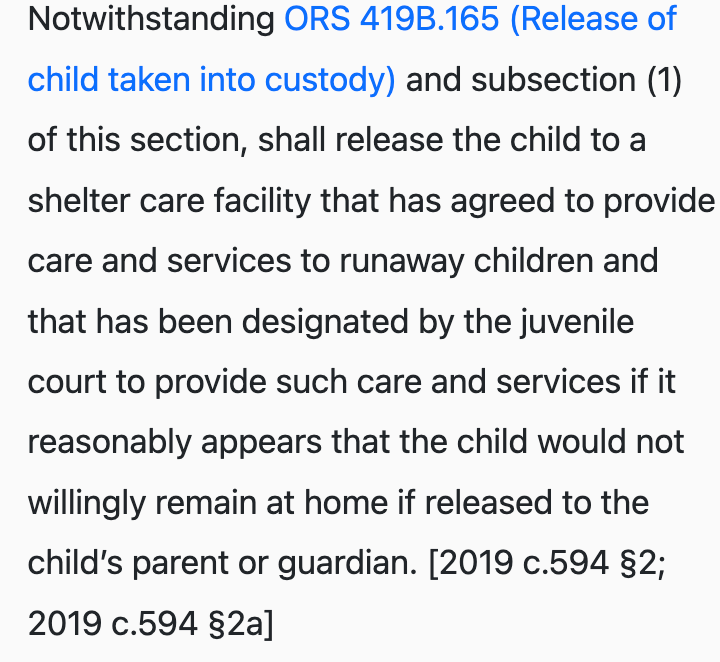
Oregon has some of the strongest runaway rights for youth. Oregon’s policy requires release without unnecessary delay either to a parent or to a shelter care facility, and the statute specifically directs attention to whether the child would actually remain at home and whether home placement serves the child’s best interests. If there is reason to believe the child will not remain with their parent, Oregon requires that the child be released to a shelter care facility instead, giving youth some semblance of a way to escape their parent.
If the runaway behavior continues, the case often moves from simple police recovery into a juvenile-court supervision or family-services track. Depending on the state, that may be called CHINS, CINS, PINS, an unruly-child case, a juvenile-family-crisis case, or conduct indicating a need for supervision.
In a general sense, when a minor runs away, the legal system usually works in this order: locate the youth, take temporary custody if authorized, notify the parent or guardian, decide whether immediate reunification is safe, use shelter or crisis placement if it is not. Secure detention usually occurs after a court order has been violated. Reunification remains the default goal in many states, but it is typically a qualified goal: return home when home is safe and workable; otherwise use a temporary, nonsecure placement and services to manage the crisis.
Note: All state statutes mentioned are linked and explained in detail in Runaway Laws by State
If you want more information on the CPS system, and what happens when minors run away from home, watch the following podcast where this information is explained by a former CPS employee:
What Happens when Youth Resist Going into Police Custody?
In most states, officers already have statutory authority to take a runaway into temporary or immediate custody, even though running away is usually a status offense rather than a criminal delinquency offense. That means the youth does not have a legal right simply to refuse pickup once the officer has lawful grounds to act. States handle the initial pickup differently, but the common model is that the officer may physically detain the youth long enough to transfer the child to a parent, shelter, intake worker, or court-approved placement.
When a youth verbally objects, tries to walk away, flees, or physically resists, the officer’s legal authority shifts from purely protective language to the ordinary rules that govern lawful temporary custody and reasonable force. A clear example comes from Texas authority: the Texas Attorney General concluded that an officer may use force to take possession of a missing child and may use force to detain a child who wishes to elude protective custody, but only to the degree the officer reasonably believes is necessary to safeguard or promote the child’s welfare. Utah’s general force statute similarly reflects the broader rule that reasonable and necessary force may be used to protect a child, and Utah’s arrest law states that if a person flees or forcibly resists after being informed of the officer’s intent, the officer may use reasonable force to effect the arrest.
In practice, agencies usually try to de-escalate first, especially because runaway cases are often treated as welfare or juvenile supervision cases. Officers commonly try verbal persuasion, explanation, parental contact, transport offers, or youth-crisis placement before escalating force. But if the youth continues to resist and the officer has lawful custody authority, the officer can still complete the pickup.
The next issue is where the youth goes after the resisted pickup. In most runaway cases, the law still prefers release to a parent, guardian, custodian, shelter, or other nonsecure placement, even if the youth resisted. Resistance during pickup usually doesn’t automatically turn the case into a delinquency matter or justify ordinary jail-like confinement. However, resistance can make the case more restrictive in the short term. If officers believe the youth will immediately flee again, cannot be safely returned that moment, or poses a danger to self or others, states often allow a brief hold for evaluation, court contact, or transfer to a more controlled juvenile setting. Virginia’s juvenile manual, for example, describes how secure detention decisions depend on statutory findings and notes that even juvenile holding in adult facilities is tightly time-limited and segregated. In other states, similar rules allow temporary detention or secure holding for reasons such as immediate safety, flight risk, or violation of a prior court order.
If the youth’s resistance is extreme, another practical complication can arise: the youth may face consequences not for running away itself, but for separate conduct such as obstruction, assault on an officer, escape from lawful custody, or violating a court order, depending on state law and what exactly happened. OJJDP materials note that juvenile systems separately track offenses such as nonviolent resisting arrest under obstruction-type categories, which shows that resistance can become its own legal issue apart from the status offense. So the legal system often distinguishes between “the child ran away,” which is usually a status offense, and “the child assaulted or obstructed an officer during lawful custody,” which may be treated much more seriously.
In states with supervision frameworks like CHINS, PINS, FINS, or similar systems, resistance to pickup can also affect the court’s later view of the case. A judge or intake officer may see repeated flight, refusal to comply, or refusal to return home as evidence that informal diversion is failing and that closer supervision is needed. That can lead to more structured conditions such as probation-style supervision, counseling, shelter placement, family-crisis intervention, or, in some jurisdictions, temporary detention after a valid court order violation.
So, when youth resist going into police custody in runaway cases, what usually would occur is this: officers attempt verbal compliance; if lawful pickup authority exists, officers may physically detain the youth. The youth is then transported to a parent, shelter, or juvenile intake setting; and the resistance may increase the likelihood of tighter supervision, short-term detention, or additional charges only if the resistance itself crosses into separate unlawful conduct.
Running Away as a Status Offense for Youth
Status offense frameworks such as CHINS, CINS, PINS, FINS, unruly child, wayward child, child in need of services, child in need of supervision, juvenile-family crisis, conduct indicating a need for supervision, and similar labels, are the legal categories states use for noncriminal youth behavior that becomes a court matter only because the person is a minor. Labeling running away as a status offense gives the state a way to put the child and family under juvenile-court authority, authorizing taking the child into police custody, supervising them, and intervening into their personal life.
What these frameworks give the court is civil-style supervisory power over the child and, indirectly, over the family. Once a petition is filed and sustained, the juvenile court can usually order the child to attend school, obey curfews, participate in counseling, undergo evaluations, live with a parent or another approved placement, report to probation or an intake officer, or comply with treatment and service plans. States vary in terminology, but the structure is similar. Texas, for example, treats running away as conduct indicating a need for supervision and handles it through juvenile adjudication and disposition statutes. New York’s PINS system likewise allows Family Court intervention for youth who are habitually disobedient, beyond control, or truant.
What these frameworks give law enforcement is usually a narrower set of powers: officers can often take the youth into temporary custody, transport the youth, identify and screen the youth, notify parents, and decide whether the youth should be released home, taken to shelter care, or brought into juvenile-court intake. In many states, that pickup power exists even though the behavior is not criminal in the usual sense.
In practice, the supervision process usually begins with intake, diversion, or screening, not a full adversarial hearing on day one. Many states require or strongly encourage early efforts to resolve the problem through services before moving deeper into court. If the case is not diverted or resolved informally, the court usually moves through two broad stages: fact-finding/adjudication and disposition/supervision. At the adjudication stage, the court decides whether the legal basis for the status category has been proven. For example, whether the child is actually a runaway, truant, or beyond parental control under the statute. At the disposition stage, the court decides what should happen next. Texas is a clear example: a child may be found to have engaged in conduct indicating a need for supervision only after an adjudication hearing, and then the court proceeds to disposition.
Once the child is under supervision, the court’s power often operates through conditions and compliance orders. That can include school attendance requirements, counseling participation, substance-use treatment, curfew rules, restrictions on who the youth may stay with, mental-health assessment, family therapy, and regular review hearings. Depending on the state, a probation department, intake unit, family-services agency, or contracted program monitors compliance. The court may also impose obligations on the parent or guardian, such as appearing in court, cooperating with treatment, participating in family counseling, ensuring school attendance, or accepting the child back into the home unless the court orders another placement.
These intervention programs often work like a hybrid of case management, crisis intervention, and court-backed service referral. In practice, that can mean shelter care for a runaway youth, transportation to counseling, school-based intervention for truancy, parent coaching, conflict mediation, mental-health screening, safety planning, and repeat review hearings. Some states use community-based diversion units; some use juvenile intake officers; some use crisis shelters or family-reconciliation programs. The practical force behind the program is that services are no longer purely voluntary once the court has entered orders. A family that previously ignored counseling recommendations may now be subject to a court order requiring attendance and participation.
The most important limit on these systems is that, at least in theory, status offenders are not supposed to be treated like delinquents. The major exception has been the valid court order pathway: if a child violates a court order entered in a status-offense case, some jurisdictions historically allowed detention for the violation even though the underlying behavior was noncriminal. That exception has been heavily criticized because it can turn a noncriminal family conflict case into a pathway to incarceration.
These proceedings can significantly affect the juvenile’s rights even though they are often described as nonpunitive. The child may be ordered to appear in court, answer a petition, comply with supervision conditions, submit to evaluations, follow placement decisions, and obey court rules backed by contempt-like or detention consequences in some systems. Movement can be restricted, school and living arrangements can be controlled even though the case is not based on a crime. The proceeding is formally civil instead of criminal, but the consequences can still be substantial in everyday life, and damage the rights and freedoms of the young person involved.
At the same time, juveniles in these proceedings usually retain important rights, though the scope varies by state. Common protections include the right to notice of the allegations, the right to a hearing, and in many jurisdictions the right to counsel or to an attorney appointed for the child. New York’s PINS materials expressly state that the child is represented by an attorney. Texas juvenile proceedings also expressly protect the child against self-incrimination; a child alleged to have engaged in delinquent conduct or conduct indicating a need for supervision need not be a witness against himself or herself. These rights are important because the case may look informal from the outside while still exposing the child to court control, placement changes, and possible detention in some circumstances.
The family’s rights are also affected. Parents often become subject to the court’s schedule, service plan, and expectations, even though they are not defendants in the criminal sense. They may be required to produce the child, attend hearings, cooperate with school plans, engage in counseling, accept or reject placements through court process, and work with caseworkers or probation staff. In some systems, the parent is also the petitioner who asked for court help in the first place; once the case is filed, however, the family dispute becomes a matter of state supervision. That shift is one of the defining features of CHINS/PINS/FINS-style systems: private family conflict becomes publicly managed through court authority.
These status offense frameworks mean that a runaway, truant, or “ungovernable” child can be brought under a structured system of intake, hearing, supervision, treatment, and review, with law enforcement empowered to recover the child and the juvenile court empowered to direct both the child’s conduct and the family’s response. The stated purpose is usually protection, rehabilitation, and family stabilization. But the real-world consequence is that the child’s liberty and autonomy can be restricted in meaningful ways even without a criminal adjudication, which is why due-process rights, detention limits, and access to counsel are so important in these cases.
Note: All state statutes mentioned are linked and explained in detail in Runaway Laws by State
Harboring a Runaway and “Interference with Custody” Charges Against Adults
When an adult lets a runaway minor stay in the home without a parent’s permission, the possible criminal exposure usually falls into two broad categories: “harboring a runaway” type offenses and “interference with custody” offenses. Harboring statutes usually focus on providing shelter and then failing to notify the parent, guardian, or law enforcement, concealing the child’s location, or helping the child remain away. An interference-with-custody statute usually focuses on taking, enticing, keeping, withholding, or concealing a child from the lawful custodian. Some states use both models; others use only one; and some states do not have a specific runaway harboring statute at all.
In states with direct harboring statutes, the rule is often straightforward: once an adult knows the child is away from home without parental permission, the adult must either notify the parent or law enforcement or risk criminal liability. Tennessee is a clear example. Under Tenn. Code § 39-15-414, a person commits the offense of harboring or hiding a runaway child if, knowing the child is a runaway, the person harbors or hides the child and fails to notify the child’s legal custodian, legal guardian, or law enforcement within a reasonable time, and the statute says no time longer than 24 hours is reasonable. Illinois uses a similar model in 720 ILCS 5/10-6, which criminalizes harboring a runaway and classifies it as a Class A misdemeanor. Washington’s RCW 13.32A.080 is broader still: it covers providing shelter without parental consent and then intentionally failing to release the child, failing to disclose the child’s location, obstructing recovery, or helping the child avoid custody.
Other states reach the same conduct through interference with custody laws. Georgia is one of the clearest examples. Under O.C.G.A. § 16-5-45, a person commits interference with custody if the person knowingly harbors a child who has absconded. That statute directly reaches adults who keep a runaway child away from the lawful custodian. In states using this kind of framework, the prosecution looks for evidence that the adult helped keep the child outside the lawful parent’s control. In practice, that can include refusing to answer the parent’s calls, lying about the child’s whereabouts, moving the child to avoid recovery, or telling the child not to return home.
A few states also build in exceptions or safe-harbor features for service providers and shelters. Georgia’s interference-with-custody statute, for example, contains an exception for certain service providers that notify the parent, guardian, or custodian of the child’s location and general well-being as soon as possible and no later than 72 hours, unless one of the abuse-related exceptions applies.
In the ordinary criminal process, the parent or guardian typically reports the situation to law enforcement, provides information showing the child is a minor and is absent without permission, and identifies the adult who is housing or concealing the child. Police then investigate by interviewing the parent, the child, and the adult; reviewing messages, call logs, social media, or location evidence; and deciding whether there is probable cause for an arrest or referral. The actual charging decision is ordinarily made by the government prosecutor.
The case usually works like this in practice: first, the parent reports the runaway and identifies the adult believed to be sheltering the child. Second, police try to locate the child and determine whether the adult knew the child was a runaway and whether the adult notified anyone. Third, if the statute requires concealment or intent, police look for evidence of those facts, such as telling the child not to answer the phone, refusing the parent entry, hiding the child, moving the child, or lying to officers. Fourth, the prosecutor decides whether the facts fit the statute. If charges are filed, the adult is prosecuted like any other criminal defendant, usually through a complaint, summons, or arrest, followed by arraignment, plea discussions, and, if necessary, trial.
Washington’s statute expressly requires that the person provide shelter without parental consent and then intentionally fail to release the child, fail to notify, obstruct recovery, or help the child avoid custody. Tennessee similarly requires knowledge that the child is a runaway plus failure to notify or concealment. Illinois focuses on knowingly giving shelter without parental consent and without notifying law enforcement. These statutes are written to target ongoing concealment or assistance.
That distinction is especially important because some states do not treat sheltering alone as enough. Nebraska is a good example. Nebraska’s statute, Neb. Rev. Stat. § 28-709, criminalizes contributing to the delinquency of a child by encouraging, causing, or contributing to the child’s delinquency or need for special supervision. But the official Nebraska legislative annotations state that “[t]he act of affording shelter to a runaway rather than immediately contacting the authorities does not necessarily constitute contributing to the delinquency of a child, especially when the person affording shelter did not induce or encourage the youth to leave home in the first place.” The annotations further note that evidence was insufficient where the defendant harbored an underage runaway and withheld the child’s whereabouts for several hours, but the youth was not exposed to unlawful or immoral activity and the defendant’s actions resulted in reunion with the parents. Nebraska is an example of a state where mere temporary shelter, without inducement or harmful encouragement, may not be enough for conviction.
In general, harboring a runaway and interference with custody charges are the legal tools states use to punish adults who turn a temporary runaway situation into ongoing concealment or custody interference. Parents usually trigger the process by reporting the adult to police, but the prosecutor decides whether the facts fit the statute. Where the adult knowingly hides the child, refuses to disclose the child’s location, or helps the child remain away, charges are much more likely. Where the adult did not induce the runaway and provided only short-term shelter without evidence of encouragement, some states, Nebraska being an important example, provide certain exceptions.
Note: All state statutes mentioned are linked and explained in detail in Runaway Laws by State
Runaway Laws State by State
NYRA has compiled a list of all Runaway laws and policies in each state. This includes states that classify running away as a status offense, harboring a runaway and interference with custody charges, and state policies for handling runaway youth.
Click on a state to learn more about the runaway laws in that state:
Alabama
1. Status offense for running away – In Alabama, running away is explicitly classified as a status offense, meaning it is unlawful only because of the person’s age and would not be a crime if committed by an adult. Under Ala. Code § 12-15-201(4), “runaway” is specifically listed as a status offense alongside truancy and being “beyond control.” More specifically, Alabama defines a child “in need of supervision” (CHINS) to include a minor who “leaves, or remains away from, the home without the permission” of a parent or guardian. These cases are handled in juvenile court rather than criminal court, and the focus is supervisory rather than punitive. In practice, this means a minor who runs away is not charged with a crime but can still be brought under court jurisdiction and subject to court-ordered supervision, services, or placement.
2. Harboring a runaway laws – Ala. Code § 12-15-111 makes it unlawful for any person to “willfully aid, encourage, or cause any child to become or remain… in need of supervision.” Because a runaway is legally classified as a “child in need of supervision,” an adult who knowingly shelters a runaway without notifying parents or authorities could be charged under this statute. Additionally, Alabama law defines a “runaway child” as one who has left a custodian’s control with intent to remain away indefinitely (Ala. Code § 13A-13-8), reinforcing the legal framework around custody interference. In effect, while the terminology differs from some states, Alabama law allows prosecution of adults who conceal or assist runaway minors in avoiding their lawful custodian.
3. State policies for dealing with runaway youth – Alabama’s approach to runaway youth is primarily protective and rehabilitative rather than punitive. Law enforcement officers are authorized to take a runaway minor into custody if they have reasonable grounds to believe the child has left home without permission. Once in custody, the child is typically returned to their parent or guardian, or referred to juvenile court as a CHINS case. The juvenile court can then impose various non-criminal interventions, such as supervision orders, counseling, or placement in a shelter or with another responsible adult. Overall, Alabama policy treats runaway behavior as a sign that the child may need services or intervention, with the goal of stabilizing the child’s living situation and addressing underlying family or behavioral issues.
Read about How Runaway Laws Harm Youth
Read about The Ideal Runaway Rights that Youth Should Have
Alaska
1. Status offense for running away – Alaska does treat running away as a status offense type behavior, though it is framed through the state’s “child in need of aid” and protective custody statutes rather than a single labeled status offense provision. Under Alaska Stat. § 47.10.141, law enforcement may take a minor into protective custody if the child is a runaway, meaning they have left home without permission. This reflects that running away is not a criminal offense but a condition that triggers juvenile court jurisdiction and intervention. Additionally, Alaska law allows courts to issue orders if a minor repeatedly runs away in violation of court directives, reinforcing that the behavior is handled within the juvenile system rather than as a criminal charge.
2. Harboring a runaway laws – Alaska Stat. § 11.51.130 (contributing to the delinquency of a minor) makes it illegal to aid or encourage a minor in unlawful or prohibited conduct, which can include assisting a runaway. Additionally, custodial interference laws (AS §§ 11.41.320–11.41.330) make it a crime to knowingly keep or remove a child from their lawful custodian, which can apply when an adult shelters a runaway without permission. Together, these statutes allow prosecution of adults who knowingly conceal or assist runaway minors in avoiding their parents or guardians.
3. State policies for dealing with runaway youth – Alaska’s policies emphasize protective custody, short-term placement, and reunification. When a runaway is located, law enforcement must take the child into custody and either return them home or place them in a licensed runaway shelter or program, prioritizing non-secure or semi-secure placements rather than detention. Runaway minors may stay in licensed programs for up to 45 days (with possible extension), allowing time for assessment and services. The system focuses on notifying parents, providing counseling, and addressing underlying issues, with detention generally limited and only used if a court order is violated.
Read about How Runaway Laws Harm Youth
Read about The Ideal Runaway Rights that Youth Should Have
Arizona
1. Status offense for running away – In Arizona, running away is generally treated as a status offense type situation rather than a crime. While there is no statute that criminalizes running away itself, Arizona law allows law enforcement to take a child into temporary custody if there are reasonable grounds to believe the child has run away from their parent or guardian under A.R.S. § 8-303. This reflects that the behavior is handled within the juvenile dependency and supervision system rather than through criminal charges, consistent with status offense treatment.
2. Harboring a runaway laws – Arizona does not have a single statute specifically labeled “harboring a runaway,” but adults can face liability under broader laws. For example, harboring a runaway may fall under custodial interference or contributing to the delinquency of a minor, depending on the facts. These types of laws generally make it illegal to knowingly keep a child from their lawful custodian or encourage them to remain away from home. As a result, an adult who allows a runaway minor to stay in their home without notifying parents or authorities can potentially face criminal consequences under these broader provisions.
3. State policies for dealing with runaway youth – Arizona’s approach is heavily administrative and investigative, focusing on locating the child and assessing their safety. Under A.R.S. § 8-810 and § 8-901, once a child is reported as a runaway, law enforcement and the Department of Child Safety must rapidly enter the child into national databases, notify parents and relevant parties, and actively search for the child. When the child is located, the state requires in-person contact, medical evaluation, and assessment of risks such as trafficking or abuse, along with determining whether returning home is appropriate.
Read about How Runaway Laws Harm Youth
Read about The Ideal Runaway Rights that Youth Should Have
Arkansas
1. Status offense for running away – Arkansas explicitly treats running away as a status offense under its “Families in Need of Services” (FINS) framework. State law recognizes behaviors such as truancy, disobedience, and running away as status offenses that bring a juvenile under court supervision rather than criminal prosecution. These cases are handled in juvenile court, where the focus is on services, supervision, and family intervention rather than punishment.
2. Harboring a runaway laws – Arkansas has clear statutes addressing conduct similar to harboring a runaway. Under Ark. Code § 5-26-503, a person commits interference with custody if they knowingly “take, entice, or keep” a minor from their parent or lawful custodian, or assist someone else in doing so. This offense can be charged as a felony. Related provisions (such as § 5-26-502) also criminalize keeping a child away from a custodian in violation of court orders. These statutes effectively cover situations where an adult shelters or conceals a runaway without permission.
3. State policies for dealing with runaway youth – Arkansas handles runaway youth through a combination of juvenile court intervention and child welfare procedures. When a child runs away, especially from foster care or placement, authorities must notify law enforcement, enter the child into national databases, and seek a pickup order from the court. Once located, the child is typically returned to their lawful custodian or placed temporarily with the Department of Human Services, with the court determining appropriate placement. The overall approach focuses on recovery, supervision, and addressing the causes of the runaway behavior.
Read about How Runaway Laws Harm Youth
Read about The Ideal Runaway Rights that Youth Should Have
California
1. Status offense for running away – California does not appear to have a standalone statute that expressly says “running away” is a separate status offense by name, but runaway behavior is generally handled as a status-offense-type juvenile matter rather than a crime. The closest core statute is Cal. Welf. & Inst. Code § 601, which places a minor within juvenile court jurisdiction if the minor “persistently or habitually refuses to obey the reasonable and proper orders” of a parent, guardian, or custodian, or is “beyond the control” of that person. California law also separately defines a “runaway youth” in its youth shelter statutes as a youth who absents themself from home or legal residence without permission. In practice, that means California generally treats running away as a noncriminal juvenile supervision issue.
2. Harboring a runaway laws – California does not use one single statewide statute titled “harboring a runaway,” but adults can still face criminal liability under broader child-custody and contributing statutes. Under Cal. Penal Code § 278.5, a person who “takes, entices away, keeps, withholds, or conceals a child” and maliciously deprives a lawful custodian of custody or visitation rights can be punished criminally. In addition, Cal. Penal Code § 272 makes it a misdemeanor to commit an act or omission that causes or tends to cause a person under 18 to come within Welfare and Institutions Code §§ 300, 601, or 602, or to remain there. Because a runaway youth may fall within section 601, an adult who knowingly shelters a runaway minor and helps the youth remain away from a lawful custodian could potentially be charged under these statutes.
3. State policies for dealing with runaway youth – California’s policies for runaway youth are oriented more toward crisis services, short-term shelter, and family reunification than punishment. The Legislature has formally recognized the need for coordinated services for runaway, homeless, and exploited youth, including housing, counseling, family support, and reunification efforts. California also authorizes youth crisis shelters and similar licensed programs that can provide short-term, 24-hour, nonmedical care and supervision to runaway youth who enter voluntarily. Overall, California’s approach is to connect runaway youth with shelter and supportive services and to treat the issue as a youth-welfare and family-crisis matter.
Read about How Runaway Laws Harm Youth
Read about The Ideal Runaway Rights that Youth Should Have
Colorado
1. Status offense for running away – Colorado does not appear to have a statute that expressly makes running away itself a standalone juvenile charge, but it treats runaway-type conduct as a non-delinquent status matter rather than a crime. The Colorado Children’s Code adopts the federal definition of a “status offense,” and Colorado law specifically provides that a juvenile who allegedly commits a status offense may not be held in a secure jail or lockup. Colorado’s detention statutes also show that juveniles who have not committed a delinquent act generally cannot be detained merely for noncriminal behavior, and alternatives such as release to a parent, placement with kin, temporary shelter, or referral for services are contemplated instead. So, in practice, running away is handled as a noncriminal juvenile-services issue rather than a delinquency offense.
2. Harboring a runaway laws – Colorado has a very clear statute on this issue. Under Colo. Rev. Stat. § 18-6-601, a person commits the crime of harboring a minor if the person knowingly provides shelter to a minor without the consent of a parent, guardian, or custodian and then, among other things, fails to release the minor to law enforcement when asked, fails to disclose the minor’s location, obstructs officers, helps the minor avoid custody, or fails to notify a parent, guardian, custodian, or law enforcement within 24 hours that the minor is being sheltered. That statute is the closest direct Colorado equivalent to a “harboring a runaway” law, and it plainly can apply to adults who allow runaway minors to stay in their home without proper notification.
3. State policies for dealing with runaway youth – Colorado’s policies for runaway youth emphasize non-secure placement, quick court review, and service-based responses instead of punishment. State law bars detention for juveniles who have not committed a delinquent act, and it lists alternatives such as remaining with a parent, temporary kin placement, temporary shelter placement, or referral to local human or social services for assessment. Colorado also forbids placing a juvenile in detention solely because of lack of supervision at home, lack of services, or as a way to punish or rehabilitate the juvenile. More recently, Colorado has also enacted legislation focused on preventing youth from running away from out-of-home placements and improving recovery and response practices.
Read about How Runaway Laws Harm Youth
Read about The Ideal Runaway Rights that Youth Should Have
Connecticut
1. Status offense for running away – Connecticut does not criminalize running away as a delinquency offense, and it has historically treated running away as a status-offense-type matter. Current Connecticut law reflects a noncriminal approach: when a parent or guardian reports that a child has run away, police must promptly try to locate the child, and if the child is found, the officer may return the child home, briefly hold the child in protective custody for up to 12 hours in an unlocked setting, or transport or refer the child to a youth service bureau or public or private agency serving children. So the state’s present framework treats runaway behavior as a child-welfare and supervision issue, not as a criminal offense by the youth.
2. Harboring a runaway laws – Under Conn. Gen. Stat. § 53a-98, a person commits custodial interference in the second degree if, knowing they have no legal right to do so, they take or entice a child under 16 from a lawful custodian or hold, keep, or refuse to return the child after the lawful custodian asks for the child’s return. While Connecticut does not use the phrase “harboring a runaway,” adults who keep a younger runaway from a lawful custodian can still face criminal liability under these custodial-interference statutes.
3. State policies for dealing with runaway youth – Connecticut’s policies for dealing with runaway youth focus on locating the child, notifying the parent, using short-term protective custody when needed, and referring the child to services. Under the current police-response statute, once an officer receives a runaway report, the officer must attempt to locate the child, report the location to the parent or guardian if found, and then may transport the child home, hold the child in protective custody for up to 12 hours in a nonlocked setting, or transport or refer the child to a youth service bureau or another public or private agency serving children. If a child is referred to an agency, that agency may provide services unless and until the parent or guardian refuses those services.
Read about How Runaway Laws Harm Youth
Read about The Ideal Runaway Rights that Youth Should Have
Delaware
1. Status offense for running away – Delaware does not have a statute that expressly labels running away itself as a standalone “status offense” or “child in need of supervision” category the way some other states do.
2. Harboring a runaway laws – Delaware does have laws that can punish adults for interfering with custody, but the fit is narrower than in some other states. The main statute is 11 Del. C. § 785, which makes it a crime to interfere with custody by taking or enticing a child under 16 from the child’s lawful custodian when the person knows they have no legal right to do so. Delaware Family Court also has jurisdiction over interference with custody of a child under § 785. Delaware does have a very specific harboring statute, 31 Del. C. § 5311, which applies only to aiding or harboring girls who escape from the Woods Haven School for Girls.
3. State policies for dealing with runaway youth – Delaware’s statutory approach appears to be protective and custodial rather than criminalizing. Under 10 Del. C. § 1004, when a peace officer takes a child into custody and the child is not charged with a delinquent act, the officer must immediately notify the custodian, and if the custodian refuses the child, cannot be located, or cannot provide care, the officer must contact the Division of Child Protective Services, which then becomes responsible for locating the custodian or providing shelter and care in a shelter home, foster home, group home, private agency home, or other appropriate facility. Delaware also participates in the Interstate Compact for Juveniles, and 31 Del. C. § 5225 specifically provides additional procedures for the return of runaway juveniles.
Read about How Runaway Laws Harm Youth
Read about The Ideal Runaway Rights that Youth Should Have
District of Columbia (Washington D.C)
1. Status offense for running away – Washington D.C does not have a statute that expressly makes running away, by itself, a standalone status offense. Running away is separately recognized elsewhere in D.C. law, including a custody statute and youth-services definitions, but no statute was identified that expressly charges running away itself as a separate status offense.
2. Harboring a runaway laws – The District of Columbia statute D.C. Code § 16-1022 prohibits certain forms of abducting, taking, concealing, harboring, secreting, or detaining a child in custody-related situations, including keeping a child for more than 48 hours after a lawful custodian demands the child’s return in certain custody-order contexts. That statute is an interference-with-custody provision rather than a general runaway-harboring law, but still criminalizes simply allowing a runaway minor to stay in a home without notifying the parents.
3. State policies for dealing with runaway youth – The District’s statutes emphasize taking the child into custody, court supervision, release to a parent when possible, and placement in nonsecure settings when necessary. Under D.C. Code § 16-2309(a)(5), a law-enforcement officer may take a child into custody when there are reasonable grounds to believe the child has run away from a parent, guardian, or other custodian. If the child is later found to be in need of supervision, § 16-2320(d) provides that the child may not be committed to a secure juvenile residential facility unless also found delinquent, must ordinarily be released to a parent, guardian, or custodian, and may instead be placed in a foster home, group home, youth shelter, or other appropriate home if return would place the child in an abusive situation or the parent or custodian is unwilling or unable to care for the child. D.C. law also defines youth residential facilities to include youth shelters and runaway shelters, showing that the statutory framework contemplates shelter-based responses rather than criminal punishment.
Read about How Runaway Laws Harm Youth
Read about The Ideal Runaway Rights that Youth Should Have
Florida
1. Status offense for running away – Florida does treat running away as a status offense-type juvenile matter, and the statute is explicit. Under Fla. Stat. § 984.03(7)(a), a “child in need of services” includes a child whom the court finds has “persistently run away” from parents, legal guardians, or custodians despite reasonable efforts by the family and appropriate agencies to fix the conditions contributing to the behavior. Florida also defines a “family in need of services” in § 984.03(15) as a family that has a child who is running away. That means running away is not handled as delinquency, but it does bring the child within juvenile court jurisdiction for supervision and services.
2. Harboring a runaway laws – Florida has a broad interference with custody law. Under Fla. Stat. § 787.03(1), a person commits the offense of interference with custody if, without lawful authority, the person knowingly or recklessly takes or entices, or aids or abets another in taking or enticing, any minor from the custody of the minor’s parent, guardian, public agency, or other lawful custodian. That statute clearly reaches adults who actively help remove or keep a child away from lawful custody, although it is not drafted as a simple “failure to notify parents when a runaway is in your home” statute.
3. State policies for dealing with runaway youth – Florida’s policies are very clearly set out in Chapter 984 and are service-oriented rather than punitive. Under § 984.13(1)(a), law enforcement may take a child into custody when the officer reasonably believes the child has run away. The chapter’s intake statute emphasizes diversion and the least restrictive available services, and the chapter authorizes voluntary shelter services that provide a safe environment, 24-hour care and supervision, referrals, and counseling under § 984.14. Florida also now expressly prohibits detention for Chapter 984-only youth: § 984.0861 says a child under the court’s jurisdiction solely under that chapter may not be placed in delinquency detention or secure detention. If the court adjudicates the child as a child in need of services, § 984.22 authorizes the court to order the least intrusive, least restrictive disposition, including treatment and services.
Read about How Runaway Laws Harm Youth
Read about The Ideal Runaway Rights that Youth Should Have
Georgia
1. Status offense for running away – Georgia explicitly treats running away as a status offense / CHINS matter. Under O.C.G.A. § 15-11-2(11)(A)(iii), a “child in need of services” includes a child who is “a runaway,” and O.C.G.A. § 15-11-381(4) defines a runaway as a child who, without just cause and without consent of a parent, guardian, or legal custodian, is absent from home for at least 24 hours. The same section also defines a “status offense” as an act prohibited by law that would not be an offense if committed by an adult. So in Georgia, running away is expressly part of the CHINS framework rather than a delinquency offense.
2. Harboring a runaway laws – Georgia has one of the clearest statutes on this issue. Under O.C.G.A. § 16-5-45(b)(1)(B), a person commits interference with custody when, without lawful authority, the person knowingly harbors any child who has absconded. The statute also contains a limited exception for registered service providers that notify the parent, guardian, or legal custodian of the child’s location and general well-being as soon as possible, but no later than 72 hours, unless abuse/neglect or certain other listed circumstances apply. That means Georgia directly criminalizes harboring a runaway child in many circumstances.
3. State policies for dealing with runaway youth – Georgia’s policy framework is also spelled out in statute and treats runaway cases as CHINS proceedings with limited detention and quick court review. Under O.C.G.A. § 15-11-412(a)(1), a child alleged to be in need of services may be held in a secure or nonsecure residential facility for up to 24 hours if the child is alleged to be a runaway, but § 15-11-412(c) bars holding CHINS youth in a jail, adult lock-up, or other adult detention facility. O.C.G.A. § 15-11-414 requires a prompt continued custody hearing, and § 15-11-415 says a CHINS child may not be detained to punish, treat, or rehabilitate the child and that the least necessary interference with liberty should be favored. Georgia also has a notable de-escalation rule in § 15-11-405: proceedings alleging for the first time that a child is a runaway must be terminated or dismissed if the parent, guardian, legal custodian, or a prosecutor requests that result.
Read about How Runaway Laws Harm Youth
Read about The Ideal Runaway Rights that Youth Should Have
Hawaii
1. Status offense for running away – Hawaii does treat runaway-type behavior as a status offense, but it does so through its Family Court jurisdiction statutes rather than by using a separate standalone “runaway” offense section. Under Haw. Rev. Stat. § 571-2, a “status offender” is a child who comes within Family Court jurisdiction under § 571-11(2)(B), (C), or (D). Section 571-11(2)(B) covers a child who is “[b]eyond the control of the child’s parent or other custodian or whose behavior is injurious to the child’s own or others’ welfare,” which is the provision Hawaii uses for runaway and similar noncriminal youth behavior. Hawaii’s judiciary also explains that children can be charged with status offenses for things like running away from home, truancy, curfew violations, and disobeying parents. In other words, Hawaii does not appear to define “runaway” in the statute text itself, but running away is handled as a status-offense matter under the “beyond control” framework, not as a delinquency crime.
2. Harboring a runaway laws – Under Haw. Rev. Stat. § 707-727, a person commits custodial interference in the second degree if the person intentionally or knowingly takes, entices, conceals, or detains a minor from the minor’s lawful custodian, knowing they have no right to do so; and under § 707-726, the offense becomes first degree in certain more serious circumstances, including removal from the state or violation of a custody order. So an adult who knowingly hides or keeps a runaway child from the lawful custodian can still face criminal liability under these custodial-interference statutes.
3. State policies for dealing with runaway youth – Hawaii’s policies are geared toward custody, notice to parents, informal adjustment, and nonsecure shelter rather than punishment. Under Haw. Rev. Stat. § 571-31, police may take a child into custody when there are reasonable grounds to believe the child comes within § 571-11(1) or (2). For status-offense youth, § 571-31.5 provides for informal adjustment through the Family Court intake process when the facts support jurisdiction and the parent/guardian and child consent. Hawaii also requires juvenile intake services to notify the parent or guardian and bring the family in for counseling as soon as practicable. And under § 571-32, if there is probable cause the child comes within § 571-11(2), the child may be held in a shelter, but generally may not be securely detained for longer than 24 hours, excluding weekends and holidays, absent limited exceptions.
Read about How Runaway Laws Harm Youth
Read about The Ideal Runaway Rights that Youth Should Have
Idaho
1. Status offense for running away – Idaho explicitly treats running away as a status offense. Under Idaho Code § 20-516(c), when there are reasonable grounds to believe a juvenile has committed a status offense, the juvenile may be apprehended, and the statute specifically says: “Status offenses are truancy, running away from or being beyond the control of parents, guardian, or legal custodian,” along with certain alcohol-age and curfew violations.
2. Harboring a runaway laws – Idaho has a very direct statute on sheltering runaway minors. Under Idaho Code § 18-1510, titled “Providing Shelter to Runaway Children,” a person who knowingly or intentionally provides housing or other accommodations to a child age 17 or younger without authority from the custodial parent/guardian, the state, or the lawful custodian is guilty of a misdemeanor. The same statute provides an affirmative defense if the person notifies the custodial parent or guardian, or the county sheriff or city police, of the child’s whereabouts. Idaho also has a broader child custody interference statute, Idaho Code § 18-4506, which covers intentionally and without lawful authority taking, enticing away, keeping, or withholding a minor child from a person or institution with custody or visitation rights. Together, those statutes clearly allow punishment of adults who knowingly shelter or keep runaway minors without proper authority or notification.
3. State policies for dealing with runaway youth – Idaho’s policy is to handle runaway youth as status offenders who can be apprehended but generally are not to be jailed like delinquents. Under Idaho Code § 20-516(c), status offenders may be apprehended when there are reasonable grounds to believe they committed a status offense, including running away. But Idaho law also provides that status offenders shall not be placed in any jail facility, including juvenile detention centers, and instead may be placed in juvenile shelter care facilities, with a limited exception relating to certain interstate runaway situations. So Idaho’s framework is to allow police intervention and custody, but to steer runaway youth toward shelter care and juvenile-system supervision.
Read about How Runaway Laws Harm Youth
Read about The Ideal Runaway Rights that Youth Should Have
Illinois
1. Status offense for running away – Illinois treats runaway behavior as a non-delinquent juvenile matter through its minor requiring authoritative intervention (MRAI) framework. Under 705 ILCS 405/3-1, proceedings may be brought for minors who require authoritative intervention. Section 705 ILCS 405/3-3 defines an MRAI to include a minor under 18 who is “absent from home without consent of parent, guardian or custodian” or beyond parental control in circumstances constituting a substantial or immediate danger to the minor’s physical safety, and who then refuses to return home after limited custody, crisis intervention services, and failed efforts at a voluntary alternative placement. So in Illinois, running away is not treated as a delinquency offense, but it can place a minor into juvenile court under the MRAI article, which is the state’s current status-offense-type mechanism for runaway youth.
2. Harboring a runaway laws – Under 720 ILCS 5/10-6, a person commits harboring a runaway if, without the knowledge and consent of the minor’s parent or guardian, the person knowingly gives shelter to a minor for more than 48 hours without parental consent and without notifying local law enforcement of the minor’s name and the fact that the minor is being sheltered. The statute excludes crisis-intervention agencies and youth emergency shelters covered by the listed statutes, and it makes harboring a runaway a Class A misdemeanor. This is one of the clearest state statutes in the country for punishing adults who allow runaway minors to remain in their home without notifying parents or police.
3. State policies for dealing with runaway youth – Illinois handles runaway youth through a mix of limited custody, crisis intervention, possible shelter care, and return/recovery procedures. Under 705 ILCS 405/3-4, law enforcement may take into limited custody a minor reasonably believed to be absent from home without consent or beyond parental control in dangerous circumstances. Under 705 ILCS 405/3-5, the child may be provided interim crisis intervention services, and 705 ILCS 405/3-6 allows for an alternative voluntary residential placement if the child and parent agree. If the matter proceeds further, the minor can be taken into temporary custody and brought before a judge for a shelter-care hearing. On the child-welfare side, Illinois DCFS’s current Rules 329 require reporting, locating, and returning missing/runaway children, define what counts as a “runaway,” require notification to police and other entities, require a follow-up interview and medical exam after return, and require caseworkers to decide whether the child should go back to the same placement or a new one. Overall, Illinois policy is structured around crisis response, temporary care, and parental reunification.
Read about How Runaway Laws Harm Youth
Read about The Ideal Runaway Rights that Youth Should Have
Indiana
1. Status offense for running away – Indiana places running away inside the juvenile “delinquent act” chapter for acts only minors can commit. Under Ind. Code § 31-37-2-2, a child commits the act if, before age 18, the child leaves home or another location designated by the parent, guardian, or custodian without reasonable cause and without permission, after the parent, guardian, or custodian requests the child’s return. This is conduct that depends on the youth’s status as a minor and would not apply to an adult, and is considered a delinquent act.
2. Harboring a runaway laws – Indiana doesn’t have an explicit harboring a runaway statute but adults can be charged under related statutes. Ind. Code § 35-46-1-8, Indiana’s contributing to delinquency statute, which Indiana appellate materials quote as making it a crime for an adult to knowingly or intentionally encourage, aid, induce, or cause a child to commit an act of delinquency. Because running away under § 31-37-2-2 is one of those juvenile acts, an adult who actively helps a minor remain away from home can be charged under that contributing statute. Indiana case materials also specifically describe prosecutions where the alleged delinquent act was the child being a runaway. I was not able to verify a broader Indiana statute that automatically punishes any adult merely for letting a runaway stay in the home without notice; based on what I found, the clearest fit is aiding or encouraging the runaway behavior itself under the contributing-to-delinquency law.
3. State policies for dealing with runaway youth – Indiana’s statutes show a system focused on release to a parent when possible, limited detention authority, and quick juvenile-court review. Under Ind. Code § 31-37-5-3, when a child is taken into custody without a court order, the officer may release the child, or release the child to the parent, guardian, or custodian on a written promise to appear; detention is allowed only in listed circumstances such as flight risk, serious safety concerns, inability to locate a parent, or when the child has a reasonable basis for asking not to be released. If the child remains in custody, § 31-37-5-5 requires an intake officer to investigate, use a detention tool, and prefer release with conditions when appropriate, and Indiana also provides for shelter care facilities as nonsecure placements for children.
Read about How Runaway Laws Harm Youth
Read about The Ideal Runaway Rights that Youth Should Have
Iowa
1. Status offense for running away – Iowa treats repeated runaway behavior as a status offense, but the statute uses the term “chronic runaway.” Under Iowa Code § 232.2(9), a “chronic runaway” is a child reported to law enforcement as a runaway more than once in any thirty-day period or three or more times in any year. Iowa’s statutory framework does not appear to create a standalone juvenile offense for a single episode of running away in the same direct way some states do, but it clearly recognizes repeated runaway behavior as a special juvenile status that can trigger court and service intervention.
2. Harboring a runaway laws – Iowa has a very clear statute to punish adults who are aiding runaway teenagers. Under Iowa Code § 710.8, “harbor” means to provide aid, support, or shelter, and a “runaway child” is a person under 18 who is voluntarily absent from home without parental, guardian, or custodian consent. The statute makes it unlawful to harbor a runaway child with the intent of allowing the child to remain away from home against the wishes of the parent, guardian, or custodian, and a violation is an aggravated misdemeanor. Iowa also gives the parent, guardian, or custodian a civil cause of action for expenses and damages under § 710.9 when someone harbors the runaway in violation of § 710.8.
3. State policies for dealing with runaway youth – Iowa’s policies are notably service-based. Under Iowa Code § 232.19, a peace officer may take a child into custody when the officer has reasonable grounds to believe the child has run away, and the officer must notify the child’s parent, guardian, or custodian as soon as possible. If the child is not immediately released, the child goes to shelter care or detention as authorized by statute, but § 232.21 strongly favors shelter care, allows it when the child wants placement or until the parent can be contacted, and limits shelter-care stays without court authorization. Iowa also authorizes counties to create runaway assessment centers under § 232.196: a chronic runaway may be placed there for up to 48 hours, must be assessed within 24 hours, and the child and family must be offered counseling to identify the causes of the runaway behavior and make a plan. The same section specifically contemplates whether child-in-need-of-assistance or family-in-need-of-assistance proceedings should be started, which shows Iowa’s emphasis on assessment, reunification, counseling, and family services.
Read about How Runaway Laws Harm Youth
Read about The Ideal Runaway Rights that Youth Should Have
Kansas
1. Status offense for running away – Kansas explicitly treats running away as a child-in-need-of-care ground, which is Kansas’s status-offense framework. Under K.S.A. 38-2202(d)(9), a child in need of care includes a child who is willfully and voluntarily absent from the child’s home without the consent of the child’s parent or other custodian. The same definitions section separately defines “runaway” as a child who is willfully and voluntarily absent from home without parental or custodian consent. Kansas also includes other minor-only conduct in the same child-in-need-of-care definition, confirming that runaway behavior is handled as a juvenile-status matter.
2. Harboring a runaway laws – Kansas has unusually explicit laws on this issue. Under K.S.A. 21-5603(a)(3)-(4), a person commits contributing to a child’s misconduct or deprivation by either failing to reveal information about a runaway to law enforcement with intent to help the runaway avoid detection, or by sheltering or concealing a runaway with intent to help the runaway avoid detection or apprehension. Kansas classifies sheltering or concealing a runaway under subsection (a)(4) as a severity level 8 person felony. Kansas also defines “runaway” in the same statute for this purpose. So Kansas plainly does criminalize adults who knowingly shelter or conceal runaway minors in order to help them avoid being found.
3. State policies for dealing with runaway youth – Kansas’s statutory policy is to combine protective custody, reporting, and intake-and-assessment services. Under K.S.A. 38-2231, law enforcement must take a child into custody in certain child-in-need-of-care situations, and if a person knowingly provides shelter to a runaway, that person must promptly report the child’s location to law enforcement or to the child’s parent or custodian. The statute also allows police, if they believe it is in the child’s best interests, to let the child temporarily remain where shelter is being provided while notifying state child-welfare authorities. Kansas then routes the case through the juvenile intake and assessment system under K.S.A. 75-7023, where an intake worker makes release and referral decisions, can release the child to a parent or another appropriate adult with conditions, or can deliver the child to a shelter facility for up to 72 hours.
Read about How Runaway Laws Harm Youth
Read about The Ideal Runaway Rights that Youth Should Have
Kentucky
1. Status offense for running away – Kentucky explicitly treats running away as a status offense under its “beyond control” framework. Under KRS § 600.020(1), a “beyond control” child includes a child who has run away from home or is beyond the control of their parent, guardian, or custodian. These cases are handled in juvenile court and are not considered delinquent (criminal) acts. Instead, they fall under the court’s status-offense jurisdiction, allowing the court to impose supervision and services rather than punishment.
2. Harboring a runaway laws – Under KRS § 530.040 (unlawful transaction with a minor), a person commits an offense if they knowingly induce, assist, or cause a minor to become a runaway or remain away from home. Additionally, KRS § 509.070 (custodial interference) makes it a crime to knowingly take, entice, or keep a child from their lawful custodian. These statutes together allow prosecution of adults who actively assist or conceal runaway minors from their parents or guardians.
3. State policies for dealing with runaway youth – Kentucky’s policies emphasize temporary custody, parental notification, and court supervision with services. Under KRS § 610.200, a peace officer may take a child into custody if there are reasonable grounds to believe the child is beyond control or has run away. The officer must notify the parent or guardian and typically release the child to them unless detention is necessary under statutory criteria. If the child is not released, they may be placed in a nonsecure facility or shelter. The case may then proceed to juvenile court, where the court can order supervision, counseling, or placement.
Read about How Runaway Laws Harm Youth
Read about The Ideal Runaway Rights that Youth Should Have
Louisiana
1. Status offense for running away – Louisiana treats running away as a status offense under its “family in need of services” (FINS) framework. Under La. Ch. Code art. 730, a family in need of services includes a child who is a runaway, meaning the child has left home without the consent of the parent or guardian. These cases are handled in juvenile court and are not considered delinquency matters. The purpose is to provide supervision and services to the child.
2. Harboring a runaway laws – Under La. Rev. Stat. § 14:45.1, a person commits interference with custody if they intentionally take, entice, or detain a child from their lawful custodian without consent. This can apply to adults who knowingly keep a runaway minor from their parent or guardian. Additionally, general contributing-to-delinquency provisions may apply if an adult encourages or assists a minor in remaining away from home.
3. State policies for dealing with runaway youth – Louisiana’s approach focuses on protective custody, court intake, and service-based intervention. Under La. Ch. Code art. 737, a peace officer may take a child into custody if the child is a runaway or otherwise in need of services. The child is typically released to a parent or placed in a shelter or nonsecure facility if necessary. The case may then proceed under the FINS process, where the court can order counseling, supervision, or placement. Louisiana emphasizes family services, mediation, and addressing the causes of runaway behavior.
Read about How Runaway Laws Harm Youth
Read about The Ideal Runaway Rights that Youth Should Have
Maine
1. Status offense for running away – Maine treats running away as a status offense-type behavior under its juvenile code, though the statute does not always use the word “runaway” directly in the primary definition section. Under 15 M.R.S. § 3103(5), a juvenile crime includes conduct that would not be a crime if committed by an adult, which encompasses traditional status offenses. Maine law and juvenile justice materials recognize running away from home as one of these status-offense behaviors handled in juvenile court but not treated as criminal delinquency. These matters are addressed through juvenile proceedings focused on supervision for the runaway.
2. Harboring a runaway laws – Under 17-A M.R.S. § 303, a person commits custodial interference if they knowingly take, entice, or keep a child from their lawful custodian without legal right. This can apply to adults who knowingly shelter a runaway minor and refuse to return them to their parent or guardian. Maine also has general endangering-the-welfare statutes that may apply depending on the circumstances.
3. State policies for dealing with runaway youth – Maine’s policies emphasize protective custody, return to guardians, and referral to services. Law enforcement may take a runaway juvenile into custody and must attempt to notify the parent or guardian. The child is typically returned home or placed temporarily in a shelter or with a responsible adult. Maine also uses community-based services, counseling, and juvenile court oversight when necessary.
Read about How Runaway Laws Harm Youth
Read about The Ideal Runaway Rights that Youth Should Have
Maryland
1. Status offense for running away – Maryland treats running away as a status-offense-type matter through its “child in need of supervision” (CINS) framework rather than through a standalone runaway statute. Under Md. Code, Cts. & Jud. Proc. § 3-8A-01(e), a child in need of supervision includes a child who is habitually disobedient, beyond parental control, or otherwise requires guidance, treatment, or rehabilitation. Maryland law also explicitly recognizes runaway situations under § 3-8A-14(a)(4), which allows a child to be taken into custody if the child has run away from a parent, guardian, or legal custodian. Running away is therefore handled as a noncriminal juvenile supervision issue.
2. Harboring a runaway laws – Md. Code, Cts. & Jud. Proc. § 3-8A-30(a) makes it unlawful for an adult to willfully contribute to, encourage, or cause a condition that results in a child becoming delinquent or in need of supervision. Because runaway behavior is addressed through the CINS system, an adult who knowingly assists a child in remaining away from home may be prosecuted under this provision.
3. State policies for dealing with runaway youth – Maryland’s policies emphasize protection, parental notification, and service-based intervention. Under § 3-8A-14(b), when a child is taken into custody, law enforcement must notify the parent or guardian as soon as possible and inform them of the child’s location. The purposes section of the juvenile code, § 3-8A-02, emphasizes care, protection, and rehabilitation while preserving family ties. Maryland law also restricts the use of detention for children in need of supervision, reflecting a policy of minimizing confinement and prioritizing services, supervision, and family-based solutions, often involving reunification with the parent as the primary goal.
Read about How Runaway Laws Harm Youth
Read about The Ideal Runaway Rights that Youth Should Have
Massachusetts
1. Status offense for running away – Massachusetts explicitly treats running away as a status offense under its “Child Requiring Assistance” (CRA) system. Under Mass. Gen. Laws ch. 119, § 21, a child between ages 6 and 18 who repeatedly runs away from home may be classified as a child requiring assistance. This classification places the child under juvenile court jurisdiction but does not treat the conduct as a criminal offense. Instead, it allows the court to intervene and provide supervision and services.
2. Harboring a runaway laws – Massachusetts has a specific statute addressing this conduct. Under Mass. Gen. Laws ch. 119, § 63A, a person age 19 or older commits an offense if they knowingly and willfully harbor or conceal a child who has run away from a parent, guardian, or lawful custodian. The statute authorizes penalties including a fine or imprisonment. This law directly applies to adults who shelter runaway minors without notifying the appropriate parties.
3. State policies for dealing with runaway youth – Massachusetts addresses runaway youth through the CRA process, which focuses on court supervision and services rather than punishment. Under ch. 119, §§ 39E and 39H, the court may issue a summons requiring the child to appear, and if the child fails to comply, a warrant may be issued. Law enforcement may take a runaway child into protective custody when necessary. The CRA system allows for referrals to counseling, mediation, and other services, emphasizing intervention and support rather than delinquency proceedings.
Read about How Runaway Laws Harm Youth
Read about The Ideal Runaway Rights that Youth Should Have
Michigan
1. Status offense for running away – Michigan explicitly treats running away as a status offense within its juvenile code. Under MCL 712A.2(a)(2)(B), the court has jurisdiction over a juvenile who has repeatedly run away from home and is beyond the control of a parent or guardian. This places the child under juvenile court supervision.
2. Harboring a runaway laws – Michigan has a statute that directly addresses harboring runaway minors. Under MCL 722.151, a person may not knowingly and willfully harbor a runaway or aid a child in violating a parent’s lawful authority or a court order. This statute clearly applies to adults who allow runaway minors to remain in their home without proper authorization and provides for criminal penalties.
3. State policies for dealing with runaway youth – Michigan’s policies emphasize limited detention and service-based intervention. Under MCL 712A.16, juveniles taken into custody may not be held in adult jails or facilities and must be separated from adult offenders. Michigan also restricts the use of secure detention for status offenders such as runaways. In addition to court involvement, the state provides runaway and homeless youth services, including crisis intervention, counseling, case management, and emergency shelter placement.
Read about How Runaway Laws Harm Youth
Read about The Ideal Runaway Rights that Youth Should Have
Minnesota
1. Status offense for running away – Minnesota defines a “runaway” as an unmarried child under 18 who is absent from the home of a parent or other lawful placement without the consent of the parent, guardian, or lawful custodian under Minn. Stat. § 260C.007, subd. 28. Minnesota’s juvenile statutes and court rules also expressly recognize “runaway matters” as a category handled in juvenile court, including citation procedures for children alleged to be runaways under Minn. Stat. § 260C.143. Minnesota law does treat runaway behavior as a noncriminal juvenile-court matter.
2. Harboring a runaway laws – Minnesota has a statute that directly addresses adults who contribute to runaway behavior. Under Minn. Stat. § 609.26, subd. 1(8), a person commits deprivation of parental rights if the person is at least 18, is more than 24 months older than the child, and causes or contributes to a child being a runaway as defined in § 260C.007, subd. 28. That statute criminalizes conduct by adults that causes or contributes to a child remaining away from a lawful custodian. The statute also provides for the return of the child and possible assessment of the costs of return.
3. State policies for dealing with runaway youth – Minnesota’s policies emphasize juvenile-court intervention, nonsecure custody options, and shelter notification requirements. Under Minn. Stat. § 260C.143, a peace officer may issue a notice to appear in juvenile court in runaway matters. Under Minn. Stat. § 260C.175, a child may be taken into immediate custody in specified circumstances, including by a peace officer, and Minnesota law separately requires emergency shelters to attempt to notify a runaway’s parent or legal guardian of the child’s location and status within 72 hours, unless there are compelling reasons not to do so, such as domestic violence, abuse, neglect, or abandonment, under Minn. Stat. § 260C.177. Overall, Minnesota’s statutory approach is to route runaway cases into juvenile court and shelter-based responses.
Read about How Runaway Laws Harm Youth
Read about The Ideal Runaway Rights that Youth Should Have
Mississippi
1. Status offense for running away – Mississippi explicitly treats running away as a status offense through its child in need of supervision definition. Under Miss. Code § 43-21-105(k)(iii), a child in need of supervision includes a child who has reached the age threshold for youth court jurisdiction and “runs away from home without good cause.” Mississippi youth court materials also describe runaway behavior as part of the child-in-need-of-supervision category rather than delinquency. Running away is therefore handled as a juvenile supervision matter.
2. Harboring a runaway laws – Miss. Code § 97-5-39(1)(a) makes it a misdemeanor to knowingly aid a child in escaping or absenting himself from lawful guardianship or custody, or to knowingly harbor or conceal a child who has absented himself without permission from the guardianship or custody of a person, agency, or institution to which the child has been committed by the youth court. That statute clearly reaches youth-court-committed children, but no separate Mississippi statute currently exists that generally criminalizes simply allowing any runaway minor from a private home to stay in a residence without notifying parents.
3. State policies for dealing with runaway youth – Mississippi’s policies emphasize youth-court custody orders, limited detention, and service-based dispositions. Under Miss. Code § 43-21-301, a child within youth court jurisdiction may be taken into custody by order of the youth court or its designee when custody is necessary and no reasonable alternative exists. The same statute limits secure detention for accused status offenders and allows longer detention mainly for valid-court-order violations or out-of-state runaways pending return. After adjudication, Miss. Code § 43-21-607 authorizes dispositions in child-in-need-of-supervision cases such as release, supervision, treatment terms, placement with a parent or relative, or custody with the Department of Human Services or another suitable organization, but not a state training school. Overall, Mississippi’s statutory framework treats runaway youth through youth-court supervision, temporary custody when necessary, and treatment or placement options rather than criminal punishment.
Read about How Runaway Laws Harm Youth
Read about The Ideal Runaway Rights that Youth Should Have
Missouri
1. Status offense for running away – Missouri treats running away as a status-offense-type juvenile matter through juvenile court jurisdiction statutes. Under Mo. Rev. Stat. § 211.031.1(2)(c), the juvenile court has jurisdiction over a child alleged to be in need of care and treatment because the child is “habitually absent from his or her home without sufficient cause, permission, or justification.” Missouri law also places within the same noncriminal jurisdiction children who are beyond parental control or whose behavior is otherwise injurious to their welfare. Running away is therefore handled as a juvenile court matter.
2. Harboring a runaway laws – Missouri’s statute Mo. Rev. Stat. § 219.061, makes it a misdemeanor to knowingly permit or aid a child to run away from an institution under the control of the division, or to conceal the child with intent to enable the child to elude pursuit. That statute applies to children who run away from a Division of Youth Services institution or facility, not to every runaway from a parent’s home. No broader Missouri statute currently exists that specifically criminalizes merely allowing any runaway minor from a private household to stay in a home without notifying parents.
3. State policies for dealing with runaway youth – Missouri’s policies focus on missing-child reporting, investigation, juvenile-court custody, and short detention limits. Under Mo. Rev. Stat. § 43.401, a parent, guardian, agency, or placement provider with custody of a missing child must file a missing child complaint promptly, and law enforcement must immediately submit the child’s information to national databases and begin an investigation. Under § 211.061, a juvenile generally may not remain in detention longer than 24 hours unless the court orders a detention hearing, and release is required if a timely hearing is not held. Missouri also has regulations requiring Division of Youth Services facilities to maintain formal procedures for youth who run away or abscond, and the state authorizes funding for temporary shelter services for runaway youth under § 210.861. Overall, Missouri’s approach is to treat runaway youth through juvenile-court supervision, investigation and recovery procedures, and temporary shelter or service responses rather than standard criminal prosecution.
Read about How Runaway Laws Harm Youth
Read about The Ideal Runaway Rights that Youth Should Have
Montana
1. Status offense for running away – Montana treats running away as a status offense-type matter through its “youth in need of intervention” framework. Under Mont. Code Ann. § 41-5-103(51)(a)-(b), a youth in need of intervention includes a youth who commits an act that would not be a criminal offense if committed by an adult, including a youth who continues to exhibit behavior “including running away from home or habitual truancy” beyond the control of parents, foster parents, a physical custodian, or guardian despite reasonable efforts to resolve or control the behavior. Montana law also defines “running away from home” as a youth reported to have run away without the consent of a parent, guardian, or legal custodian.
2. Harboring a runaway laws – Montana’s statute Mont. Code Ann. § 45-5-304, makes it custodial interference to knowingly take, entice, or withhold a child from lawful custody without legal right. That statute can apply when a person keeps a child away from a lawful custodian, but no separate Montana statute currently exists that specifically criminalizes specifically allowing a runaway minor to stay in a home without notifying the parent.
3. State policies for dealing with runaway youth – Montana’s policies emphasize release to a responsible person, immediate notice to parents, and use of nonsecure placements rather than punishment. Under Mont. Code Ann. § 41-5-322, a youth taken into custody may be released to a responsible person when appropriate, and under § 41-5-331, the parents, guardian, or legal custodian must be immediately notified that the youth has been taken into custody, why the youth was taken into custody, and where the youth is being held. Montana law also defines shelter care as temporary substitute care in physically unrestricting facilities and limits state youth correctional facility placement for youths whose conduct would not be a crime if committed by an adult. Overall, Montana’s statutory framework treats runaway youth as needing intervention, supervision, and shelter-based responses.
Read about How Runaway Laws Harm Youth
Read about The Ideal Runaway Rights that Youth Should Have
Nebraska
1. Status offense for running away – Nebraska does not have a statute that expressly makes running away, by itself, a separate status offense in the way some other states do. Nebraska law does, however, specifically authorize law enforcement to take a juvenile into temporary custody when there are reasonable grounds to believe the juvenile “has run away from his or her parent, guardian, or custodian” under Neb. Rev. Stat. § 43-248(2). Along with this, Nebraska juvenile justice materials also continue to refer to runaway youth as status offenders.
2. Harboring a runaway laws – Nebraska statute Neb. Rev. Stat. § 28-709, makes it a misdemeanor to encourage, cause, or contribute to the delinquency or need for special supervision of a child. However, Nebraska case annotations under that statute state that affording shelter to a runaway rather than immediately contacting authorities does not necessarily constitute contributing to the delinquency of a child, especially where the person did not induce or encourage the child to leave home in the first place. No Nebraska statute exists that specifically criminalizes simply allowing a runaway minor to stay in a home without notifying the parents. These materials support the idea that “harboring a runaway” is technically not illegal under Nebraska law, making it a state with one of the clearest protections for runaway rights.
3. State policies for dealing with runaway youth – Nebraska’s policies emphasize temporary custody, prompt parental notification, release when appropriate, and restrictions on secure detention for status offenders. Under § 43-248(2), a peace officer may take a runaway juvenile into temporary custody. Under § 43-250(1), the officer must immediately take reasonable measures to notify the juvenile’s parent, guardian, custodian, or relative, and may release the juvenile or require the juvenile to appear in court. Nebraska law also provides that status offenders or nonoffenders taken into temporary custody shall not be held in a secure area of a jail or other adult detention facility. Overall, Nebraska’s statutory approach is to treat runaway cases through custody, notice and juvenile court procedures.
Read about How Runaway Laws Harm Youth
Read about The Ideal Runaway Rights that Youth Should Have
Nevada
1. Status offense for running away – Nevada expressly treats running away as a status offense through its child in need of supervision statute. Under NRS 62B.320(1)(c), the juvenile court has exclusive original jurisdiction over a child alleged or adjudicated to be in need of supervision because the child “deserts, abandons or runs away from the home or usual place of abode of the child and is in need of care or rehabilitation.” The statute also provides that a child subject to this section must not be considered a delinquent child.
2. Harboring a runaway laws – Nevada does not have a statute specifically titled “harboring a runaway” that was identified in its state code materials. No Nevada statute currently exists that specifically criminalizes simply allowing a runaway minor to stay in a home without notifying the parents.
3. State policies for dealing with runaway youth – Nevada’s policies emphasize quick release, limited detention, informal supervision, and counseling-based responses. Under NRS 62C.050, a child alleged to be in need of supervision generally must be released within 24 hours, with limited exceptions. Nevada materials describing the statute explain that an additional 24 hours may be allowed only after a detention hearing and specific findings. Nevada also limits secure detention before disposition: a child alleged to be delinquent or in need of supervision must not be detained in secure detention unless there is probable cause to believe the child is likely to commit another offense, run away or be taken away, was taken into custody on a warrant, or is a fugitive. In addition, Nevada’s disposition statutes require an initial admonition and referral to counseling or similar services for a child in need of supervision who has not previously been under juvenile-court supervision.
Read about How Runaway Laws Harm Youth
Read about The Ideal Runaway Rights that Youth Should Have
New Hampshire
1. Status offense for running away – New Hampshire explicitly treats running away as a child in need of services matter, rather than a delinquency offense. Under RSA 169-D:2, II(b), a child in need of services includes a child under 18 who “habitually runs away from home” or repeatedly disregards the reasonable and lawful commands of a parent, guardian, or custodian and places the child or others in unsafe circumstances. Running away is therefore handled as a juvenile status matter through the CHINS system.
2. Harboring a runaway laws – New Hampshire statute RSA 633:4, the interference-with-custody law, applies when a person knowingly takes or entices a child away with intent to detain or conceal the child from a parent, guardian, or other person with lawful parental rights and responsibilities. No New Hampshire statute was identified that specifically criminalizes allowing a runaway minor to stay in a home without notifying the parents, however, adults who do this behavior could be charged under the interference of custody statute.
3. State policies for dealing with runaway youth – New Hampshire’s policies emphasize temporary custody, least restrictive placement, and family- or service-based intervention. Under RSA 169-D:8, a police officer or juvenile probation and parole officer may take a child into temporary custody when there are reasonable grounds to believe the child has run away. Under RSA 169-D:17, if the court finds the child is in need of services, it must order the least restrictive and most appropriate disposition, which can include counseling, conditional release, supervision by a suitable adult, or, in habitual-runaway cases, placement through the Department of Health and Human Services in a foster home, group home, crisis home, or shelter care facility.
Read about How Runaway Laws Harm Youth
Read about The Ideal Runaway Rights that Youth Should Have
New Jersey
1. Status offense for running away – New Jersey treats running away as part of a juvenile-family crisis, which functions as the state’s status-offense framework for runaway youth. Under N.J.S.A. 2A:4A-22(g)(3), a juvenile-family crisis includes an unauthorized absence by a juvenile for more than 24 hours from home. The statute places that conduct alongside other non-delinquent family-crisis situations, meaning runaway behavior is handled through family-court intervention.
2. Harboring a runaway laws – New Jersey statuteN.J.S.A. 2C:13-4, the interference-with-custody law, criminalizes taking, detaining, enticing, or concealing a child in specified custody-related situations, including concealing a child from the other parent in violation of a custody or parenting-time order. Because of the wording around “concealing” a child, this statute could be used to criminalize simply allowing a runaway minor to stay in a home without notifying the parents.
3. State policies for dealing with runaway youth – New Jersey’s policies emphasize immediate crisis intervention, voluntary use of community services, family stabilization, and non-delinquent dispositions. Under N.J.S.A. 2A:4A-76 through 2A:4A-78, each county must have a juvenile-family crisis intervention unit, and those units must respond immediately to referrals, complaints, or information suggesting a juvenile-family crisis. The intervention response consists of immediate interviews with the juvenile and family, advice about the purpose of the unit, and an emphasis on the voluntary exhaustion of community services before court involvement. If the matter reaches court, N.J.S.A. 2A:4A-46 permits dispositions for juvenile-family crises but bars placement of a juvenile-family-crisis youth in an institution or facility established for delinquent children or another physically restrictive facility.
Read about How Runaway Laws Harm Youth
Read about The Ideal Runaway Rights that Youth Should Have
New Mexico
1. Status offense for running away – New Mexico does not have a statute that expressly labels running away itself as a standalone status offense. Instead, the state addresses runaway behavior through the Family in Need of Court-Ordered Services Act. Under NMSA 1978, § 32A-3B-1(B)(2), the Legislature states that many instances of truancy and running away are symptomatic of a family in need of services and recognizes that, “in some situations, the child and parent are unable to share a residence”. Running away is therefore treated as a family-services and court-intervention issue rather than a delinquency offense. This recognition provides some legal pathway for youth in the state to have basic runaway rights
2. Harboring a runaway laws – New Mexico statute NMSA 1978, § 30-4-4, criminalizes custodial interference and unlawful interference with custody when a person maliciously takes, detains, conceals, entices away, or fails to return a child with the intent to detain or conceal the child permanently or for a protracted time from a person with custody rights. Because of the specific wording around “concealing” the child, this could criminalize merely allowing a runaway minor to stay in a home without notifying the parents.
3. State policies for dealing with runaway youth – New Mexico’s policies emphasize law-enforcement assistance, short-term nonsecure custody, protective custody when necessary, and referral into the family-services system. Under § 32A-1-21, when a parent, guardian, or custodian reports that a child has run away, law enforcement may help locate the child, return the child unless safety concerns are present, hold the child for up to six hours if the parent or guardian cannot be located, and may not place the child in a secured setting under that section. After six hours, the procedures in § 32A-3B-3 apply. That section allows a law-enforcement officer to take a child into protective custody without a court order when there are reasonable grounds to believe the child has run away from a parent, guardian, or custodian, and it makes interference with placing the child into protective custody a petty misdemeanor. New Mexico’s missing-child law also requires quick law-enforcement database entry and notifications when a child is reported missing. Overall, the statutory framework treats runaway youth through return, temporary nonsecure custody, protective custody when appropriate, and family-services intervention.
Read about How Runaway Laws Harm Youth
Read about The Ideal Runaway Rights that Youth Should Have
New York
1. Status offense for running away – New York does not have a statute that expressly makes running away, by itself, a separate status offense. The closest juvenile-court category is “person in need of supervision” (PINS) under Family Court Act § 712(a), which covers a person under 18 who is truant or is “ungovernable or habitually disobedient and beyond the lawful control” of a parent or other lawful authority. New York separately defines a “runaway youth” in Executive Law § 532-a(1) as a person under 18 who is absent from a legal residence without parental, guardian, or custodian consent. Because the PINS definition does not specifically list running away, New York does not have a statute that expressly charges running away itself as a standalone status offense.
2. Harboring a runaway laws – New York statute Penal Law § 135.45, makes custodial interference in the second degree a crime in certain situations involving taking or enticing a child under 16 from a lawful custodian. However, since the statute only makes custodial interference a crime when there is an element of “enticing”, adults wouldn’t technically be breaking the law to simply allow a runaway minor into their home without reporting them to their parents or the police.
3. State policies for dealing with runaway youth – New York’s statutory policy is centered on the Runaway and Homeless Youth Act. Under Executive Law § 532-b, runaway and homeless youth crisis services programs must provide assistance, attempt to determine the cause of the youth’s runaway status, explain legal rights and service options, work toward family reunification when appropriate, and help arrange food, shelter, clothing, medical care, education, and counseling. Under Executive Law § 532-c, program staff must, to the maximum extent possible, notify a runaway youth’s parent, guardian, or custodian preferably within 24 hours and no later than 72 hours after admission, while the statute also authorizes alternative living arrangements in certain circumstances.
Read about How Runaway Laws Harm Youth
Read about The Ideal Runaway Rights that Youth Should Have
North Carolina
1. Status offense for running away – North Carolina explicitly treats running away as a status offense through the “undisciplined juvenile” definition. Under G.S. 7B-1501(27), an undisciplined juvenile includes a juvenile who is regularly disobedient and beyond parental control, is regularly found where it is unlawful for a juvenile to be, or “has run away from home for a period of more than 24 hours.” Running away is therefore handled in juvenile court as an undisciplined matter.
2. Harboring a runaway laws – North Carolina statute G.S. 14-316.1, makes it a crime for a person who is at least 16 to knowingly or willfully cause, encourage, or aid a juvenile to be in a place or condition, or to commit an act, whereby the juvenile could be adjudicated delinquent, undisciplined, abused, or neglected. Because running away can make a juvenile undisciplined under G.S. 7B-1501, this statute can apply when an adult actively encourages or aids runaway behavior, which could apply when adults allow runaway minors to stay in their home.
3. State policies for dealing with runaway youth – North Carolina’s policies allow limited custody but emphasize short time limits and nonsecure options. Under G.S. 7B-1903(b)(7), a juvenile alleged to be undisciplined because the juvenile is a runaway may be placed in secure custody for up to 24 hours, excluding weekends and state holidays, if nonsecure placement is inappropriate or refused and secure custody is needed to evaluate medical or psychiatric needs or to facilitate reunion with a parent, guardian, or custodian. North Carolina court guidance likewise states that an undisciplined juvenile may be held in secure custody only in very limited circumstances and, after 24 hours, must be returned to a parent or guardian unless the court has issued an order for nonsecure custody.
Read about How Runaway Laws Harm Youth
Read about The Ideal Runaway Rights that Youth Should Have
North Dakota
1. Status offense for running away – North Dakota explicitly treats running away as a status offense-type juvenile matter through its child in need of services definition. Under N.D.C.C. § 27-20.2-01, a child in need of services includes a child who is “habitually disobedient of the reasonable and lawful commands” of a parent, guardian, or other custodian, “including running away,” and is ungovernable or is willfully in a situation dangerous or injurious to the child’s or others’ health, safety, or morals. Running away is therefore handled as a juvenile court matter.
2. Harboring a runaway laws – Under N.D.C.C. § 12.1-08-10, “harboring a runaway minor” is a Class A misdemeanor when a person willfully harbors a runaway minor with knowledge that the child is being sought by law enforcement. However, the statute includes a limited exception for a person who provides temporary sanctuary for up to 72 hours to a runaway minor seeking refuge from a physically, sexually, or mentally abusive person.
3. State policies for dealing with runaway youth – North Dakota’s policies emphasize juvenile-court intake, diversion, informal adjustment, and nonsecure shelter care. The juvenile code defines “certified shelter care” as a nonsecure emergency placement and defines “shelter care” as temporary care when a child needs a safe bed outside the home. Before a petition is filed, N.D.C.C. §§ 27-20.2-08 and 27-20.2-09 authorize diversion and informal adjustment, allowing juvenile court personnel to impose requirements, provide counsel and advice, and resolve the matter without adjudication when the child and parent or custodian consent. North Dakota court materials also describe runaway behavior as one of the core examples of child-in-need-of-services cases handled in juvenile court. Overall, North Dakota’s statutory framework treats runaway youth through diversion, counseling, and nonsecure shelter-based responses rather than ordinary criminal punishment.
Read about How Runaway Laws Harm Youth
Read about The Ideal Runaway Rights that Youth Should Have
Ohio
1. Status offense for running away – Runaway-type conduct is generally handled through the “unruly child” definition in Ohio Rev. Code § 2151.022, which includes a child who does not submit to the reasonable control of a parent, guardian, teacher, or custodian by reason of being wayward or habitually disobedient, as well as a child whose behavior injures or endangers the child’s own health or morals or those of others. In Ohio juvenile-law materials, runaways are treated as part of the broader unruly/status-offender category.
2. Harboring a runaway laws – Ohio statute Ohio Rev. Code § 2919.24, makes it a crime to contribute to the unruliness or delinquency of a child, and statute § 2919.23(B), prohibits aiding, abetting, inducing, causing, or encouraging a child committed to another person’s or institution’s custody to leave that custody without legal consent. Since contributing to “unruliness” is a crime, and running away is handled under “unruly child” definitions, an adult who allows a child to run away to them without informing their parents could be charged under this statute.
3. State policies for dealing with runaway youth – Ohio’s statutes treat runaway youth through the juvenile court and unruly-child system, with limits on where those children may be held. Under Ohio Rev. Code § 2151.31, a child may be taken into custody and may be placed in detention or shelter care only in limited circumstances, including when the child may abscond or when no parent, guardian, or custodian is available to provide care and supervision. Under § 2151.311, the person taking the child into custody must promptly notify a parent, guardian, or other custodian and the court if the child is delivered to detention or shelter care. Under § 2151.312, an alleged or adjudicated unruly child may be held only in specified placements such as approved homes, certified foster homes, certain certified children’s homes, detention facilities in limited circumstances, or other court-designated facilities. If a child is adjudicated unruly, § 2151.354 authorizes juvenile-court dispositions such as supervision, treatment, and other juvenile-court orders.
Read about How Runaway Laws Harm Youth
Read about The Ideal Runaway Rights that Youth Should Have
Oklahoma
1. Status offense for running away – Oklahoma law repeatedly treats a runaway child as a child in need of supervision. Under 10A O.S. § 2-2-101, a child may be taken into custody before a petition is filed alleging that the child is delinquent or in need of supervision, and the statute specifically states that, for purposes of that section, a peace officer may reasonably believe a child has run away from home without just cause in listed circumstances. Oklahoma criminal statutes also refer specifically to a “runaway child” in 21 O.S. § 856, which prohibits causing, aiding, abetting, or encouraging a minor to become a runaway child. Oklahoma therefore treats runaway behavior as a juvenile supervision matter rather.
2. Harboring a runaway laws – Oklahoma has a statute directly on point. Under 21 O.S. § 856.2, it is unlawful to knowingly and willfully harbor an endangered runaway child. Oklahoma also has the broader 21 O.S. § 856, which prohibits causing, aiding, abetting, or encouraging a minor to become a delinquent or runaway child, and 21 O.S. § 858.1, which criminalizes causing, encouraging, or contributing to a minor becoming in need of supervision, dependent, or neglected. These statutes allow punishment of adults who actively shelter or encourage runaway minors in covered circumstances.
3. State policies for dealing with runaway youth – Oklahoma’s statutes emphasize temporary custody, non-adult placement, and rehabilitative placement for children in need of supervision. Under 10A O.S. § 2-2-101, when a child is taken into custody as a child in need of supervision, the child is to be held temporarily in the custodial care of a peace officer, placed in a community intervention center, children’s emergency resource center, or host home, or released to a parent, guardian, custodian, attorney, or other responsible adult on a written promise to bring the child to court if a petition is filed. Under 10A O.S. § 2-3-101, a child alleged or adjudicated to be in need of supervision may not be confined in a jail, adult lockup, or adult detention facility and generally must be placed in shelter care or foster care or released to a responsible party. If the child is later adjudicated in need of supervision, 10A O.S. § 2-7-502 allows placement in the child’s home, a relative’s home, foster care, group care, transitional living, independent living, community-based settings, rehabilitative facilities, or certain child-care facilities, and provides that facilities for children in need of supervision are primarily nonsecure and focused on rehabilitation.
Read about How Runaway Laws Harm Youth
Read about The Ideal Runaway Rights that Youth Should Have
Oregon
1. Status offense for running away – Oregon does not have a statute that expressly makes running away, by itself, a standalone status offense for minors. Instead, Oregon law addresses runaway children through the protective-custody provisions in ORS 419B.150 and ORS 419B.152. ORS 419B.150 authorizes taking a child into protective custody when it reasonably appears that the child has run away from home, The statutes use protective-custody language rather than a standalone runaway adjudication offense.
2. Harboring a runaway laws – Oregon does not have a statute specifically titled “harboring a runaway” that applies generally to runaway minors from private homes. No Oregon statute was identified that specifically criminalizes merely allowing a runaway minor to stay in a home without notifying the parents.
3. State policies for dealing with runaway youth – Oregon’s statutes emphasize protective custody, release to parents or shelter care, and limits on detention. Under ORS 419B.152, if it reasonably appears that a child is a runaway, the child may be taken into protective custody by a peace officer, counselor, Department of Human Services employee, or another person authorized by the juvenile court. The child must then be released without unnecessary delay either to a parent or guardian or to a shelter care facility designated to provide care and services to runaway children, and the person taking custody must, if possible, determine the preferences of the child and parent as to whether placement with the parent or in shelter care better serves the child’s best interests.The statute also requires release to a shelter care facility if it reasonably appears that the child would not willingly remain at home if returned there. Oregon law separately tracks detention use for runaway youths and permits detention for out-of-state runaways only in the least restrictive setting necessary pending return, under ORS 419C.156 and related 2019 and 2021 enactments. Overall, Oregon’s statutory framework treats runaway youth through protection, shelter placement, and limited detention rules rather than criminal prosecution.
Overall, Oregon is the state with possibly the strongest runaway rights framework. Oregon does not treat running away as a status offense, doesn’t have a separate offense for harboring a runaway, doesn’t detain runaway youth in most circumstances, and specifically prioritizes the best interests of the child, including requiring the release to a shelter care facility if the child refuses to return to their parents.
Read about How Runaway Laws Harm Youth
Read about The Ideal Runaway Rights that Youth Should Have
Pennsylvania
1. Status offense for running away – Pennsylvania does not have a statute that expressly makes running away, by itself, a standalone status offense for minors. Pennsylvania law does, however, recognize juvenile shelter care and detention procedures for children taken into custody, and older Pennsylvania bill text has proposed a separate framework for “chronic runaway children,” but that proposal was not identified as current law. Pennsylvania therefore does not have a statute that expressly charges running away itself as a separate status offense.
2. Harboring a runaway laws – Pennsylvania statutes 18 Pa.C.S. § 2904, makes it an offense to knowingly or recklessly take or entice a child under 18 from the custody of a parent, guardian, or other lawful custodian, and 18 Pa.C.S. § 2905, applies to interference with the custody of committed persons. No Pennsylvania statute was identified that specifically criminalizes merely allowing a runaway minor from a private home to stay in a residence without notifying the parents.
3. State policies for dealing with runaway youth – Pennsylvania’s juvenile-court statutes emphasize parental notification, release when possible, shelter care instead of secure detention when appropriate, prompt petitions, and a quick hearing schedule. Under 42 Pa.C.S. § 6326, a person taking a child into custody must notify the parent, guardian, or custodian of the child’s apprehension and whereabouts, release the child to that adult unless detention or shelter care is warranted, or bring the child before the court or to a detention or shelter-care facility. Under § 6331, the court’s intake officer must immediately investigate and release the child unless detention or shelter care is warranted, and if the child is not released, a petition must be presented within 24 hours or the next court business day. Under § 6332, an informal hearing must be held within 72 hours after the child is placed in detention or shelter care. Pennsylvania law also defines “shelter care” as temporary care of a child in physically unrestricted facilities.
Read about How Runaway Laws Harm Youth
Read about The Ideal Runaway Rights that Youth Should Have
Rhode Island
1. Status offense for running away – Rhode Island expressly treats running away as a status-offense-type matter through its definition of a “wayward” child. Under R.I. Gen. Laws § 14-1-3(11)(i), a wayward child includes a child who “has deserted his or her home without good or sufficient cause.” Because this is conduct that would not ordinarily be a crime if committed by an adult, Rhode Island treats running away through Family Court’s wayward-child jurisdiction.
2. Harboring a runaway laws – Rhode Island statute R.I. Gen. Laws § 11-26-1.5, makes it a felony to entice a child under 16 to leave home or school or enter a vehicle or building when done with intent to engage in felonious conduct against the child. Since this only applies to situations where the child is enticed, and the adult wants to engage in illegal behavior with the child, this does not cover harboring a runaway situations. No Rhode Island statute currently exists that specifically criminalizes merely allowing a runaway minor to stay in a home without notifying the parents.
3. State policies for dealing with runaway youth – Rhode Island’s statutes emphasize immediate custody when necessary, court reporting, nonsecure temporary holding for status and non-offenders, and placement outside jails. Under R.I. Gen. Laws § 14-1-22, a police officer or probation counselor may immediately take a child into custody when the child’s surroundings endanger the child’s health, morals, or welfare, and the officer must immediately report the matter to the court. Under § 14-1-26.1, a juvenile taken into custody for an offense that would not be criminal if committed by an adult, or a non-offender juvenile, may be held only for identification, investigation, and processing in an unlocked, multipurpose room and must remain under continuous visual supervision. Under § 14-1-23, cities and towns may maintain suitable places not directly connected with any jail or lockup for temporarily detained children. Rhode Island law also allows the Family Court to commit a wayward child to the training school for youth or place the child in the custody of the Department of Children, Youth and Families or another agency under § 14-1-36.
Read about How Runaway Laws Harm Youth
Read about The Ideal Runaway Rights that Youth Should Have
South Carolina
1. Status offense for running away – South Carolina explicitly treats running away as a status offense. Under S.C. Code § 63-19-20(9), a “status offense” is an offense that would not be a misdemeanor or felony if committed by an adult and includes, among other things, “running away.” Running away is therefore handled as a juvenile status matter rather than as an ordinary criminal offense.
2. Harboring a runaway laws – South Carolina statute S.C. Code § 16-17-490, makes it unlawful for a person over 18 to knowingly and willfully encourage, aid, cause, or do any act that causes or influences a minor to violate any law or municipal ordinance. Because running away is expressly treated as a status offense under the Children’s Code, this statute can potentially apply when an adult actively encourages or aids runaway behavior. No South Carolina statute was identified that specifically criminalizes merely allowing a runaway minor to stay in a home without notifying the parents.
3. State policies for dealing with runaway youth – South Carolina’s statutes emphasize parental notification, nonsecure release when possible, strict detention limits for status offenders, and quick court review. Under S.C. Code § 63-19-810, when a child is taken into custody, the officer must notify the parent, guardian, or custodian as soon as possible and may release the child to a parent, responsible adult, or approved nonsecure placement. Under § 63-19-820(E), a child taken into custody for conduct that would not be a criminal offense if committed by an adult must not be placed in an adult detention facility and must not be detained in a juvenile detention facility for more than 24 hours, unless there is a prior valid court order authorizing further detention; if detained for violating a valid court order, secure detention is limited to 72 hours, excluding weekends and holidays. Under § 63-19-830, if the child is not released, the court must hold a detention hearing within 48 hours, excluding weekends and holidays. South Carolina law also requires the Department of Juvenile Justice to provide intake services and referral assistance where prosecution is not warranted under § 63-19-1010.
Read about How Runaway Laws Harm Youth
Read about The Ideal Runaway Rights that Youth Should Have
South Dakota
1. Status offense for running away – South Dakota expressly treats running away as a status offense through the child in need of supervision (CHINS) statute. Under S.D. Codified Laws § 26-8B-2, a child in need of supervision includes a child “who has run away from home or is otherwise beyond the control of the child’s parent, guardian, or custodian.” That means running away is handled in juvenile court as a CHINS matter rather than as a delinquency offense.
2. Harboring a runaway laws – South Dakota does not have a statute specifically criminalizing harboring a runaway that was identified in the state code materials. No South Dakota statute currently exists that specifically punishes an adult simply for allowing a runaway minor to stay in the home without notifying the parents.
3. State policies for dealing with runaway youth – South Dakota’s statutes emphasize temporary custody, notice to parents, least restrictive placement, and limited detention. Under S.D. Codified Laws § 26-7A-12, a law-enforcement officer or court services officer may take a child into temporary custody without a court order if there are reasonable grounds to believe the child has run away or escaped from a parent, guardian, or custodian. Under § 26-7A-15, the child’s parents, guardian, or custodian must be notified without unnecessary delay of the temporary-custody hearing. For CHINS cases, § 26-8B-3 provides that the child generally must be released unless specified detention grounds exist, requires the least restrictive available shelter or detention option, and limits detention to short periods unless further procedures are followed. South Dakota court materials also describe CHINS cases as being supervised through statewide response grids and court services rather than treated as ordinary criminal cases.
Read about How Runaway Laws Harm Youth
Read about The Ideal Runaway Rights that Youth Should Have
Tennessee
1. Status offense for running away – Tennessee expressly treats running away as a status offense-type juvenile matter through the definition of an “unruly child.” Under Tenn. Code § 37-1-102(b)(33)(D), an unruly child includes a child who is away from the home, residence, or other residential placement of the child’s parent, guardian, or legal custodian without consent, and the statute states that such a child is “known and defined as a ‘runaway.’” Running away is therefore handled as an unruly-child matter in juvenile court.
2. Harboring a runaway laws – Tennessee has a statute directly on point. Under Tenn. Code § 39-15-414, a person commits the offense of harboring or hiding a runaway child if, knowing that a child is a runaway, the person harbors or hides the child and fails to notify the child’s legal custodian, legal guardian, or law enforcement within a reasonable time, conceals the child’s whereabouts, or aids the child in escaping from custody. A violation is a Class A misdemeanor.
3. State policies for dealing with runaway youth – Tennessee’s statutes emphasize notice to parents, shelter care or release when appropriate, and strict limits on detention for unruly children. Under Tenn. Code § 37-1-115, a person taking a child into custody may bring the child before the court or deliver the child to a detention or shelter-care facility, and must give notice to the parent, guardian, or other custodian and to the court, together with the reason for taking the child into custody. Under § 37-1-114(b), children alleged to be unruly may not be detained for more than 24 hours, excluding nonjudicial days, unless there has been a detention hearing and a judicial determination of probable cause that the child violated a valid court order, and even then detention is capped before adjudication. Tennessee also uses the Family Crisis Intervention Program, which state materials describe as a service intended to stabilize crises and ensure that appropriate community services are exhausted before an unruly child is placed into state custody.
Read about How Runaway Laws Harm Youth
Read about The Ideal Runaway Rights that Youth Should Have
Texas
1. Status offense for running away – Texas expressly treats running away as a status offense under the category of conduct indicating a need for supervision. Under Tex. Fam. Code § 51.03(b)(2), conduct indicating a need for supervision includes the voluntary absence of a child from the child’s home without the consent of the child’s parent or guardian for a substantial length of time or without intent to return. Texas agency guidance also states that running away is a status offense, not a criminal offense, meaning it would not be an offense if committed by an adult.
2. Harboring a runaway laws – Texas has a statute directly addressing this conduct. Under Tex. Penal Code § 25.06, a person commits an offense if the person knowingly harbors a child and is criminally negligent about whether the child is under 18 and has escaped from the custody of a peace officer, probation officer, the Texas Juvenile Justice Department, a juvenile secure detention facility, or a juvenile correctional facility, or is voluntarily absent from home without the consent of the child’s parent or guardian for a substantial length of time or without intent to return. Texas therefore does have a direct statute punishing harboring a runaway child.
3. State policies for dealing with runaway youth – Texas law treats runaway youth through juvenile-court supervision and restrictions on secure detention for status offenders. Under Tex. Fam. Code § 52.01, a child may be taken into custody by a law-enforcement officer or probation officer when there is probable cause to believe the child engaged in conduct indicating a need for supervision. Texas juvenile-law materials and state guidance explain that runaway youth are status offenders and generally may not be placed in secure detention like delinquent offenders, except in limited circumstances such as valid-court-order cases. Texas also operates a runaway and crisis-services framework through state youth and family services, and DFPS materials describe runaway youth as needing return, safety planning, and services.
Read about How Runaway Laws Harm Youth
Read about The Ideal Runaway Rights that Youth Should Have
Utah
1. Status offense for running away – Utah treats running away as a juvenile-court status matter. Utah’s juvenile code has a dedicated part titled “Runaways and Ungovernable Children,” and Utah court rules expressly provide for runaway cases in juvenile court. Utah court materials also state that anyone under 18 who willfully leaves home without permission from a parent or guardian is considered a runaway. Running away is therefore handled as a juvenile-court matter rather than as an adult criminal offense.
2. Harboring a runaway laws – Utah has a statute directly on point. Under Utah Code § 80-5-601, titled “Harboring a runaway,” a parent or guardian of a runaway who is aware that the runaway is being harbored may notify law enforcement and request assistance in returning the runaway, and the statute sets out reporting requirements, Division of Child and Family Services assistance, affirmative defenses, and rules for providing shelter after notice.
3. State policies for dealing with runaway youth – Utah’s policies emphasize temporary custody, parental notification, brief holding limits, and referral for services. Under Utah Code § 80-6-201, a minor may be taken into temporary custody by a peace officer without a court order in specified circumstances. Under § 80-6-203, when a child is taken into temporary custody, the child’s parent, guardian, or custodian must be notified. Utah also limits temporary holding in a law-enforcement facility; under § 80-6-204, a child may be detained in a holding room for no longer than four hours. In addition, Utah Code § 80-5-603 authorizes the juvenile court to order an assessment for prevention and early-intervention youth services if the court finds that a child is ungovernable or a runaway, or that the family is in crisis. Overall, Utah’s statutory approach is to respond through temporary custody, quick notification, short holding limits, and service referrals.
Read about How Runaway Laws Harm Youth
Read about The Ideal Runaway Rights that Youth Should Have
Vermont
1. Status offense for running away – Vermont does not have a statute that expressly makes running away, by itself, a standalone status offense. Vermont law does specifically address runaway children in its juvenile-custody statutes. Under 33 V.S.A. § 5301(3), a law-enforcement officer may take a child into custody when the officer has reasonable grounds to believe that the child has run away from a custodial parent, foster parent, guardian, custodian, a noncustodial parent lawfully exercising parent-child contact, or a care provider.
2. Harboring a runaway laws – Vermont has a statute directly addressing this conduct. Under 13 V.S.A. § 1311, titled “Unlawful sheltering; aiding a runaway child,” a person may not knowingly shelter a runaway child, intentionally aid or assist a child to become a runaway child, or knowingly take, entice, or harbor a runaway child with the intent of committing a criminal act involving the child or enticing or forcing the child to commit a criminal act. The statute also includes exemptions and distinct penalties depending on the conduct involved.
3. State policies for dealing with runaway youth – Vermont’s statutes emphasize protective custody, immediate placement decisions, and return to a parent or shelter rather than criminal punishment. When a child is taken into custody as a runaway under 33 V.S.A. § 5301(3), the officer must follow the emergency-care procedures in Chapter 53. Vermont legislative materials describing the statute explain that an officer who takes a runaway child into custody must deliver the child to a parent or guardian or to a shelter designated by the Department for Children and Families. Vermont also participates in the Interstate Compact for Juveniles, which includes procedures for the return of juveniles who have run away from home and left the state.
Read about How Runaway Laws Harm Youth
Read about The Ideal Runaway Rights that Youth Should Have
Virginia
1. Status offense for running away – Virginia expressly treats running away as a status offense through the definition of a child in need of supervision. Under Va. Code § 16.1-228, a child in need of supervision includes a child who, without reasonable cause and without the consent of a parent, lawful custodian, or placement authority, remains away from or deserts or abandons the family or lawful custodian on more than one occasion, or escapes or remains away without proper authority from a residential care facility in which the child has been placed by the court, provided the required danger-and-services findings are also met. The same chapter separately defines “status offense” as an act prohibited by law which would not be an offense if committed by an adult.
2. Harboring a runaway laws – Virginia statute Va. Code § 18.2-371, makes it unlawful for a person 18 or older to willfully contribute to, encourage, or cause any act, omission, or condition that renders a child delinquent, in need of services, in need of supervision, or abused or neglected. Because runaway behavior can place a child within the child in need of supervision definition in § 16.1-228, this statute can apply when an adult encourages or causes that status. No Virginia statute was identified that specifically criminalizes merely allowing a runaway minor to stay in a home without notifying the parents.
3. State policies for dealing with runaway youth – Virginia’s statutes emphasize immediate custody when necessary, strict detention criteria, parental notification, and court-ordered supervision or services. Under Va. Code § 16.1-246(G), a law-enforcement officer may take a child into custody when there is probable cause to believe the child has run away from home. If the child is not released, the child must appear before a judge on the next day the court sits, and in any event within a reasonable time not exceeding 72 hours, under § 16.1-250. Secure detention is controlled by § 16.1-248.1, and juveniles may not be confined in adult jails except in limited circumstances under § 16.1-249. If a child is found to be in need of services or is a status offender, § 16.1-278.4 authorizes dispositions such as supervision, remaining with a parent subject to conditions, treatment, or other rehabilitative orders.
Read about How Runaway Laws Harm Youth
Read about The Ideal Runaway Rights that Youth Should Have
Washington
1. Status offense for running away – Washington does not have a statute that expressly makes running away, by itself, a standalone status offense. Instead, Washington addresses runaway youth primarily through the Family Reconciliation Act, Chapter 13.32A RCW, which recognizes family conflict and specifically identifies running away as one of the behaviors involved. The chapter states that services for runaway youth and families in conflict should be voluntary whenever possible and that courts should be used as a last resort.
2. Harboring a runaway laws – Washington has a statute directly addressing this conduct. Under RCW 13.32A.080, titled “Unlawful harboring of a minor,” a person commits the offense if the person provides shelter to a minor without parental consent, knows the minor is away from home without the parent’s permission, and then intentionally fails to release the minor to a parent after being requested to do so, fails to notify a parent or law enforcement of the child’s location, obstructs a person attempting to recover the child, or assists the child in avoiding or deterring custody.
3. State policies for dealing with runaway youth – Washington’s statutes emphasize law-enforcement pickup, crisis residential centers, youth shelters, parental notice, and reconciliation-focused services. Under RCW 13.32A.050, a law-enforcement officer must take a child into custody in certain runaway-related circumstances, including when a parent has reported the child as absent from home without consent or when a child has run away from placement. Under RCW 13.32A.060, the child is then taken to one of the locations authorized by the statute, including a parent’s home, a crisis residential center, or another designated setting. Washington law also regulates shelters for runaway and homeless youth: under RCW 13.32A.082, a licensed overnight youth shelter or similar licensed organization that shelters a child known to be away from home without parental permission must contact the youth’s parent within 72 hours, and preferably within 24 hours.
Read about How Runaway Laws Harm Youth
Read about The Ideal Runaway Rights that Youth Should Have
West Virginia
1. Status offense for running away – West Virginia does not have a statute that expressly makes running away, by itself, a standalone status offense. West Virginia’s juvenile code does recognize status offenders generally, including petitions alleging that a juvenile is a status offender under W. Va. Code § 49-4-704, and it authorizes a law-enforcement officer to take a juvenile into custody without a court order when the officer has reasonable grounds to believe the juvenile is “a runaway without just cause” from the juvenile’s parents or legal custodian and the juvenile’s health, safety, and welfare demand custody under § 49-4-705.
2. Harboring a runaway laws – West Virginia statute W. Va. Code § 61-2-14d, makes it a felony to conceal, take, or remove a minor child in violation of a court order and with intent to deprive another person of lawful custody or visitation rights. West Virginia also has a separate statute, § 61-5-14, that penalizes aiding the escape of an adult or juvenile who is already lawfully detained in custody or confinement. No West Virginia statute was identified that specifically criminalizes merely allowing a runaway minor from a private home to stay in a residence without notifying the parents.
3. State policies for dealing with runaway youth – West Virginia’s statutes emphasize taking the juvenile into custody when safety requires it, filing a status-offender petition when appropriate, and using missing-child reporting and interstate-return procedures rather than criminal punishment. Under § 49-4-705, a runaway may be taken into custody when the juvenile’s health, safety, and welfare demand it. If a petition is filed and the juvenile is kept in custody, the petition must be served within 96 hours under § 49-4-704. West Virginia also requires law enforcement to enter missing-child reports into state and national systems under § 49-6-105, and the state participates in the Interstate Compact for Juveniles, which covers the return of juveniles who run away from home and leave the state under § 49-7-301. Overall, West Virginia’s statutory framework treats runaway youth through juvenile-court status procedures, protective custody when needed, missing-child reporting, and return mechanisms.
Read about How Runaway Laws Harm Youth
Read about The Ideal Runaway Rights that Youth Should Have
Wisconsin
1. Status offense for running away – Wisconsin does not have a statute that expressly makes running away, by itself, a standalone status offense in the same way some states do. Instead, Wisconsin treats runaway youth through the juvenile in need of protection or services (JIPS) and runaway home framework. Under Wis. Stat. § 48.13(8), a child may be adjudicated in need of protection or services as a runaway child, but only as provided under § 48.227 for the child’s first or second time as a runaway, while § 48.13(4) separately covers children whose parent is unable or needs assistance to control them because the child is uncontrollable or because another person has interfered with that control. Because Wisconsin routes runaway situations through JIPS and runaway-home statutes rather than a separate delinquency offense, running away is handled as a juvenile matter.
2. Harboring a runaway laws – Wisconsin’s statute on this topic is Wis. Stat. § 48.227, which regulates runaway homes. Under that section, a licensed foster home, group home, shelter care facility, or certain other authorized providers that shelter a runaway child without parental consent must notify the intake worker or agency immediately and must also notify the parent, guardian, or legal custodian unless doing so would endanger the child. Wisconsin legislative materials show that bills have been proposed to create criminal penalties for harboring or transporting a runaway child without parental consent, but those proposals are not the current law.
3. State policies for dealing with runaway youth – Wisconsin’s statutes emphasize release to a runaway home, temporary housing, notification requirements, and juvenile-court JIPS proceedings rather than punishment. Under Wis. Stat. § 48.20(7)(a) and § 938.20, if a child or juvenile is a runaway, the person who took the child or juvenile into custody may release the child or juvenile to a home authorized under § 48.227. Section 48.227 then governs temporary care and housing, parent or guardian notification, and time limits for remaining in a runaway home unless further court action is filed. Wisconsin also has interstate-compact provisions authorizing the return of juveniles who have run away, absconded, or escaped from supervision under § 938.999. Overall, Wisconsin’s statutory approach is to use runaway homes, notification, temporary placement, and JIPS procedures.
Read about How Runaway Laws Harm Youth
Read about The Ideal Runaway Rights that Youth Should Have
Wyoming
1. Status offense for running away – Wyoming explicitly treats running away as a status offense-type matter through its child in need of supervision definition. Wyoming legislative materials describing the current Children in Need of Supervision Act state that a child in need of supervision includes a child under 18 who is habitually truant, has run away from home, habitually disobeys the reasonable and lawful demands of parents, guardian, custodian, or other proper authority, or is ungovernable and beyond control. Those same materials also state that “child in need of supervision” includes any child who has not reached his eighteenth birthday who has committed a status offense. Running away is therefore handled through juvenile-court supervision.
2. Harboring a runaway laws – Wyoming statute Wyo. Stat. § 6-2-204 makes it a crime to interfere with custody by knowingly taking or enticing a minor from the custody of the minor’s parent, guardian, or lawful custodian, or by failing or refusing to return the minor, and it increases the penalty when the defendant knowingly conceals and harbors the child or refuses to reveal the child’s location to the parent, guardian, or lawful custodian.
3. State policies for dealing with runaway youth – Wyoming’s policies emphasize district-attorney screening of child-in-need-of-supervision complaints, shelter care, and court-ordered supervision and services rather than punishment. Wyoming legislative summaries explain that complaints alleging a child is in need of supervision are referred to the district attorney for investigation and determination of whether judicial action is needed, and that if a child is adjudged in need of supervision, the court reviews a predisposition report, the multidisciplinary team’s recommendations, and the case plan, and may allow the child to remain with parents under protective supervision or order other appropriate placements and services. Wyoming materials also describe shelter care as temporary care in physically unrestricted facilities and explain that detention or shelter care may be used when necessary to protect others, prevent the child from running away from the court’s jurisdiction, or provide supervision when no responsible adult is available.
Read about How Runaway Laws Harm Youth
Read about The Ideal Runaway Rights that Youth Should Have
Why do Young people Run Away from Home?
The strongest pattern across national reports, hotline data, and research studies is that minors usually run away because of family conflict and unsafe home conditions, not because of simple impulsiveness or adventure. The Congressional Research Service summarizes that youth most often cite family conflict as the major reason for homelessness or episodes of running away.
A recent national service-data source points the same way. In the National Runaway Safeline’s 2024 Crisis Services & Prevention Report, the most common reported reason for seeking crisis intervention was family dynamics (72%), including conflict over rules, blended-family issues, divorce or custody conflict, death of a family member, and pregnancy or parenting issues. Other commonly reported reasons were economics (35%), mental health (23%), transportation/access problems (23%), emotional abuse (21%), physical abuse (13%), and neglect (8%).
Abuse is a recurring theme across sources. The same 2024 National Runaway Safeline report found that among focal youth under 18, reported adverse experiences included emotional/psychological abuse (19%), physical abuse (16%), neglect (11%), and sexual abuse (3%). The report also notes that family and household challenges such as mental health problems, parental substance use, and violence can create living conditions that make young people more likely to leave home.
There is major evidence that some youth run away because they fear mistreatment tied to identity, especially LGBTQ identity. The Trevor Project reported in 2022 that 16% of LGBTQ youth had slept away from parents or caregivers because they ran away from home, and 55% of those youth said they ran away because of mistreatment or fear of mistreatment due to their LGBTQ identity. Other research summaries on LGBTQ homeless youth likewise identify family rejection, abuse, neglect, and family conflict as major reasons for leaving home.
For youth in foster care or other out-of-home placements, the reasons can overlap with family-runaway cases but also include dissatisfaction with placements, restrictive settings, and efforts to reconnect with family or peers. Chapin Hall’s research on youth who run away from out-of-home care found that these youth had multiple reasons for leaving care, rather than one single motive.
Taken together, the evidence suggests that the most common reasons minors run away are: family conflict, abuse or neglect, lack of parental support or rejection, mental health struggles, school disengagement, parental substance use or household dysfunction, economic instability, and, for some youth, identity-based mistreatment.
How Runaway Laws Harm Youth
Looking at the actual reasons why young people run away from home puts the issues into perspective as to just how important it is that youth have runaway rights. All of the statistics, studies and surveys point to the fact that young people who run away from home do so because they are experiencing some harmful situation in their home life—not just because they are unruly and want to disobey parental authority.
However, the runaway law statutes do not reflect this approach in the way that they view runaway youth. First of all, just the names of the statutes reflect this lack of respect. Ohio’s status offense for running away falls under a statute that labels runaways as “unruly” children, while Kentucky labels runaways as children who are “beyond parental control.” These labels in and of themselves are harmful to runaway youth, since it shows that state laws view them—basically—as deliquants, despite most evidence pointing to them just wanting to escape a harmful environment.
A major flaw within runaway laws, is that officers are given authority to forcefully take youth into custody, without a warrant, if they have reason to believe the minor has run away from home without a parent’s consent. And youth in these situations do not have any authority to reject being taken into police custody, or else they risk catching other charges such as resisting arrest and obstructing law enforcement. This requirement for officers to take runaway youth into police custody violates the freedom of movement of young people, and prevents them from having a choice within their living situation.
The most important goal that runaway laws should be looking to accomplish, is making sure that the youth is in a safe environment. So if a young person is walking the streets in the middle of the night by themselves, then that is a situation where their safety is threatened, and going into protective custody can be beneficial. However, if a young person has run away to a safe home (of a relative, friend, etc) where there is no threat to their safety, then that is where the police’s job should end. If a young person is safe, then an officer should have no authority to be able to take them into custody.
Current runaway laws do not operate under this framework whatsoever. The primary goal of runaway statutes is to take the youth into custody, then reunite them with their parents, which is especially dangerous, considering the previously discussed reasons as to why young people run away from home. Even in states that have a heavy emphasis on protective services for runaway youth, they still prioritize a law enforcement approach to take the youth into custody, rather than prioritizing the freedom and safety of the young person.
And while runaway youth are usually not held in secure detention facilities, states treating running away as a status offense gives authority for the juvenile court to intervene. This can result in court orders to keep the young person at home, which will lead to the juvenile being placed in a secure detention facility if they violate it. This means that a young person could be consistently running away from home to escape abuse, but if the juvenile court doesn’t believe the abuse they are facing is valid, they can legally enforce (with punishment of incarceration) that the juvenile has to remain in that home.
Along with this, harboring a runaway and interference with custody laws are major violations of youth rights and freedom of movement. These laws punish adults for simply allowing a runaway minor into their home without reporting them to law enforcement or notifying the parents. Even though some states have protections regarding adults keeping youth safe from abuse, most do not. This means that in several states, a young person could run to a trusted relative or family friend’s house to escape abuse they are facing, but the parents report this to the police, leading to the adult in question being charged with a criminal offense—just for trying to help. And even if they are found innocent, due to them protecting the young person from abuse, the fact that these offenses are criminal charges still means that the life of the adult will be turned on its head having to grapple with criminal charges.
This will undoubtedly have an effect on the minds of adults who would want to help, and lead them to reject runaway minors seeking safety with them, further harming vulnerable youth.
Current Runaway laws exist under the flawed traditionalist ideal that kids “belong” to their parents, almost like they are some kind of property of adults. But this is wrong. Young people are their own individuals, and deserve to have freedom of movement over which home they chose to reside in, without having to fear anyone involved being charged with a crime.
In order to escape their parents, young people are forced to go through flawed systems that often do not have their best interests at heart. First of all, in order to legally escape their parents, young people usually have to go through the child protective services system. This usually involves making a report to CPS, which prompts an investigation, and still operates under the idea that keeping the child within their same home should be the primary goal. This leads to many circumstances where CPS fails to intervene to protect young people. There have been many times where CPS did not remove young people from a home with an abusive parent—leading to the young person being severely injured or even killed. Along with this, there have been many instances where CPS returned a child to an abusive home, after they believed the parents would change—which also led to the child being severely injured or even killed. The most notable instance of this is the Supreme Court case of DeShaney. The Court. Children’s services in Wisconsin received multiple reports that a young boy was being physically abused by his father. Caseworkers documented injuries and concerns but chose not to remove him from the home. Despite ongoing warning signs, the child remained in his father’s custody until he was brutally beaten and left permanently brain damaged.
Along with this, there is another flaw in the process of removing young people from abusive homes. There is an immense subjectivity in emotional abuse cases, leading to discrepancy in how CPS reacts. Some case workers may consider types of emotional abuse and parental oppression to be valid concerns and actually remove the child, while others might write it off as “just discipline”. However, regardless of how CPS reacts to the situation, the young person in question is still experiencing emotional abuse that harms their everyday life. And if they can’t trust CPS to intervene, then the only way they believe they can escape—is by running away.
This is especially important when you look at parental discrimination against queer identity. As previously discussed in the reasons young people run away from home, half of LGBTQ youth that ran away from home because they were afraid of the way their parents would treat them as a result of their queer identity. This type of parental discrimination usually comes in the form of emotional abuse and psychological abuse, rather than pure physical abuse, sexual abuse or neglect (which are the main things CPS looks for). Because of this, queer youth with discriminatory parents are often devalued by CPS workers, and not taken seriously since their parent’s discrimination isn’t an active safety threat, despite it ruining their mental health.
Even when CPS does intervene and successfully removes a child from their parents’ custody, there are still several more hurdles that young people have to face. Despite kinship placements (placements with family members or family friends) being the go-to goal for CPS, there are still various reasons that CPS may reject them, even if it is a safer situation for the child. This forces the young person into the Foster Care system, which has been shown to have many abuses within it.
These instances show that CPS and Foster Care is not a reliable system that young people can trust. All of these flaws combined paint a scary picture for runaway youth. Let’s say that a young person is facing emotional abuse and parental oppression in their home, so they run to a friend or relative’s home where they feel safe and won’t be experiencing the abuse. However, the parents report this to the police, the police officer forcefully takes the youth into custody, and charges the adults “harboring” them with a crime. The runaway incident will most likely trigger an investigation by CPS or child welfare services, but since there isn’t direct physical abuse or neglect, they will most likely choose to return the young person to their parents—where the abuse will continue. If the young person attempts to run away in the future, this can lead to juvenile court orders, and punishment of incarceration if it is violated. This system is a violation of youth rights, and young people should have the right to run away from home safely. In many instances, it would be much safer for a young person to skip the CPS system, and go straight to living at a safer home away from their parents.
Ideal Runaway Rights that Youth Should Have
The harms of runaway rights on youth begs the question of how do we solve these problems? NYRA supports reasonable Runaway rights for youth to make sure that their freedom of movement is protected. An ideal runaway rights framework would make it so law enforcement have no authority to take a runaway minor into custody and/or return them to their parents if these certain conditions are met:
- The child is currently residing in a home/environment where all of their basic needs are met
- This home/environment has no underlying safety issues that would threaten the health of the child
- The residents of this home/environment consent to the child residing with them
- The child wants to stay at their current location, instead of being returned to their parents, out of their own free will.
Along with this, an adult simply allowing a runaway minor to reside in their home without notifying the parents or reporting them as a runaway should never be punishable by law. The only reason this conduct should be illegal is if the adult is actively harming the safety of the child or keeping them against their will.
This runaway rights framework would ensure that the safety of the young person is protected, while also ensuring that their freedom of movement, and right to choose their living situation is respected by law enforcement.