
Child Protective Services (CPS) plays a crucial role in protecting children from abusive families. Oftentimes, CPS is the only way that a child can escape abusive and toxic homes. However, there have been many documented instances where CPS failed to intervene, choosing not to remove a young person from their parents, despite clear signs of abuse. Along with this, there have been many instances as well where CPS chooses a policy of reunification, deciding to return a child to their abusive home, despite clear warnings that the parents’ horrific behavior will continue.
In this webpage, the National Youth Rights Association will go into detail explaining the CPS system, why CPS fails to intervene, and list comprehensive reports, court cases, lawsuits and personal stories of CPS failing to intervene to protect children from abusive homes.
Table of Contents
- What does CPS look for to Remove a Child from their Parents
- The Subjectivity of Emotional Abuse in CPS Cases
- What leads CPS to “Reunify” a Child and their Parents
- Why Children are Returned Despite Reported Abuse
- What Courts say when the State Fails to Protect
- Patterns in Detrimental Reunification, and Failed Intervention
- Personal Stories of Failures of CPS to Intervene
- Comprehensive Reports and Court Cases of Failures of CPS to Intervene
- Comprehensive Reports and Court Cases of CPS Choosing Reunification to the Detriment of the Child
The National Youth Rights Association
If you’re interested in Youth Rights, consider volunteering with us. We are always looking for new members and would love to have you on board. If you have a personal story to share about a failure of CPS to intervene in your life, consider sending us an email at nyra@youthrights.org. We’d love to help get your story out to the world.
What does CPS look for to Remove a Child from their Parents
Child Protective Services (CPS) generally becomes involved with a family after receiving a report that a child may be experiencing abuse or neglect. These reports can come from teachers, doctors, neighbors, relatives, or other mandated reporters who are legally required to notify authorities if they suspect a child is being harmed. When CPS receives a report, they typically conduct an initial screening to determine whether the allegation meets the legal definition of abuse or neglect under state law. If it does, a caseworker may open an investigation, which often involves interviewing the child, the parents, and sometimes other people who know the family, as well as observing the child’s living conditions.
During an investigation, CPS workers evaluate whether the child is facing an immediate safety risk. They commonly look for signs of physical abuse, such as unexplained injuries or patterns of harm that suggest intentional violence. They also examine potential neglect, which can include failing to provide basic necessities like food, safe housing, medical care, or adequate supervision. Evidence of emotional abuse, sexual abuse, or exposure to severe domestic violence can also be factors. Caseworkers may also consider environmental risks in the home, such as dangerous living conditions, substance abuse by caregivers, or situations where a parent’s behavior seriously impairs their ability to care for the child.
In many situations, CPS does not remove a child immediately. Instead, the agency often attempts to work with the family to correct problems through services such as parenting classes, counseling, substance abuse treatment, or safety plans. Removal is generally considered a last resort and usually occurs when CPS believes the child is in imminent danger or when prior efforts to address the situation have failed. When removal does occur, courts typically become involved quickly, and a judge reviews the evidence to determine whether the child should remain temporarily in foster care or another placement while the case continues.
The Subjectivity of Emotional Abuse in CPS Cases
In most jurisdictions, the main aspects CPS looks for when making the decision to intervene in a family is Physical Abuse, Sexual Abuse, Emotional Abuse and Neglect. With physical abuse, sexual abuse and neglect, the situations are usually very straightforward. These things either happened or they didn’t, and usually come with a lot of evidence and direct reasoning. However, with emotional abuse, CPS can be a bit more subjective. There are many situations where a child is living with oppressive parents, who exhibit behaviors that are overly controlling, strict and manipulative which can severely detriment a child’s mental health but may not be considered “abuse” under a traditional definition. These behaviors can include things like stealing a child’s money, restricting interactions with friends, violating privacy, restricting self expression, discriminating against their identity, and instituting overbearing responsibilities and/or expectations onto the child.
A caseworker’s reaction to this will inherently be subjective, because of the less traditional nature of the abuse. Some may consider the aspect of emotional abuse, and recognize the detriment that the parents’ behavior is having on the child’s life. Others will simply disregard this behavior as “parenting” or “just discipline”. This oftentimes creates situations where the child’s pleas fall on deaf ears, and they are not taken seriously by the very agency that is there to protect them. The most important part of these situations, is the effect on the child’s mental health. Parental oppression often leads a child to have anxiety, depression or in extreme cases, suicidal ideation, as a direct result of the mistreatment they are facing at the hands of their parents. It is critical in these instances for CPS to take the concerns of the child seriously, and recognize two important factors:
- The child’s mental health is being directly harmed by their parents’ behavior.
- The child is actively reaching out for help and wants to escape their situation.
If these two conditions are met, then CPS should, ideally, prioritize the child’s needs, and remove them from their parents. However, CPS oftentimes will either ignore these needs entirely, since emotional abuse isn’t perceived with the same urgency that physical abuse, sexual abuse and neglect are.
Along with this, the parents’ word may be taken more seriously than the child’s. If the child is living in a home that doesn’t have outward signs of neglect and abuse, then CPS will oftentimes believe the words of the parents. So if a child calls and complains about oppressive parental behaviors damaging their mental health, and CPS talks to the parents about the concerns, the parents may chock the child’s report up to the child “being disobedient”, or outright accuse the child of lying. Unfortunately in our society, there is a negative stereotype around young people that they are oftentimes unruly, disobedient, ungrateful and lack respect. This perpetual ageism that exists with our society undoubtedly has an impact in the way that a child’s accusations against their parents are viewed in these situations. And if all of the abuse is coming at the mental and emotional level, with no direct visible signs in the household, then CPS workers may choose to take the easy way out, and believe the parents over the child.
There is another factor to consider in this as well. Child protective services as an agency, and the entire child welfare system, is often looked down upon and heavily criticized. This criticism comes from the fact that CPS “breaks up families” or “unnecessarily intervenes”. This criticism undoubtedly has a major impact on the way CPS handles these cases as well. The stigma leads CPS to maintain the traditionalist ideal that returning the child to their home is always the preferred solution when possible, and they should only remove the child from a home when there is a clear threat to their safety. Again, this damages the potential for children in emotionally abusive and oppressive homes to be removed, since CPS may view emotionally abusive homes as technically “safe” to return children to, since there isn’t a threat to their physical health. CPS’s policies reflect this belief, as reunification with parents is usually treated as the primary goal.
What leads CPS to “Reunify” a Child and their Parents
When a child is removed from their home by Child Protective Services (CPS), the agency’s primary goal is usually family reunification, meaning safely returning the child to their parents once the issues that led to the removal have been addressed. Child welfare systems in the United States generally operate under the principle that children should remain with or return to their families whenever it can be done safely. Because of this, courts and CPS agencies often focus on helping parents correct the conditions that originally placed the child at risk.
Reunification typically occurs when parents demonstrate that they have taken meaningful steps to resolve the problems that caused the child to be removed. This can involve completing services ordered by the court or recommended by CPS, such as parenting classes, counseling, substance abuse treatment, or mental health therapy. Parents may also need to show that they have improved their living conditions, obtained stable housing or employment, or addressed issues such as domestic violence in the home. Caseworkers often monitor progress over time and may increase visitation between the parent and child as the situation improves.
If you want more information on the CPS system, how it operates, and what leads the agency to reunify children and parents, watch the following video:
Why Children are Returned Despite Reported Abuse
In many jurisdictions, the legal and policy structure of child welfare emphasizes both child safety and family preservation. In the United States, federal funding rules (Title IV‑E) require “reasonable efforts” to prevent removal and to reunify families, while specifying that a child’s “health and safety” must be the “paramount concern.”
Child welfare agencies also describe reunification as the most common permanency goal when children enter foster care, with reunification pursued “when it is safe enough to do so.” This policy environment can lead to decisions such as:
- leaving a child in the home with monitoring or services,
- temporary placement with relatives,
- short “trial home visits” / step‑down plans,
- court‑ordered or agency‑supported reunification based on compliance checklists, substance testing, counseling participation, or housing conditions.
When agencies and courts rely heavily on self‑reporting by caregivers (especially during constrained access periods), or when investigations are incomplete (no medical expert consult, no photographs, limited interviews), reunification or return decisions can occur while risks remain.
A major issue here is believing that reunification is a viable solution, when it is oftentimes not. Parents can go through mental health counseling, parenting classes, and substance abuse treatment, but the underlying factors that lead someone to be abusive is always within them. People who are violent and abusive towards their family once, are simply more likely to continue to be abusive in the future. For example, a large population study of 27,456 individuals arrested for domestic violence found that many offenders committed violent crimes again later. In the study, 15.4% were convicted of another violent crime during follow-up, demonstrating measurable rates of repeat violence. This statistic shows that violence continues, even after someone was arrested and reprimanded by the system. Correcting certain behaviors doesn’t magically turn an abuser into a functioning member of society, and the same logic applies to CPS trying to “fix” the issues in a home, especially when abuse is involved.
In a large number of cases, the parents initially comply with the orders of CPS, going through drug counseling or whatever other requirements are issued. Their child is returned to them, and subsequently, the abusive behaviors continue. This can have drastic consequences, and in many cases, have led to the death or severe injury of the child… all because CPS trusted an abuser to not be abusive.
What Courts say when the State Fails to Protect
A central U.S. constitutional baseline for child welfare cases is the Supreme Court’s decision in DeShaney. The Court. Children’s services in Wisconsin received multiple reports that a young boy was being physically abused by his father. Caseworkers documented injuries and concerns but chose not to remove him from the home. Despite ongoing warning signs, the child remained in his father’s custody until he was brutally beaten and left permanently brain damaged. His mother then sued the county agency, arguing that its failure to act violated his constitutional rights. The US Supreme Court ruled that the Constitution does not impose an affirmative duty on the state to protect individuals from private violence when the state has not taken them into custody.
This means that CPS and other state agencies, in most circumstances, cannot be held accountable for failing to remove children from abusive situations. In fact, the supreme court made it clear that the state agencies only have a duty to protect individuals when they are in the state’s custody. In simple terms, if child abuse or death occurs in the home, it’s not the state’s fault, but if child abuse or death occurs while the child is in CPS custody, or the foster care system, the state can then be held accountable. Because of this, the state is actually incentivized to not remove children from their parents, and not take them into state custody, since by doing so, they would be increasing their own responsibility. This leads to extremely dangerous situations where these corrupt agencies will value protecting themselves from liability, over protecting children in vulnerable situations.
Patterns in Detrimental Reunification, and Failed Intervention
Case closure or de-escalation despite visible injuries and repeated reports: A consistent pattern across many tragedies where children are returned to abusive parents, is that temporary custody or protective supervision created an expectation of safety, but the system returned the child because the case did not meet (or could not sustain) the legal threshold for removal, or because the court record was incomplete. In Joshua DeShaney’s case, the Supreme Court record notes the county obtained temporary custody via a juvenile court order, then the case was dismissed and Joshua was returned to his father, after which additional injuries were observed while the caseworker “did nothing more,” culminating in catastrophic injuries.
Safety planning or service referrals without verification of compliance: A second pattern is service referrals as “risk mitigation” (counseling, parenting classes, voluntary agreements) replacing removal, often without verification, creating a “paper safety net.” This appears explicitly in the DeShaney record (voluntary agreement and recommended measures) and in multiple later oversight findings and media investigations.
Information gaps and weak coordination: A third pattern is inter-agency coordination failure, where usually police contacts not escalated, medical signals not acted upon, or incomplete information is presented to courts. UK safeguarding reviews repeatedly identify this (e.g., failures to integrate police/school/health signals), and U.S. reports similarly emphasize missed cross-system handoffs.
Court-Driven reunification/contact decisions: Finally, several cases hinge on court-ordered custody/contact decisions in which the child welfare agency may advocate, but the court ultimately decides. This distinction shows up in U.S. litigation records (e.g., Glenara Bates’ custody orders) and in UK family-court disclosure disputes around Sara Sharif. In these situations, the courts may often ignore very visible risks, and past reports of abuse and trauma.
Personal Stories of Failures of CPS to Intervene
Examples of CPS failing to intervene and remove a child from an abusive living situation is more common than you think. In the following video, NYRA member Bailey McCoy describes a situation where she attempted to contact CPS on behalf of her friend, and nothing came of it.
According to Bailey’s story, her friend was subject to constant emotional and physical abuse at the hands of his mother, due to her hostility towards his gender identity. This culminated in incidents where she would physically strike him, one time hitting him in the head with a roll of wrapping paper. The police were called and child abuse were reported, but when they arrived and the situation was explained, they took the side of the mother, and berated the child for attempting to seek help. But this wasn’t the end of the situation, after the police had left, the mother continued to treat the child worse, berate him and punish him for attempting to get help.
Along with this, when Bailey’s friend compiled a list of abusive incidents by his mother, and gave it to Bailey to contact child protective services, this didn’t end much better. According to Bailey, all CPS did was have one conversation with him at school, then refused to follow up, never even opening an investigation into the abuse that was occurring. In this situation, both the police, and child protective services didn’t take the concerns of the child seriously, despite clear issues being present and him even stating that he’d prefer to run away rather than continue living with his abusive mother.
The sad part is that running away wouldn’t even be enough to free an abused child from their troubled home life. Runaways unfortunately lack basic rights, and most states either consider running away a status offense, and/or have statutes regarding “harboring a runaway” or “interfering with custody”. Because of these laws, anyone who takes in a runaway child, whether that be a family member, friend, or trusted adult, can be charged with a crime if they do not report the child as a runaway. And when the report is made, in all likelihood, the police will simply drag the child back to their abusive home, where they will be punished for attempting to escape.
This reflects the hopelessness that abused youth are forced to live with every day. If the police don’t take them seriously, and if CPS doesn’t open an investigation, they have no legal way out. They don’t have rights, and they are seen legally, for the most part, as property of their parents. This is why it is extremely important that CPS takes concerns of youth seriously.
These examples of CPS failing to intervene can be even more drastic than previously described. In this video, NYRA President Zane Miller interviews two other NYRA members, Rebecca Vigil and Bailey McCoy as they tell their stories of when CPS failed to intervene:
In Bailey’s case, she and her siblings were living in a toxic home environment in which their parents engaged in drug use and domestic violence often. The domestic violence situations became so worrisome that her siblings would all hide in one room, often crying in fear because of it. Bailey described that on more than one occasion, she left home during her parents’ domestic violence outbursts and went to a stranger’s house to tell them to call the police. Once the police arrived, all they did was talk to the parents, and then left Bailey to return to them. This happened multiple times, even after several of Bailey’s suicide attempts had been reported, with some leaving her hospitalized. This story reflects a brutal example of when the police and CPS failed to remove a child from an abusive living situation.
Rebecca’s case was equally as disturbing. According to Rebecca, when she was only four years old, her father attempted to kill her and her brother, with them only narrowly being able to escape and call the police. After the initial incident, Rebecca and her little brother were returned to the father before they were eventually removed and entered the foster care system.
These two horror stories show exactly how drastic the stakes are. Children are basically fighting for their lives against abusive parents and toxic living environments, and yet the police and CPS seem to not take them seriously. These failures of CPS to intervene will kill children, and are completely unacceptable.
Unfortunately though, there have been many reported instances of failures of CPS to intervene actually leading to the death or severe injury of the children in the abusive homes. The following sections contain comprehensive reporting, lawsuits, and court cases regarding situations where CPS either failed to remove a child from an abusive home, or when they returned a child to an abusive home, despite obvious safety risks. In all of these reports, the child either died, or was severely injured as a result of negligence on the part of child protective services.
Comprehensive Reports and Court Cases of Failures of CPS to Intervene
DeShaney: return after temporary custody, then catastrophic injury
In the Supreme Court record, Joshua DeShaney was placed into temporary custody of a hospital after a physician suspected abuse and notified authorities; an interagency “Child Protection Team” then concluded evidence was insufficient to keep custody, and the juvenile court dismissed the protection case and returned him to his father. Over the following months, emergency room staff again reported suspicious injuries, and the assigned caseworker’s notes reflected ongoing suspicion but no escalated action. The record states that in 1984 he was beaten so violently that he suffered life-altering brain damage.
Langdon v. Skelding: repeated reports corroborated, CPS closes, fatal outcome
The Sixth Circuit account in Langdon states that multiple reporters alleged that Calista Springer was being restrained (chained to a bed) and otherwise abused/neglected; the CPS investigator interviewed the child and sibling, who confirmed details, yet the investigations were closed. Calista later died in a house fire when she could not escape because she was chained.
Rica Rountree: repeated failures alleged; and the child was killed
Reporting on Rica Rountree describes a federal lawsuit against multiple Illinois child welfare workers after the child’s fatal abuse, alleging investigations were inadequate and emboldened continued abuse. A detailed timeline document describes the story: a sibling was hospitalized after allegedly being choked and thrown through a screen door by the mother and another sibling. Multiple reports to DCFS were made, stating that the family was engaging in domestic violence constantly, creating an unsafe living situation for their children. However, these reports were expunged. The mother ended up being arrested and custody of Rica was given to her father, where later reports state that while living there, she sustained a split lip, black eye and new and old scars on her neck. Multiple other reports state that while living there, she was missing school, experiencing neglect and that the environment was causing injury. However, she was not removed from her father and father’s girlfriend. Rica later arrived at a hospital with a large bruise to her abdominal section and went immediately into surgery for internal injuries. She was unresponsive and subsequently died from the injuries.
Hershall Creachbaum Jr: state assessment after death identifies procedural lapses
A state assessment summarized in Ohio reporting found that children services agencies did not follow required procedures in multiple areas in handling the case of Hershall Creachbaum Jr. Investigators never made a face to face contact visit, and safety assessments were not documented in time. Hershall’s mother’s boyfriend allegedly punched and struck Hershall when he was drinking and got into an argument on the phone. He claimed Hershall died the next day in the shower, according to court records.
Adrian Jones: years of reports, no timely intervention, child was tortured and killed.
AP reporting states that Adrian Jones’ family sued Kansas over failure to intervene despite multiple abuse reports. According to AP, “The Kansas Department for Children and Families received reports that Adrian was being abused several years before his death, but its last physical contact with him was almost four years before his death”. Authorities stated that the boy was beaten and locked naked in a shower stall for months on end. His body was then fed to pigs on the family’s property after his death.
Gabriel Fernandez: non-removal after repeated warnings; reforms and litigation
Several reports were made to social workers in Los Angeles about the treatment of Gabriel Fernandez. He was not removed after multiple warnings. He was later then tortured and murdered, allegedly at the hands of his own mother and her boyfriend. A Los Angeles County Blue Ribbon Commission report was produced in the broader reform response to the death of Gabriel Fernandez, framing the local child protection system as in need of fundamental transformation. Major reporting documents wrongful-death litigation and the criminal case against the caregivers; later reporting notes that charges against social workers were dismissed.
Anthony Avalos: reports, system failures alleged; child died in parental care
Public reporting (including investigative child welfare reporting) describes a county-issued corrective plan identifying systemic root causes such as program termination failures, misuse of risk tools, and weak collaboration. According to the reporting, “Court documents filed in the civil case allege that before he died, Anthony had been whipped with a cord and a belt, held upside down, dropped on his head and burned with hot sauce. Local child protection authorities received 13 reports about the welfare of Anthony and his siblings from 2013 to 2016.” Unfortunately, the child protective authorities did not remove him from his parents, and he was subsequently killed.
Noah Cuatro: lawsuit and settlement after child’s death and systemic failures
The report states that Noah’s “death came after multiple reports of abuse had already been made to the Department of Children and Family Services, according to the wrongful death lawsuit filed by Evangelina Hernandez, the boy’s great-grandmother.” Later reporting states Los Angeles County approved a major settlement with the family of Noah Cuatro in wrongful-death litigation alleging agency failures.
Zymere Perkins: official ACS review after fatal abuse
New York City’s ACS published a detailed report reviewing agency actions leading up to the death of Zymere Perkins, widely treated as a major failure case with documented missed signals and decision errors. The ACS reports contained “repeated claims of drug and alcohol abuse by Zymere’s family, excessive corporal punishment, and inadequate guardianship of Zymere by his mother and her boyfriend”. The ACS was determined to have not followed regulatory standards or conducted proper investigations. THe child should have been removed from her parents, but never was, leading to her death.
Nixzmary Brown: investigative failures documented by oversight
According to the report, “the seven-year-old was found beaten to death in her Brooklyn apartment. Her mother and stepfather face murder charges in connection with her death. ACS received repeated reports that Nixzmary and her siblings were being abused and neglected.” However, she was not removed from her parents despite these reports of abuse. NYC oversight reporting documents failures by child welfare and scapegoating problems in the handling of Nixzmary Brown, including investigative deficiencies and failures to protect.
Elisa Izquierdo: repeated reports and subsequent policy response
A contemporary national account describes how Elisa Izquierdo was reported to child protective services repeatedly yet remained in her mother’s custody until her death. New York State documentation shows “Elisa’s Law” as part of a legislative response associated with child protection reforms and reporting structures.
Chayce Allen: repeated CPS contact; child died, lawsuit against workers
Mainstream local reporting describes a federal lawsuit claiming gross negligence and deliberate indifference by numerous CPS workers in the handling of abuse indicators involving Chayce Allen, a child later found deceased. The lawsuit states CPS was “entrusted with the duty of protecting this vulnerable child from harm and neglect and had the chance to intervene and diligently respond to the severity of the situation and the horrific nature of the allegations. However, each time, Defendants left Chayce with or returned him soon after to his abusive mother.”
Mercedes Losoya: investigative reporting on CPS contact and continuing abuse, child died.
Texas Public Radio’s investigation recounts the fatal abuse of Mercedes Losoya as intertwined with repeated system contact and failures in CPS response and accountability. According to the article, “Mercedes Losoya was tortured for months by her mother’s boyfriend, Jose Angel Ruiz” who “documented much of the abuse with his phone and a series of webcams.” When police were contacted, they “did not enter the apartment or see the child. They were assuaged by Ruiz and Mendoza, who described a disobedient child who wailed despite modest punishment.”
Comprehensive Reports and Court Cases of CPS Choosing Reunification to the Detriment of the Child
Currier v. Doran: removal from mother, placement with father, return after warning signs, fatal harm
The Tenth Circuit record in Currier describes how CYF removed Latasha and Anthony Juarez from their mother’s home and then, despite court statements about inadequate care, the children were granted physical custody to the father based on agency recommendation while CYF retained legal custody. The case describes repeated bruising, direct allegations of abuse, and a guardian ad litem’s warning that the children would be subject to further injury; nonetheless, the children were returned after removal to relatives, and allegations were not fully investigated. The record states that the father later inflicted catastrophic harm (boiling water burns) and that Anthony died in 1994.
Glenara Bates: foster care at birth, protective supervision, then return and death
In federal litigation records involving Glenara Bates, the court notes she was placed in foster care at birth, and later the juvenile court terminated the agency’s temporary custody, awarded legal custody to her mother, and ordered protective supervision, which was later terminated. The same record states that she was in her parents’ custody at death and references the father’s conviction.
A.J. Freund: protective custody ended, children returned, then death
An official Illinois timeline describes years of repeated abuse. Andrew Freund’s mother was abusing prescription drugs, living in an injurious environment and neglecting her children. After an ER visit and investigative activity the children were eventually removed and put into protective custody. However, a DCFS investigator ended protective custody after the mother participated in a drug rehab program, and the children were returned home in December 2018. The same timeline describes continuing contacts and concern indicators, but the children were never removed from their parents again. Andrew was later reported missing, police observed the home to have ripped up floors, food lying around and clothes/garbage everywhere. Andrew’s body was then found by police.
O.Y. (Contra Costa/Antioch): removal at birth, reunification, then death
KQED reporting on a federal civil-rights/wrongful-death suit states that an infant (identified as O.Y. in reporting) was removed after birth due to drug exposure, and later returned from foster care; the suit alleges authorities missed clear signs of risk. The report states that “The children’s parents repeatedly failed to comply with the terms of their case plan, including missing required drug tests, but were granted unsupervised overnight visits and eventually regained custody”. After this, the child died in parental custody.
Liam Rivera: reunification, then homicide; official fatality findings
Connecticut’s OCA fatality report is explicitly framed around Liam Revera, a child who had been in state care and later returned home, with the report describing procedural missteps and incomplete information affecting court decisions. According to the report, “Prior to Liam’s birth, three reports were made to DCF alleging child abuse or neglect of children in Ms. Rivera’s household between 2017 and 2021.” He later died in parental custody.
Ethan Belcher: substantiated abuse, return, then death
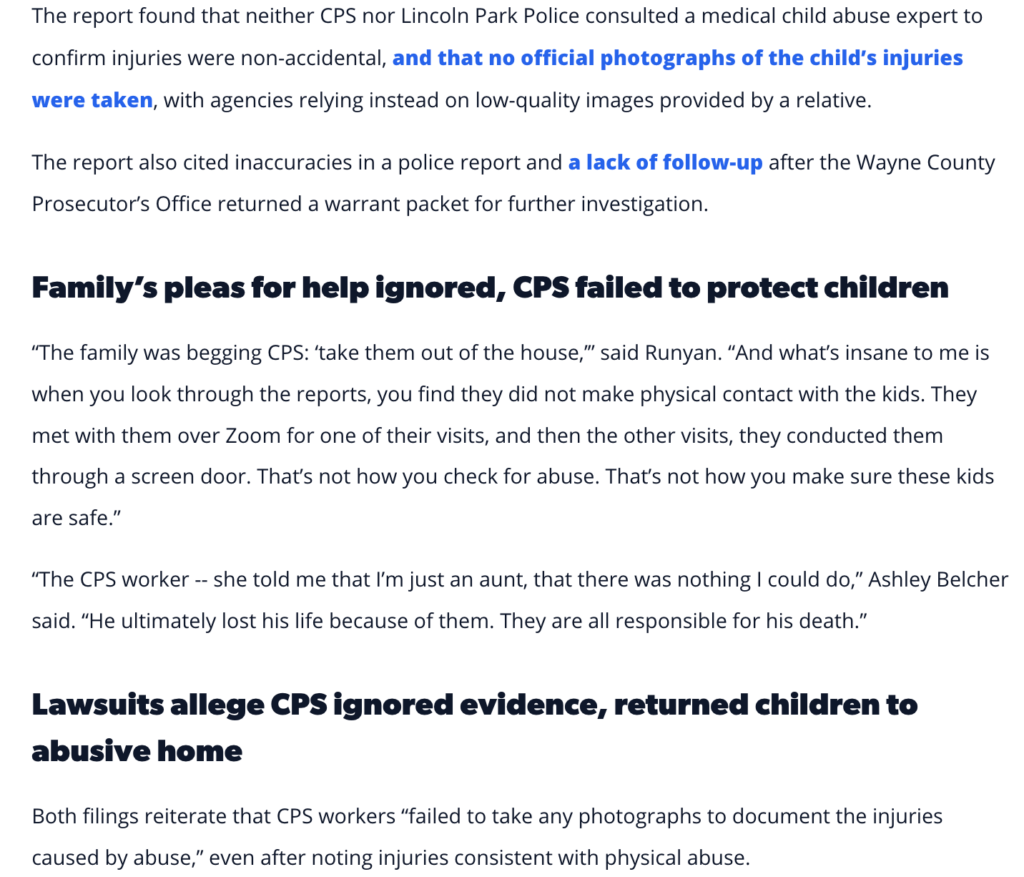
A Michigan OCA findings report (Case No. 2023-0062) provides recommendations following review of CPS/system handling (redactions required by law). Investigative reporting accuses CPS of sending Ethan Belcher back into danger after substantiated abuse and details alleged failures by both CPS and law enforcement. The following excerpt from the news article shows just how drastic the failures of CPS were.
Rashid Bryant: reunification, then death; investigative review of DCF records
An investigative piece reports that Rashid Bryant had been in foster care but was reunified with his mother and later died; the story is anchored in review of DCF records, describing prior injuries/medical events and the reunification. A national summary similarly notes repeated agency investigations and public questions about why removal did not occur sooner.
Finley Boden: return to parents, then death
The Local Child Safeguarding Practice Review publication and major reporting emphasize multiple CPS failures. Finley Boden was removed from his parents due to multiple abusive concerns. However, according to the article, “The family court heard from the Children and Family Court Advisory and Support Service (Cafcass) that the risk of harm posed to Finley by his parents was not unmanageable and did not require him to be placed out of their care “in the foreseeable future’” Finley Boden was returned to parental care and then died soon after.
Sara Sharif: custody return, then death
Multiple reports and reviews describe that she was returned to live with her father after court decisions and remained at risk amid long-running concerns involving children’s services and police.