
In different parts of the world, there is a growing attempt to solve education problems with simplistic and authoritarian measures. Among them, the prohibition of cell phone use in schools has been presented as a magic solution to inattention, low performance, and indiscipline. But this narrative ignores a fundamental truth: taking away rights does not improve education, it only silences students.
Recent research in Australia reveals that the real challenges in education lie far beyond the presence of cell phones in classrooms. Teacher shortages, overwhelming workloads, funding gaps, and inequalities between schools significantly impact student learning and well-being (UNSW Sydney, 2025; Australian Education Union, 2025). Yet, many schools respond by banning cell phones, treating them as if they were the root of educational failure. This approach is both alienating and shortsighted: while removing phones may reduce minor distractions, it ignores the structural issues, lack of qualified teachers, high student-to-teacher ratios, and uneven resource distribution, that actually hinder learning. Studies on digital inclusion also show that technology, when properly integrated, can enhance engagement and provide equitable learning opportunities (arXiv, 2023). Similarly, research on standardized high-stakes testing (NAPLAN) demonstrates that systemic pressures, not devices, drive student anxiety and performance disparities (arXiv, 2024). In other words, blaming cell phones is a convenient but misguided scapegoat, and policies focused on removing them risk alienating students while doing nothing to solve the deeper problems. The cell phone is not the enemy. Schools exerting overbearing control over students is the real issue.
In Brazil, this trend materialized significantly with the approval of Law No. 15,100/2025, sanctioned in January 2025, which prohibits the use of cell phones and other portable electronic devices by students during classes, recess, and breaks throughout basic education, public and private. This law, sold as a measure to “protect the mental, physical, and psychological health” of students, ignores the very voice of the students, who did not remain silent in the face of authoritarianism: more than 1.5 million young people signed petitions and organized protests throughout the country, making it clear that they will not accept being treated as objects of control. It is a policy that ignores the reality of schools, underestimates the students’ capacity for responsibility, and prefers to punish instead of listening. The struggle continues to this day, and is once again a topic of interest for the elections that will take place in 2026.

More than 1.5 million signatures from Brazilian students on the Petição Pública website.
Young people’s struggles against a government attempting to restrict their access to technology is also reflected in many other parts of the world. In the United Kingdom, this shift crystallized with the passage and phased implementation of the Online Safety Act 2023, which empowers regulators to require platforms hosting adult or harmful content to implement “highly effective age assurance” measures (UK Parliament, 2023; Ofcom, 2024). Under the Act, Ofcom, the UK’s communications regulator, was given authority to issue guidance and enforce compliance, including fines for platforms that fail to adopt robust age-verification systems (Ofcom, 2024).
Companies may use methods such as government-issued ID checks, credit card verification, facial age estimation, or third-party identity services. While officials emphasize that the measures are intended to reduce exposure to harmful content, digital rights groups and many young people contend that the approach risks creating centralized databases of sensitive personal data and may disproportionately affect youth who rely on anonymity for safety or self-expression (Open Rights Group, 2024). Civil liberties advocates have also warned that expanding age-verification infrastructure could set a precedent for broader content controls in the future.
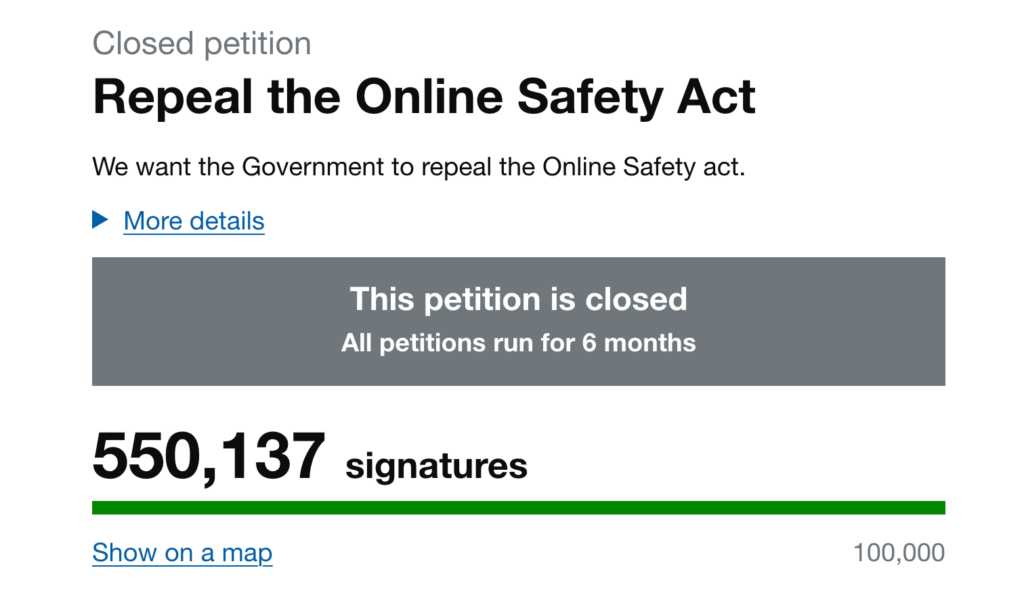
In the aftermath of these measures being put into place, backlash emerged quickly online. Young people, digital privacy activists, and content creators expressed concern that the measures would chill speech and reduce access to lawful content. A petition was launched on the official UK Parliament Petitions website calling for reconsideration or repeal of the age-verification provisions of the Online Safety Act, arguing that the policy undermines digital privacy and treats young internet users as passive subjects rather than rights-bearing individuals (UK Parliament Petitions, 2024). The petition gathered significant public attention and hundreds of thousands of signatures within a short period, triggering widespread discussion across social media platforms and youth advocacy circles.
Under the UK’s petition system, once a petition reaches 10,000 signatures the government must issue a written response, and at 100,000 signatures it becomes eligible for parliamentary debate. After surpassing the 10,000-signature threshold, the government responded by defending the Act’s child-protection rationale and reaffirming Ofcom’s enforcement role (UK Government Response, 2024). This is another instance of a government instituting a policy that restricts the rights of young people, and being met with backlash, but continuing to ignore any opposition. This situation illustrates a broader global tension: efforts from governments to “protect” young people online increasingly rely on technological gatekeeping, with many young people themselves believing these measures erode privacy and digital autonomy, actually harming them rather than helping them.
The struggle of Brazilian and UK students connects with a global movement of young people who do not accept authoritarian measures that attack their rights and their voice. In September 2025, Nepal experienced what became known as the “Generation Z” protest: thousands of young people and students took to the streets in response to a government blockade of 26 digital platforms, including networks and applications used daily for communication, learning, and organization, a measure seen as censorship and an attack on freedom of expression and access to information. The demonstrations, spread across several cities in the country, grew in intensity and scale, resulting in violent clashes with security forces and dozens of deaths and injuries, many of them young people protesting against the repression of their voice and the closure of the digital spaces where they organized and expressed themselves.
The Nepalese case shows that when governments try to control or limit where and how young people connect, whether online or at school, the response can be intense, legitimate, and deeply political. Just as in Nepal, the total ban on the use of cell phones in Brazilian schools under Law No. 15.100/2025 is perceived by millions of students here as an attempt to silence, exclude, and delegitimize their voices, instead of opening spaces for dialogue and participation.
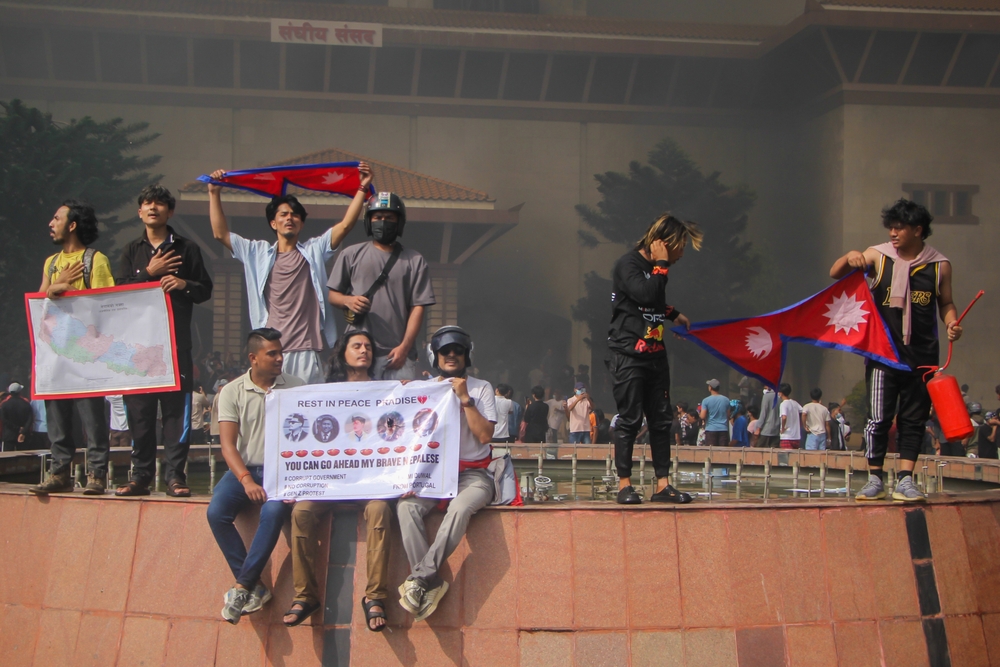
Generation Z in Nepal raises their voices: young people protest for their rights and their future, showing that change starts with them.
Cell phones in schools, as well as online restrictions for youth, justified as a way to protect learning, reveals a simplistic and authoritarian response to a challenge that demands pedagogical maturity. In both Brazil and Nepal, there is a clear tendency to replace dialogue and digital education with control and restriction. Instead of forming critical and responsible citizens, authorities choose to limit, monitor, and remove, as if the mere absence of a device could solve the structural problems of education.
Fundamental rights are not temporary concessions that can be suspended for administrative convenience. They are non-negotiable guarantees that sustain the very idea of democracy. If education is meant to shape free, critical, and conscious citizens, it cannot rely on practices that normalize authoritarianism. Defending responsible phone use is not defending disorder, it is affirming that freedom and responsibility go hand in hand, and that schools must teach both without sacrificing either.
Resources and References
- AUSTRALIAN EDUCATION UNION. Teacher shortages and structural inequalities in Australian schools. Education Matters, 2025. Disponível em: https://educationmattersmag.com.au/australia-among-worst-in-oecd-for-teacher-shortages- union-warns/. Acesso em: 24 fev. 2026.
- ARXIV. Inclusive Online Learning in Australia: Barriers and Enablers. 2023. Disponível em: https://arxiv.org/abs/2312.04777. Acesso em: 24 fev. 2026.
- ARXIV. A Policy Report Evaluating the National Assessment Program for Literacy and Numeracy (NAPLAN) Reform in Australia. 2024. Disponível em: https://arxiv.org/abs/2409.17959. Acesso em: 24 fev. 2026.
- EDUCATION MATTERS. Student behaviour improving following mobile phone bans and vaping reforms. 2025. Disponível em: https://educationmattersmag.com.au/student- behaviour-improving-following-mobile-phone-ban-and-vaping-reforms/. Acesso em: 24 fev. 2026.
- PETIÇÃO PÚBLICA. “Por uma escola que dialogue com os jovens, não que os censure”. Petição Pública, 2024. Disponível em: https://peticaopublica.com.br/viewsignatures.aspx? pi=BR146748&pg=1641. Acesso em: 24 fev. 2026.
- BBC PORTUGUÊS. Geração Z protesta no Nepal por mudanças políticas e direitos sociais. BBC, 2023. Disponível em: https://www.bbc.com/portuguese/articles/c0kn6xngdnno. Acesso em: 24 fev. 2026.
- UK PARLIAMENT. Online Safety Act 2023. Available at: https://www.legislation.gov.uk/ukpga/2023/50/contents. Accessed 26 Feb. 2026.
- OFCOM. Online Safety Act: Illegal content and age assurance guidance. 2024. Available at: https://www.ofcom.org.uk/online-safety. Accessed 26 Feb. 2026.
- OPEN RIGHTS GROUP. Concerns about age verification and privacy under the Online Safety Act. 2024. Available at: https://www.openrightsgroup.org. Accessed 26 Feb. 2026.
- UK PARLIAMENT PETITIONS. Petition regarding age verification under the Online Safety Act. 2024. Available at: https://petition.parliament.uk/petitions/722903?reveal_response=yes. Accessed 26 Feb. 2026.
The National Youth Rights Association
If you’re interested in Youth Rights, consider volunteering with us. We are always looking for new members and would love to have you on board. If you have a personal Youth Rights story to share about how phone bans or online restrictions negatively impacted your life, consider sending us an email at nyra@youthrights.org, and we’d love to help get your story out to the world.
The text of Cell Phone Bans and Online Restrictions Spark Youth-led Activism Around the World © 2026 by Gabriel Dunley is licensed under CC BY-SA 4.0