

Many hotels institute policies of age discrimination when it comes to the minimum age that customers are allowed to independently book a room. Various hotels require customers to be at least 21 to book a room with some extending these age requirements up to 25 years of age. Along with this, hotels will often place higher fees on young adults, with some requiring parents to assume financial responsibility for young adults, even if they’re traveling independently.
These policies are an example of business discrimination by age, and shouldn’t be tolerated. These policies create various safety issues, such as creating circumstances where young travelers have no way of staying somewhere for the night on a long road trip, and making it almost impossible for young people fleeing situations of abuse to find a temporary roof over their head. Young people deserve freedom of movement, and freedom from business discrimination, which includes the ability to freely and independently book hotels.
In the following webpage, the National Youth Rights Association explains hotel booking age, the minimum age requirements for major hotel brands, stories of travelers being denied rooms due to age, and the reasons why young people deserve access to booking hotel rooms.
Table of Contents
- How Hotel Booking Age Requirements Work in Practice
- Minimum Booking Age Requirements of Major Hotel Companies
- Hotel Minimum Age Requirements Over 18
- How Hotel Companies Justify Discriminatory Age Requirements
- Cases and Stories of Travelers Being Denied Rooms Due to Age
- Why Youth Deserve Access to Hotels
- How to Find a Hotel With a Lower Minimum Booking Age
The National Youth Rights Association
If you’re interested in Youth Rights, consider volunteering with us. We are always looking for new members and would love to have you on board. If you have a personal story to share, about being denied a hotel room due to your age, or about a general youth rights violation, consider sending us an email at nyra@youthrights.org. We’d love to help get your story out to the world.
How Hotel Booking Age Requirements Work in Practice
Hotel age rules almost always hinge on check‑in (registration), not whether a reservation can be created online. Many travelers can “book” successfully through an online channel but still be refused at the front desk if they cannot meet the property’s minimum age to register policy (and/or ID + payment requirements).
Within large hotel systems, the most consistent pattern is that minimum age is set at the property level (sometimes influenced by local law, insurance requirements, or destination risk factors), while brand corporate sites often tell customers to check the individual hotel’s policy.
Legally, hotels are generally treated as public accommodations, but U.S. federal public‑accommodations law (Title II of the Civil Rights Act) prohibits discrimination on race, color, religion, or national origin, but not age.
State laws differ, however. A 50‑state survey of public‑accommodations statutes indicates that some states include age as a protected characteristic in public accommodations in some form, sometimes with limits. For example, the survey notes that in Wisconsin the prohibition against age discrimination applies only to lodging establishments.
A particularly direct example of direct age discrimination in state level policy regarding hotel booking age is New Hampshire’s 2025 enactment of a statute stating that “Nothing in this subdivision shall prohibit a hotel, motel, or other lodging establishment held out to transient guests for public accommodations from having policies denying or refusing rental agreements with guests under 21 years of age.”
Minimum Booking Age Requirements of Major Hotel Companies
Hilton
Hilton’s Help Center states the minimum age to book varies by hotel, and directs guests to find each property’s minimum age to register in the “Hotel policies” section.
Hilton’s site usage agreement also includes an eligibility statement that users warrant they are 18+ to reserve a room on the site.
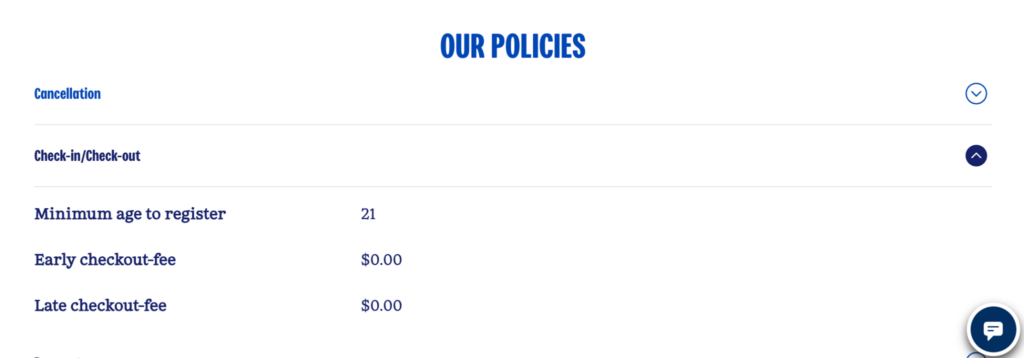
Hilton property pages can list 21 as the minimum age to register. For example a Hampton Inn & Suite in Idaho states that their minimum age to register is 21.
Marriott International
Marriott’s help article states the minimum age to check in is set by the hotel. Marriott property pages show variation, including 18 at some properties and 21 at others.
IHG Hotels & Resorts
IHG’s Terms of Use state that users warrant they are at least 18 and have legal authority to use the site for reservations.
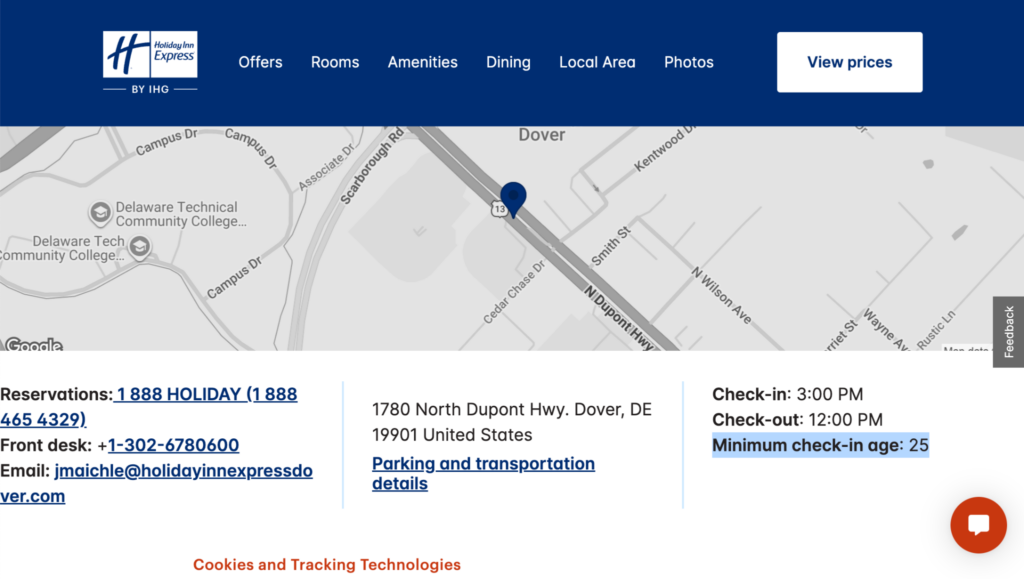
IHG property pages show a wide range including 18, 21, and even 25 as minimum check‑in age at certain properties.
Hyatt
Hyatt does not appear to publish one universal check‑in age across all hotels in a single global FAQ; instead, many Hyatt property pages publish a specific “Minimum Age Policy.”
Hyatt property pages can specify that customers “must be 18…or older” to check in, or that the minimum check‑in age is 21, with cancellation language if underage.
Wyndham Hotels & Resorts
Wyndham’s FAQ states the minimum age to book varies by hotel and advises contacting the hotel directly for its policy.
Because Wyndham’s corporate FAQ frames this as hotel‑specific, higher minimum ages (e.g., 21) are mainly evidenced at the property level, not as a single brand‑wide rule.
Choice Hotels
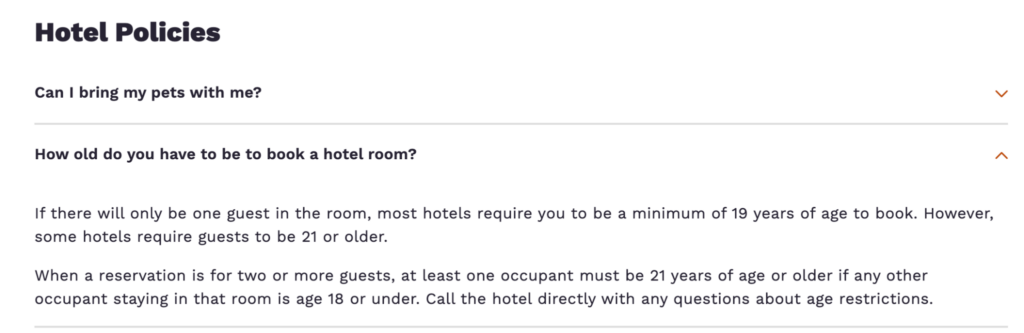
Choice’s FAQ gives a more specific general rule: most hotels require at least 19 to book if there is only one guest; some require 21+. It also notes additional age-related occupancy conditions for multi‑guest reservations involving someone 18 or under. Choice explicitly documents 19 (higher than 18) as typical for solo occupancy, with some hotels at 21+.
Motel 6
Motel 6 reservation policies state that registering guests must be 18+, while some locations require 19 – 21. Motel 6 explicitly acknowledges 19 – 21 minimums at some properties.
Radisson Hotel Group
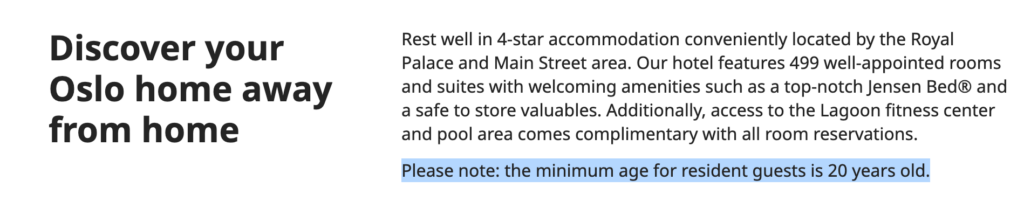
Radisson’s corporate materials are often property‑specific on age; one Radisson Blu property page states its own rule directly. A Radisson Blu property page in Norway states a minimum age of 20 for resident guests, an example of a published “20+” threshold in a major international chain’s inventory
Hotel Minimum Age Requirements Over 18
There are clear, documented instances of hotels setting minimum ages above 18, and some reach 25.
Some systems publish a “typical minimum above 18.” The most striking example in major U.S. chains is Choice’s statement that most hotels require 19 if there is only one guest. Motel 6 similarly documents that while the baseline is 18, some properties require 19 – 21.
Property-level 21+ rules are common. Many properties within Hilton, Marriott, Hyatt, IHG publish 21 as their minimum age to register/check in, even when the corporate brand does not claim a universal 21+ age requirement policy.
Even 25+ age requirements exist and are explicitly published by major-brand properties. IHG property pages include at least some listings with minimum check‑in age of 25.
Some hotels add deposits/surcharges for “younger adults,” explicitly resembling rental‑car risk pricing. One independent beachfront hotel policy states: you must be 21+ to reserve, and guests 21 – 24 not traveling with a parent/guardian must pay a refundable cash security deposit per person.
“Parental consent / guarantor” requirements for under‑21 guests also exist. An independent hotel’s published house rules state “Guests under 21…require a Parental Consent form at check‑in,” and warns that without it, check‑in is not allowed and payment is not refunded. A separate third‑party authorization and waiver form from another hotel includes a clause that if the guest is under 21, the guarantor/parent/guardian assumes financial responsibility for room and incidentals/damages.

How Hotel Companies Justify Discriminatory Age Requirements
Hotels and lodging associations tend to justify higher age thresholds around a few recurring risk and compliance themes:
Contract enforceability and “minor” status under 18: A lodging trade association explains that hotels may refuse to rent to minors under 18 because minors can typically void contracts, creating payment and liability risk; it further notes that hotels may adopt policies refusing to rent to those under 21 (or even 25) when they have valid concerns about potential damage, disturbances, or underage drinking. Legal references commonly describe “necessities” doctrines under which minors may be liable for reasonable value of essential goods/services (potentially including lodging), but that framework does not guarantee a hotel will accept the transaction operationally.
Alcohol and party risk: Hotels explicitly connect under‑21 guests to alcohol management in some published policies. For example, a Hyatt-affiliated property FAQ requires guests under 21 to notify the hotel so alcohol can be removed from the minibar. The lodging association legal FAQ also highlights underage drinking as a liability concern and discusses precautions around prom/graduation periods (including underage drinking risk).
Property damage, noise, and security deposits: Some hotels operationalize age risk via higher deposits or restrictions. One property policy requires customers to be 21+ to reserve and adds a refundable cash security deposit for guests 21- 24 not traveling with a parent/guardian.
Operational identity/payment controls: Hotel systems often require matching government ID and a credit card at check‑in, and they may require credit card authorization forms if someone else is paying, procedures that can become hurdles for young travelers without established credit access or when parents are attempting to pay remotely.
Cases and Stories of Travelers Being Denied Rooms Due to Age
A well‑documented dispute involved a 20‑year‑old traveler who alleged he was denied a room because a hotel property’s minimum age to register was 21. The case drew news coverage at the time, including by Associated Press.
The ACLU of New Hampshire press release described the lawsuit as challenging a policy at Homewood Suites Nashua that disallowed adults under 21 from booking a room and said the plaintiff was denied for being 20. The filed complaint likewise alleges the hotel maintained and published a “Minimum Age to Register 21” policy and that the plaintiff was denied solely due to age.
However, in a significant development after this dispute, New Hampshire enacted a new statute effective June 19, 2025 stating that nothing in the relevant public‑accommodations subdivision prevents hotels, motels, or other lodging establishments from having policies denying or refusing rental agreements with guests under 21. This is an example of how quickly the legal landscape can crystalize in one direction even while public controversy points in another.
Self-reports on social platforms show that age-based denials are not merely theoretical.
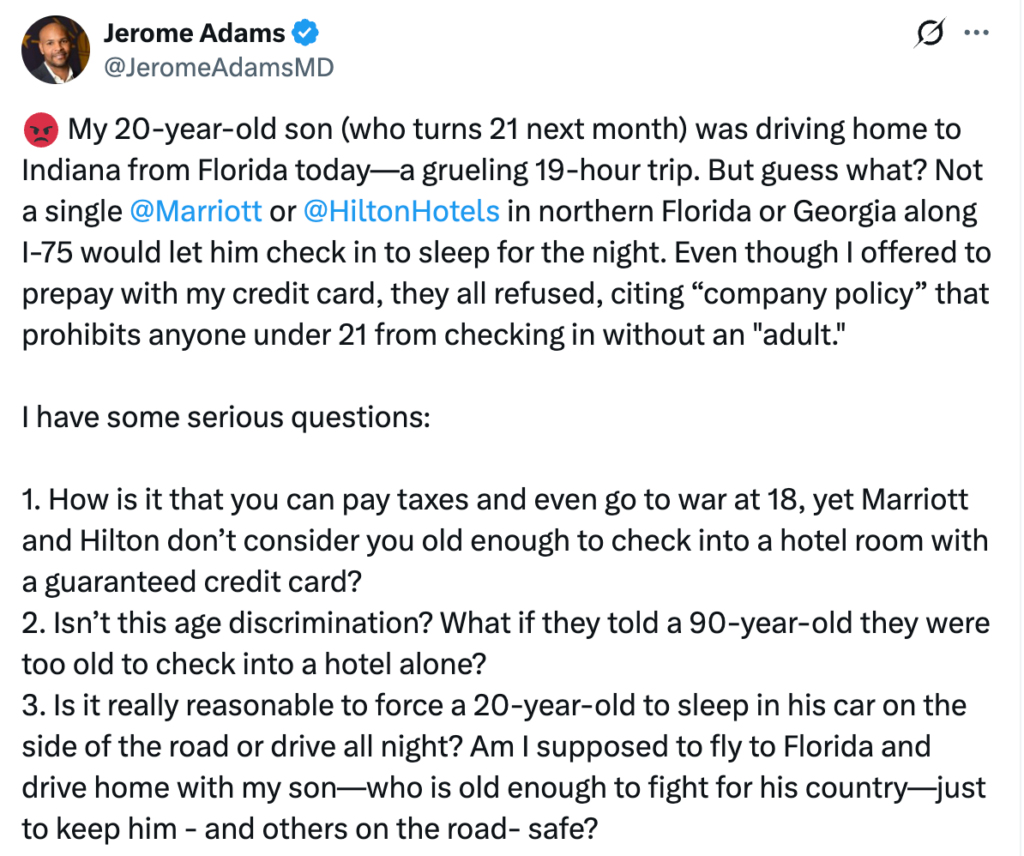
A widely circulated post from X quotes Jerome Adams describing that his 20‑year‑old son, traveling along I‑75, could not find a Marriott or Hilton Hotels property that would allow him to check in, even with an offer to prepay by credit card, citing “company policy” prohibiting under‑21 check‑in without an “adult.”
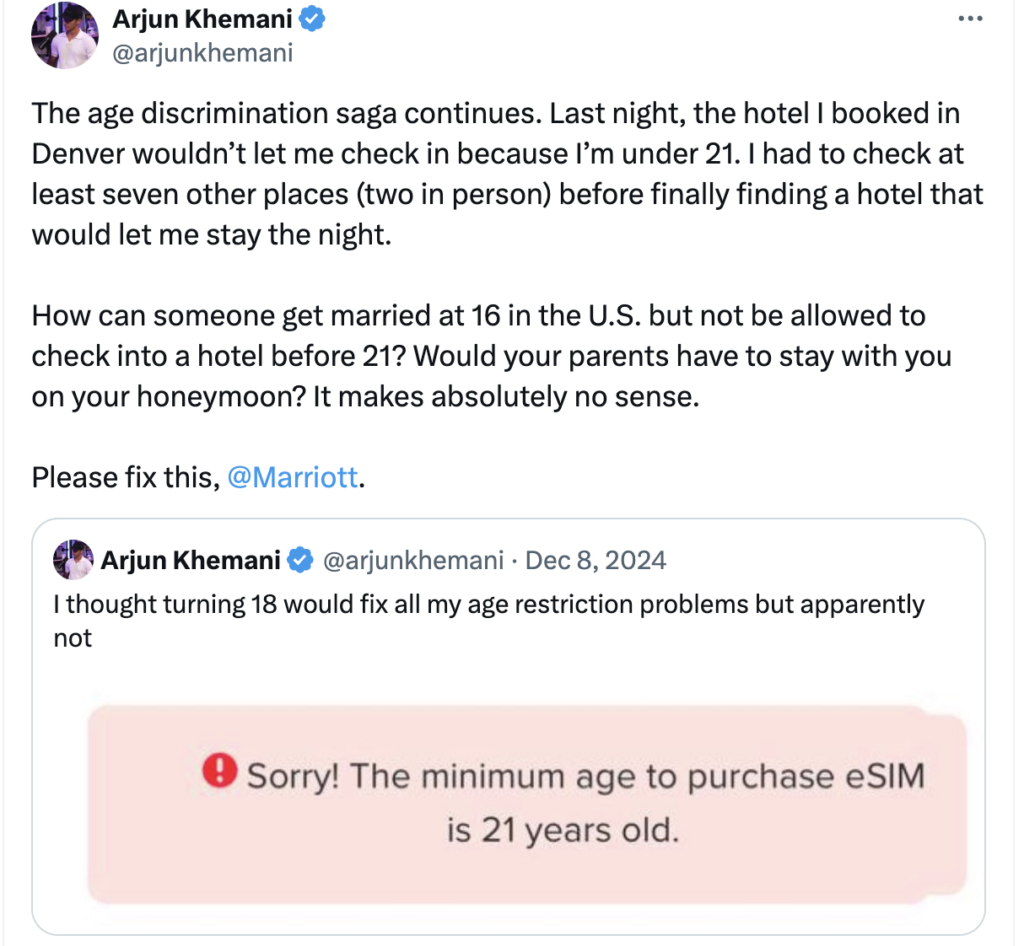
Another self-reported instance of this age discrimination from X states that a traveler booking in Denver was refused check‑in because they were under 21 and reported having to check multiple hotels to find one that would accept them.
Online travel communities frequently discuss age-based refusals, especially for 18 – 20-year-olds traveling alone or on work trips.
A long-running Reddit thread titled “(Help) 18 year old trying to get a hotel in Denver” contains user anecdotes of being required to be 21+ to book a room at various hotel properties in Denver.
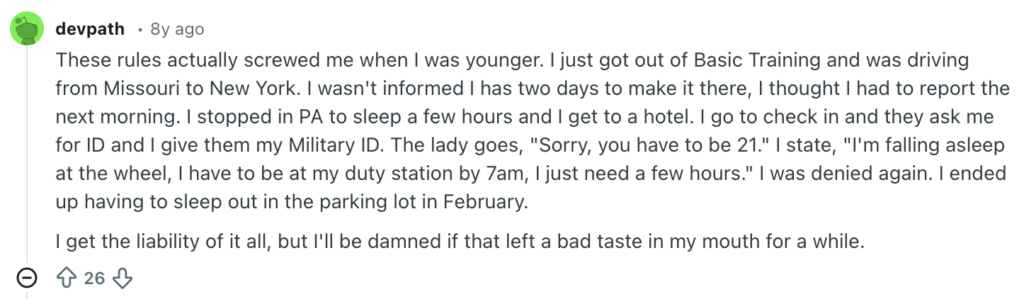
In a hotel-industry subreddit, r/talesfromthefrontdesk, users often discuss age restriction policies with hotels. One particular post details an experience of a hotel worker who had to deny a traveling couple (20 years old and 18 years old) due to their age. Comments tell similar stories, with one discussing a particularly disturbing instance of an 18 year old in the military being denied access to a hotel. Even after he informed the hotel employee that “I’m falling asleep at the wheel, I have to be at my duty station by 7am, I just need a few hours.”, he was still denied. These stories illustrate real instances of young people being extremely inconvenienced (and in some cases, facing a safety risk) due to discriminatory policies of hotels.
Why Youth Deserve Access to Hotels
For you to fully understand the extent of why young people should be able to book hotels independently of their parents, we need to break down the reasons why a young person would even need to do so in the first place. In most circumstances, a young person needing to book a hotel independently from their parents comes from two circumstances- either independent travel, or escaping a toxic home situation.
Freedom of Movement
Young people, including both minors and young adults under 21 deserve freedom of movement. Unfortunately, the freedom of movement of minors under 18 are usually tied to their parents, severely limiting their ability to travel independently of their parents. So for this section, we’re going to focus on how hotel booking age policies limit the freedom of movement of young adults.
Once someone turns 18, they should not have to rely on their parents to have access to privileges of adulthood, if they do not wish to. However, hotels have instituted very weird policies, roping in parents to have costs and responsibilities of a young adult’s hotel stay. For example, the previously mentioned policy that requires parent consent for all guests under 21. This enforces the idea that young adults should still be bound to their parents when attempting to make adult decisions like traveling. This stifles the independence of young people, and severely limits them in the cases where they are not on speaking terms with their parents, or if their parents are unreasonably strict/controlling. Let’s say that hypothetically, a young person has grown up with abusive, manipulative and overbearing parents their entire childhood. So as soon as they turn 18, they immediately cut them off and go about their life independently. Despite trying to obtain this independence, which is their right as a legal adult, hotel policies still force them to rely on their parents or guardians for privileges.
Along with this, young adults may not even have a parent or guardian. If the parent/guardian of a young adult (over 18 but under 21) dies unexpectedly, nobody else has to legally obtain guardianship over them, because they are an adult. This would obviously make it impossible for the parents to consent to the young adult booking a hotel room. So the hotel’s policy basically is stating that any young adult whose parents have died unexpectedly are not allowed to book a room with them. And maybe the hotel would make an exception if they were informed of the young person’s situation… however that should not be necessary. Nobody should have to break down into a sob story, explaining the death of their parents, in order to have a basic privilege granted to them by a business.
And the entire root of these policies is inherently unreasonable because of who they target. The hotel policies specifically discriminate against young adults who are traveling without their parents/guardians, or other older adults. Young adults who are doing this type of independent traveling with no other adults present, are likely to be extremely independent. Young adults who have more independence are also more likely to be more responsible, and therefore less likely to cause liability issues for the hotel. Along with this, young adults traveling independently obviously have access to their own money—enough to be doing the traveling in the first place. So the hotel doesn’t need to worry about them not paying. However, they still institute policies forcing young adults to pay “younger adult” surcharges.
These policies can have major hindrances on the lives of young adults. If a young person is facing travel disruptions, being stranded during long road trips, sudden loss of transportation, job travel, etc, they have no way to obtain temporary housing from a hotel. Usually, if young adults are doing this type of independent traveling, it is for work, school, or other important duties. Like in the instance mentioned in the reddit comment, the young adult was driving across states in order to get to his situation for the military. He was obviously a very independent and responsible young person… but still was denied a room solely based on his age, even after presenting a military ID. This forced him to have to sleep in the parking lot in order to not fall asleep at the wheel while driving.
Age discriminatory hotel policies also pose safety risks to young adults. In the instance mentioned by Jerome Adams, his 20 year old son was driving on a road trip from Indiana to Flordia, and yet couldn’t find a hotel anywhere due to his age. This forces him to either have to continue driving through the night (which puts him at a safety risk due to being tired impairing his driving), or pulling over somewhere and sleeping in his vehicle, which imposes various other safety risks. His safety was severely threatened by the fact he was denied a hotel room because of his age.
Emergency Access In Cases of Abuse and Domestic Violence
Young people (including 18 – 20 year olds) may need a hotel as a rapid, temporary fallback for reasons that overlap with broader emergency-housing needs, such as housing instability, family conflict, or abruptly needing to leave an unsafe home or abusive environment. Because of this, it is important that not just young adults, but also minors under 18, should have independent access to booking hotels as well. One of the main reasons why minors run away from home is due to facing abuse and domestic violence within the home.
For youth homelessness and family violence, a toolkit from the National Resource Center on Domestic Violence summarizes research indicating that a primary cause of youth homelessness is family dysfunction including physical/sexual abuse and family violence, reporting substantial shares of runaway youth describing violence by caretakers. Organizations such as Covenant House explicitly position their services for young people facing homelessness, abuse, or abandonment.
The linkage between violence and emergency housing is extensively documented. The National Domestic Violence Hotline describes domestic violence as a leading cause of housing instability and homelessness for survivors and emphasizes that fear of homelessness can increase danger, creating barriers to leaving abusive situations.
The U.S. domestic violence services system explicitly recognizes hotels/motels as a shelter modality. A formal FVPSA guidance memo issued by the Administration for Children, Youth, and Families within HHS states that FVPSA funds can be used for “hotel, motel” costs and clarifies that the regulatory definition of shelter includes hotel or motel vouchers as temporary refuge.
Taken together, these sources show that:
- Domestic violence and family violence can create urgent housing needs.
- Hotel/motel placements are an acknowledged component of emergency refuge pathways in some domestic violence service funding and practice.
Youth in these situations, who have been forced to run away from home due to an emergency, are possibly the most vulnerable people being out on the streets without a place to stay. U.S. Department of Justice’s National Crime Victimization Survey (NCVS) consistently shows that adolescents and young adults experience higher rates of violent crime than older age groups. Along with this National crime data shows that women between the ages of 18 and 24 experience the highest rates of rape and sexual assault compared to any other age group. Surveys have also found that the majority of female rape victims experienced their first assault before the age of 25, highlighting how sexual victimization is disproportionately concentrated during adolescence and early adulthood.
This shows that young people face violence and sexual assaults worse than any other age demographic… so imagine how much more that risk is amplified if they are homeless without a place to stay and keep safe.
And unfortunately, other laws make it even more difficult for homeless youth to find a safe place. Many states have extremely strict runaway laws, which both charge young people with status offenses for leaving home without a parents consent, AND charge anyone who they run to stay with, with a crime if they do not report the young person as a runaway. Because of this, youth fleeing abusive situations have to make a choice… they either can run away to a home that they do feel safe in, and risk either being reported as a runaway and being forced to return to their home. Or, they take to the streets. This is where runaway rights tie directly back to hotel booking age discrimination. Because if runaway youth do not feel safe going to another safe home, and also do not have the ability to independently book a hotel room, then they literally have no choice but to stay on the streets.
Some might say that youth in these situations should just report the abuse they are facing to the police, or child protective services. And while sometimes, this can help them escape the situation, there have been many reported incidents of CPS failing to intervene to protect vulnerable youth. So if a young person attempts to report the abuse they are facing, and ends up right back at the home, that removes the lifeline they are counting on. Once again, their choices involve running away to a home they feel safe, and risking being reported and having to go back, or running to the streets, where they can’t have a roof over their head since they don’t have the right to book a hotel.
All in all, age discrimination in hotel booking should not be tolerated. This age discrimination limits the independence and freedom of movement of young adults, while also forcing vulnerable youth fleeing abuse into even more dangerous situations where their safety is directly threatened.
How to Find a Hotel With a Lower Minimum Booking Age
If you are under 21 and need to find a hotel, do not assume that every hotel in an area has the same minimum age. As discussed above, many major hotel companies allow individual properties to establish their own check-in requirements. This means that one hotel may require guests to be 21 while another hotel from the same chain, sometimes only a short distance away, may allow guests to check in at 18. Because of this, it is worth checking several individual properties rather than giving up after being denied by one hotel.
One helpful resource is CheckInAge, which allows travelers to search for hotels based on their city and their age at check-in. The website researches individual hotel policies and links to the official sources used to verify their listed minimum ages. It can therefore make it much easier for an 18, 19, or 20-year-old traveler to identify hotels that may actually accept them instead of manually checking dozens of properties. CheckInAge itself recommends confirming the requirements directly with the hotel before booking, since an age match does not necessarily confirm other requirements such as identification, payment cards, or security deposits.
Travelers can also check the individual hotel’s official webpage or call the property directly. For example, Hilton explicitly states that its minimum booking age varies by hotel and provides instructions for finding a property’s policy online. When calling, it is best to specifically ask whether someone of your age can check in independently, rather than simply asking whether you can make a reservation, since successfully reserving a room online does not necessarily mean the hotel will allow you to register when you arrive.